Friday, June 19, 2015

A funny thing happened while leaving Inglewood

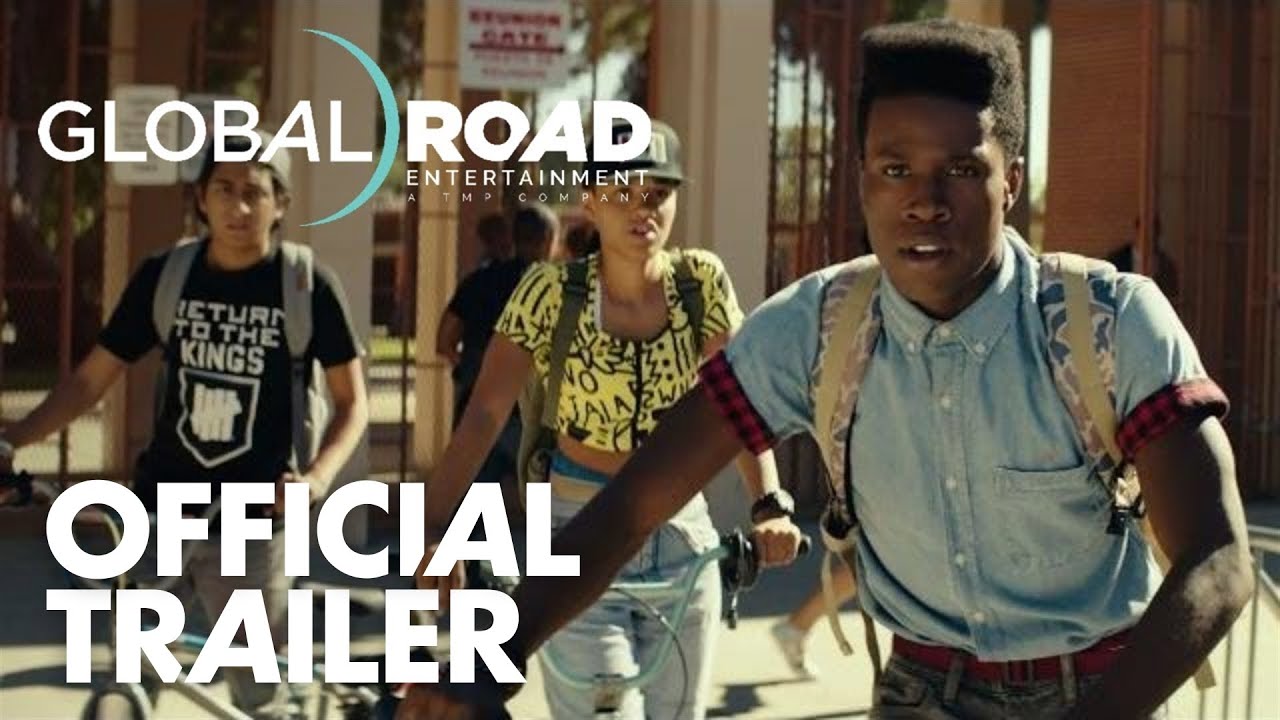
Tony Revolori, Kiersey Clemons and Shameik Moore in a scene from "Dope." Image courtesy Open Road Films
“Dope” is a film about falling back into the comfort of retro culture, except when it indulges in the pleasures of 21st Century technology. It's a film about the tragedy of street violence and the difficulties growing up in that environment, except when it swerves into comedy both physical and vulgar in nature. It's a movie steeped in neighborhood realism, except when it veers off toward a Wile E. Coyote-esque chase sequence through Inglewood.
All of that is to say “Dope” is a complex film, one that sheds the categorizations its protagonists define themselves by. It has a lot to say about black culture, the white appropriation of black culture, sexuality, economics, the American Dream and violence. It has perhaps too much to say to maintain a smooth and clean pacing, but”Dope” always expresses itself wit, smarts, a deft touch, and a killer soundtrack.

                                                              For example. 

“Dope” is a film divided at its simply by levels, the top of which is the simple story of three teenagers in Inglewood, Calif.: Malcolm (Shameik Moore, rocking a hi-top fade), Diggy (Kiersey Clemons) and Jib (Tony Revolori). They're self-proclaimed geeks, a smart group of friends who listen to 1990s-era rap, go old school with their sartorial choices, play in a punk band, ogle girls (mostly ZoĆ« Kravitz), study to get into college – Moore's aiming for Harvard – and try very, very hard to stay out of trouble.
Level two is when that last part falls asunder when Moore agrees to do a small favor for local drug dealer Dom (rapper A$asp Rocky) that results in a disturbing amount of Molly (aka ecstasy) and a handgun finding their way into his backpack. Going to the cops isn't an option, meaning they have to find a way to get rid of the stash without drawing the ire of drug dealers, users and a rather intimidating businessman (Roger Guenveur Smith).
Then there's level three, the story of how they extricate themselves from a really insane situation with the help of a surprisingly brilliant drug user (Blake Anderson). They come up with an ingenious way of selling the unwanted product (one that doubles as a promo for bitcoin), but have to watch out for federal agents and potential interlopers who would cause their best laid plans to backfire on them.
The description makes “Dope” sound like a drama, and while it does have those elements to it, the film copes with the dark realities of growing up in an undesirable place and circumstances with humor. A fair bit of the humor is vulgar and sophomoric, although those are balanced by some clever callbacks, jokes via voiceover narration, and one or two utterly macabre punchlines that make a viewer feel bad for laughing. 
“Dope” wouldn't succeed without the comedic element (the humor ties a lot of it together) but the film's genre subversions and cultural politics ensure it'd remain interesting without it. There are moments when “Dope” aligns itself to 1990s films like “Boyz n the Hood” and “Menace II Society” – films that serve as morality plays warning against the violence of the cultures and neighborhoods depicted in those films. Anyone who has seen either knows bad things happen to the lead characters due to circumstances both outside, but especially within, their control, and “Dope” adds a little of that ominous air to its proceedings too. Yet it swerves away from the portentous and instead uses what would be punishable activities in those films as a vehicle toward success for Moore, Clemons and Revolori. They dip into the dark side, engage in the things they tried so hard to avoid, and come out in much better shape than when they entered.
Drug culture does get a shout out in “Dope,” along with about a dozen other topics ranging from self identification and the complexity of black culture to the appropriateness of white people dropping the N-bomb. Writer/director Rick Famuyiwa uses his movie as a platform to address those issues and does have success in spurts, especially in the brevity of that last point.

                                            I'll let Chris Rock explain the issue. 

The problem though is he tries to say too much, tries to get far more material in “Dope” than there should be. It kills the film's pacing – almost half of it takes place over one day, while the rest is part of a three-week stretch – and it definitely meanders long enough to wobble right past a terrific ending, one that induced a boisterous round of applause from the audience. (The response to the actual ending was much more muted.) Ending on that right moment would have bumped up “Dope’s” final score by a few points. As it stands, it remains a rather good film (with an amazing soundtrack) that falls just short of exemplary.

Review: Four out of Five Stars

Click here to see the trailer.

Rating: R
Run time: 103 minutes
Genre: Comedic drama


Ask Away

Target audience: Mainly black viewers in their teens to mid 20s, along with independent film fans and anyone down with 1990s rap and hip hop.

Take the whole family?: “Dope” is a bit too violent and certainly vulgar for a young audience. Teenagers at least age 15 really won't have a problem with it though.

Theater or Netflix?: Theater if you can find it locally. Wait for Netflix if you have to drive to the boonies to find it.  

How does the film treat its LGBT character? “Dope” generally does right with Kiersey Clemons' Diggy, a lesbian who is by far the funniest of the three central characters. She’s never knocked for her lesbianism either; “Dope” celebrates her comfort with her self and redirects jokes made about the subject to the people shaming her for it.

Watch this as well?: The first half of the film has a very strong “Dude, Where's My Car?” and “Harold & Kumar Go to White Castle” vibe to it, so either works as accompaniments. Also check out “Menace II Society” and the original “Friday,” although do avoid the sequels to the latter.

Side effects of watching No. 3 include temporary stupidity and homophobia.

Never get out of (high school) alive

Thomas Mann and Olivia Cooke in a scene from "Me and Earl and the Dying Girl." Courtesy Fox Searchlight Pictures, (C) 20th Century Fox.
There are so, so many reasons “Me and Earl and the Dying Girl” comes ever so close to devolving into a disaster. The lead is a white, angst-ridden, middle-class high school boy, the film is loaded with references to other films to a heightened degree, and one of the three main characters is a girl with cancer. “Me and Earl and the Dying Girl” doesn't just walk on thin ice, it hops up and down while wearing metal boots.
So it's to the credit of the filmmakers and collection of young actors involved that “Me and Earl and the Dying Girl” not only works, it evolves into a marvelous little movie that occasionally abandons verisimilitude yet still tells a poignant story with levity and a light touch.
The “Me” in the film's title is Greg (Thomas Mann), a reserved high-school senior trying to skate by as quietly as possible while living with his eccentric parents (Nick Offerman and Connie Britton, continuing her reign as media's coolest mom). When he's not blending in the background at school, Mann spends his free time filming parodies of classic films (for example, “Senior Citizen Kane”) with his so-called partner Earl (RJ Cyler), who also seems to have problems fitting into the school's social web.
Skating by ceases to be an option after Britton forces him to hang out with Rachel (Olivia Cooke) – the titular dying girl who is diagnosed with cancer and lives with her lush of a mom, Denise (Molly Shannon). The friendship is rocky at first, but it deepens as Cooke continues her treatment and Mann opens up little by little, even showing her a few of his films. Mann is eventually enlisted by high-school crush Madison (Katherine Hughes) to make a film for Cooke, a project that  becomes more and more difficult as Cooke's condition worsens and Mann loses his precious anonymity. Also on hand are Jon Bernthal as an insanely cool teacher and a few bizarre students to flesh out a very movie-fied Pittsburgh high school.

Similar to this classic, but without Tina Fey.
Figuring out how to categorize“Me and Earl and the Dying Girl” is tricky because it eschews a simple classification. The film instead aims to be an amalgamation of diverse genres, from cancer weepies and high school parodies to indie comedies and films about filmmaking (a la “Sunset Boulevard.”) That sounds a little messy, but director Alfonso Gomez-Rejon and screenwriter Jesse Andrews, who wrote the novel the movie is based on, use the absence of categorization to tell a simple coming of age story deepened by the other components. “Me and Earl and the Dying Girl” is about Mann's Greg getting over himself, and his way of doing so is through cinema and, most notably, through his complicated friendship with Cooke's Rachel.
The process though is often painful to watch. Greg, like legendary embodiment of teen angst Holden Caulfield, is a perpetual pain in the butt. He’s a petulant child focused so much on his own needs he doesn't want to understand what Cooke is going through; hell, most of the time Mann and Cooke spend together features Mann complaining about one thing or another. Mann’s character comes ever so close to earning a punch to the face, but he never quite crosses the punchable threshold thanks to the performer’s underlying melancholy that proves endearing. Andrews plays a prominent role in that as well: his script constantly calls out the central character for his selfishness. As Cyler's Earl says at one point, “Don't make this all about you.”

He is certainly not the Cosmos.
“Me and Earl and the Dying Girl” is mostly about Mann; that makes sense given the first word in the title is “me.” But the film at least spreads the focus a bit to add a little Earl (that's a good thing; Cyler is pretty great) and a lot of Rachel, which is very much to the film's benefit. Greg may be the main character, but the heart and soul of the story belongs to Cooke's Rachel, who suffers through her cancer with grace, dignity and a maturity that belies her age. Even as the situation worsens and hope begins to dwindle, Rachel is never a victim of her circumstances or the cancer; she owns up to her mortality and faces it with courage and verve. Cooke, who puts on a wonderful performance, never succumbs to the movie cancer that wrings alligator tears from even the most noble actors and actresses; the audience feels for her fight, but she's never a pitiable figure.
Cooke grounds a film prone to flights of animated fancy and the occasional high-school stereotype for storytelling ease. She’s a major reason why “Me and Earl and the Dying Girl” succeeds rather than devolving into the kind of film-school thesis that drapes itself in forced quirkiness.

Review: Four and a half out of Five Stars

Click here to see the trailer.

Rating: PG-13
Run time: 105 minutes
Genre: Dramatic Comedy


Ask Away

Target audience: Independent film followers in search of a quality entry into that field, as well as fans of well-made high school flicks.

Take the whole family?: This is one of those rare occasions where the PG-13 rating fits well. It wouldn't be a huge problem for a 12 year old or anything, but the heavy subject matter might bother anyone too young.

Theater or Netflix?: Worth a matinee trip for sure.

How much of the film is owed to other films?:  Almost all of it, really. Multiple shout outs are given to Francois Truffaut's “The 400 Blows” and Werner Herzog's oeuvre, and there are touches of Billy Wilder, Wes Anderson, Alfonso Cuaron and countless other directors as well. The film literally wears its influences on its sleeves; one character sports a jacket with a notable “Dawn of the Dead” patch on it.

Watch this as well?: “The Kings of Summer” is another solid indie flick about young men growing up with fantastical elements and slightly odd undertones, along with a performance by Nick Offerman. Might as well watch “The 400 Blows” and just about anything by Werner Herzog too; they play prominent roles in the film and are just awesome.

                     From "400 Blows," one of the most poignant scenes in cinema history.

The infinite pleasures of sadness and joy

Joy (voiced by Amy Poehler) and Sadness (Phyllis Smith) in Disney Pixar's "Inside Out." Image courtesy Disney/Pixar
What stands out most about Pixar's exceptional “Inside Out” is the current of playfulness swirling just underneath the emotional complexities and mayhem. The film gets dark on occasion, especially when it dips into melancholy and fright while reflecting the confused thoughts of a lost 11-year-old girl, but it never loses the happiness and optimism that starts the moment Amy Poehler's voiceover starts. “Inside Out” reminds viewers that while danger lurks around every corner of the mind, there’s always something there to make it OK, at least for a while.
In what might be the greatest casting choice in animation history, Poehler stars as the embodiment of joy (dubbed Joy) that exists in the mind of 11-year-old Riley (Kaitlyn Dias). Joy is the leader of the five emotions – she's joined by Fear (Bill Hader), Anger (Lewis Black), Disgust (Mindy Kaling) and annoying Debbie Downer, Sadness (Phyllis Smith) – guiding Riley's emotional state and the tone of her memories from a control room in the girl's head. Riley's memories are rooted in what the film calls core memories, which both dictate her outlook on life and influence her hobbies and interests (family, friends and hockey among them).

Props to Disney for showing that girls love hockey.
Things are going pretty well for Riley in the early going – having Joy in charge makes for a pretty sweet life – at least until she moves from her native Minnesota to San Francisco with her mom (Diane Lane) and dad (Kyle MacLachlan). It's a difficult moment for the young girl, and it becomes even more complex when Joy and Sadness, along with the core memories, are sucked out of the control room and into the maze of Riley's memory bank. Joined by Riley's old invisible friend Bing Bong (Richard Kind), Joy and Sadness must navigate through her memories and find a way home before Riley falls completely into emotional emptiness.
“Inside Out” is a blast, a film intent on giving the audience as much fun as it can within a 90-minute window. It plays with language, messes around with animation and the mind's reality, and offers a few moments of respite to smile and laugh at the monkey shines taking place on screen. I hate to use the targeted at kids while entertaining adults trope – how many movies don't try to appeal to as wide an audience as possible? – but “Inside Out” does work on that level, mixing light and friendly colors with Gilbert and Sullivan inspired wordplay involving bears. (Give yourself a second and it'll become obvious given the film's locale.) 

Wrong city.
It does all that without talking down to the target audience, despite a plot much more dense than a person would expect from a kid's movie. “Inside Out's” filmmakers handhold a little just to make sure no one gets lost, but they trust the viewers can do the heavy lifting and find their way through Riley’s mind.
“Inside Out's” plot complications also mirror those of the experience it depicts. With the caveat that I was never an 11-year-old girl, the film captures the complications of Riley's age and circumstances marvelously. Moving is an intense experience for any child, especially at that time when puberty begins to creep in and friendships begin to deepen or fade away. Riley's essentially forced to start over from scratch after more than a decade establishing her proverbial roots. Compounding the move is the broadening of Riley's emotional maturity. She's advanced beyond the age when thoughts and feelings are simple and easy to categorize; she's 11, and life has more nuance than it did before.
That's really the heart of “Inside Out's” story, the realization by Joy that the only way for Riley to grow up become a more complete person is to let go of her control of the memory banks a little and embrace the new emotional depths. The feeling of joy doesn't exist without contrast; people need some sadness, some anger, some fear and some disgust to strengthen the state of happiness. Even “Inside Out's” overarching happiness is contrasted by moments of sorrow (and one of absolute horror for people with coulrophobia) that bring out the best of Joy. The film does plunge deep into the sadness well though; every good Pixar film has at least one moment that just crushes viewers, and “Inside Out” is no exception.
To use a silly, juvenile but rather effective piece of jargon, “Inside Out” evokes all the feels. It brings just about everything out of you in just 94 minutes, leaving viewers a little bit wrecked but ultimately happy and gleeful at the end of its runtime. In other words, it leaves you in the same state as the best Pixar films.

                                                   It never stops hurting.


Review: Four and a half out of Five Stars

Click here to see the trailer.

Rating: PG
Run time: 94 minutes
Genre: Animated 

Ask Away

Target audience: Families and people who still have faith in what Pixar can do.

Take the whole family?: You're all set if the kids are 5 and up, as long as clowns are not a major fear for them or you.

Theater or Netflix?: I'm on board with a family outing with a little dinner and this movie as a centerpiece.

How's the short film?:  Kind of fun, actually. Simply called “Lava,” it tells the story of a lonely volcano that sings a song of love to attract another volcano. Even though “Lava” doesn't reach the heights of Disney's short “Paperman,” it's still a cheeky and playful appetizer that doesn't overstay its welcome.

Watch this as well?: Pick your Pixar film – my favorites include the “Toy Story” franchise, “Up,” “Finding Nemo,” “The Incredibles,” “Ratatouille” and “Wall-E.” I also suggest “Ponyo,” a Hayao Miyazaki-helmed film that also broaches the complexities of emotion amid adolescence.


Thursday, June 18, 2015

A little more with the minds behind "Me and Earl and the Dying Girl"

Director Alfonso Gomez-Rejon on the set of "Me and Earl and the Dying Girl." Photo by Anne Marie Fox, © 2015 Twentieth Century Fox Film Corporation.
Here's part two of the question and answer session with the people behind "Me and Earl and the Dying Girl," featuring director Alfonso Gomez-Rejon and screenwriter Jesse Andrews, who wrote the book the script is based on. The discussion encompasses the motivation for the film, the "400 Blows," and a little interlude about Werner Herzog. Audio from the interview is available here.

Q: (To Alfonso Gomez-Rejon) Why did you want to direct this film?

Alfonso Gomez-Rejon: It was a very original piece of writing. We didn't know what to expect when someone says there's this movie about high school, that you should read it. You think of high school, you know exactly what it's going to look like. Usually it deals with people I don't understand or don't relate to, like jocks in high school who are never these six-foot guys with a letterman jacket. Plus, I was Mexican in a town where you didn't have to learn English.
“The Breakfast Club” specifically is a movie I carry with me because it spoke to me and I identify with Anthony Michael Hall's character so clearly and I hadn't seen anything since then. But when I read his (Jesse Andrews') novel, I really loved everybody; there was a deep sense of compassion that was on the page for every character. And I particularly loved Greg's journey; it kind of mirrored my own or one I wanted to take. It was something I could throw myself into and make something from the heart and also something that had a very unique sense of humor.

Q: So you thought you could be the narrator like Greg?

Gomez-Rejon: I'm not that smart or that funny, but his emotional journey is one I really respected. Visually, also, it was an opportunity celebrate movies. Once you start seeing the movie in your head your like OK, I'm hooked, I have to figure this out. How do I get this out of my system? I have to get the job done.

Q: Werner Herzog: Great director or the greatest director? Because you guys reference him a lot.

Gomez-Rejon: He saw the movie and enjoyed it.

Jesse Andrews: He sent an epic email. Not epic long, just epic Werner Herzog definitely wrote this.

Gomex-Rejon: It's when you get your inbox and it says “Werner Herzog” that this isn't a joke.

Andrews: Then you hung out with him.

Gomez-Rejon: I went to his house and (he said) can I make you an expresso, for example. Then he led me to the kitchen and making an espresso.

Andrews: Very German.

Gomez-Rejon: He is tied as one of the greatest directors in the history of film.

Andrews: Tied with a lot of directors.

Q: Also referenced more than anything else is Francois Truffaut's “400 Blows.” Of all the films to pick, why that one?

Gomez-Rejon: The film is one of my favorites, if not my favorite, and it has been for many, many years. Truffaut captured life and captured that freedom … it was this freedom you can sense was very palpable of them doing something new and also capturing this very bittersweet story that's both very funny and quite heartbreaking. Especially that last scene, which when I saw for the first time I couldn't leave my seat, I couldn't stand, I didn't know what to expect. When finally he (Antoine Doinel, played by Jean-Pierre LĆ©aud) dreams of going to the beach and he finally gets there and he hits another wall and can only go so far, it's just heartbreaking. That movie just defined me in a lot of ways, of something I hope at some point I can capture that feeling. (Truffaut) never talked down to the kids, always treated them with so much respect; so much so that you identify with that young kid.

Q: There are parallels between the boy and Greg; they seem to be kids who are a bit misunderstood.

Gomez-Rejon: Very different in a lot of ways, but that interior life, that journey is so complicated and you feel such compassion for them. Also, what posters do you put on the wall? You put up your favorite movies and you go from there. And it was a way to pay homage to Truffaut.

Q: Both characters are finding themselves through other voices, through film or through Balzac.

Gomez-Rejon: That's really interesting. Sometimes when talking about it (“Me and Earl and the Dying Girl”) and hearing about it, you keep learning about this movie. You're absolutely right; sometimes it's a feeling there's no logic to.

Q: Something subliminal?

AGR: Exactly.

Q: Screenwriter Dan Fogelman was saying how he helped you write the script. Can you talk about that a little bit?

Andrews: Dan's the reason this is all happening in a way. So I'd written the book, and the book was going to be published. And that was already enough of this mind-blowing, holy shit I'm a published author now I don't have to live the rest of my life illegally disposing garbage out of the back of a truck among other degrading jobs I have to do. At that point I was represented by William Morris Endeavor, and they wanted to package the film rights with someone who would make it more appealing, who would make this project more appealing. So they showed the book to a number of people, and one was Dan. He read the book, and said “I want to be part of this, but I think maybe the author can write the script.” And who knows why; that's an insane thing to think, I'm a totally unproven commodity. He felt this had a strong voice and he felt maybe the author should get the first crack at trying to coax that voice into a script.
With Dan attached, it had become much more appealing, this project. Then he really shepherded me through this process of writing the script. I first had to read some scripts, or at least a script, before writing. I didn't have Final Draft, I really didn't know the form. I knew it was in Courier, I knew you capitalized some words if you think they were really important. You usually get a couple of words per paragraph maybe that you point to. I didn't know the rules.
Dan, his process was very organic, and very “I don't what you to learn more rules or shoulds and shouldn'ts than you have to.” He let me make a ton of mistakes, and some of them are still in there, and they look less like mistakes than things that make this movie a little different than other movies. That's how he works; some mistakes aren't mistakes, but you don't know until you make them.

Q: How different is directing the young kids than directing experienced actors? With experienced actors, you tell them a scene and they get it in the first take.

Gomez-Rejon: No, no, no. Not necessarily true. Not at all. You can have to 6-year-old actors and they'll both need different things. Just say three (actors): One actor may have a lot of training in a specific school and is married to that process. Another actor may be like a version of RJ with no training but just raw talent, and that is what keeps him pure. And another person that turns it off quickly and turns it back on. It's as simple as some actors like to talk and prepare, some people like to feel it and then get notes afterward. And it's the exact same way for teenagers and even child actors: Some child actors are so schooled that it's about breaking them out of that, and some are just absolutely raw. It's an intuitive thing; what does this actor need to make them more comfortable.
(“American Horror Story: Coven”) was an example: one day you could have teenagers, 20-somethings, and Angela Bassett and Dennis O'Hare, Jessica Lange, Kathy Bates, Patti LuPone, all in one day. Everyone just needs certain things: What a 12-year-old needs is the same thing an 80-year-old might need. It's just what's best for them.

Q: How did you find a way to keep the Greg character a realistic teenager without going too far? Teenage boys are kind of the worst, but you don't want to necessarily slap him around like Holden Caulfield.

Andrews: It's just an act of calibration that you just labor over for a very long time until you get it right, and you write it the wrong way once, twice, 10 times, 20 times, until you've finally written it the right way. It just takes forever.
Teenage boys are the worst, but they also contain things in them that are good. The world view of this book, this movie, of anything I'd want to make, is anyone you see is capable of surprising you, doing something unexpected that contradicts and deepens and enriches your conception of them. You see someone and you see a type, you say all right, this is this kind of person, here's the kind of thing they say and do and think and like and hate and so forth. And then they like or do something that totally upends that.
Yeah, he's selfish, and yet he is giving. His selfishness, his desire for invulnerability for example, it's a function of how deeply and how unbearably strongly he feels. He doesn't want to feel feelings because they're of such terrible magnitude.

Q: In a weird way, his selfishness is beneficial. Everyone else is talking about the cancer except for him, so he serves as an escape for Rachel. Was that intentional?

Andrews: Nothing is ever the plan. You're never like, here's the formula, this character's obnoxious but she likes it. You create the kids first, you put them in the room together second and then if it works it's because of these underlying principles that you're describing. But it starts with just who's a kid, who's a real kid, what's the real shit that he says, and does she like that or does she hate that? Am I expecting her to like it and in fact she hates it? Am I expecting her to hate it and in fact she likes it? And when it works you just know, and then it's the right thing. And that's the point when you've stopped writing the wrong thing and started writing the right thing.

Q: What's in the future for both of you?

Andrews: I wrote a book that got picked up by my old publisher. I'm excited, and hopefully it comes out spring of next year. I've written some screenplays too; it's great to go back and forth between the two. They require different things of you as a writer, so it's energizing to go from one to the other.

Gomez-Rejon: I've been trying to pick my next project, but there are a lot of opportunities now. So I'm taking my time and focusing on getting the word out on this movie first.

Wednesday, June 17, 2015

A little quality time with the stars of "Me and Earl and the Dying Girl"

Olivia Cooke, Thomas Mann, and RJ Cyler star in "Me and Earl and the Dying Girl." Photo by Anne Marie Fox. © 2015 Twentieth Century Fox Film Corporation.
“Me and Earl and the Dying Girl” is an unconventional coming-of-age story about a high school student, Greg, his friend Earl, and a girl with cancer named Rachel. It features a young cast, a first-time screenwriter, and a director whose work has mostly appeared on TV. Yet the film has already drawn high praise in limited release: it won the Grand Jury Prize at this year's Sundance Film Festival and already sports positive feedback from Rotten Tomatoes and Metacritic. It's primed to become an indie summer sleeper hit in the same vein as “Napoleon Dynamite” and “Little Miss Sunshine.”

Film stars Olivia Cooke (Rachel), RJ Cyler (Earl) and Thomas Mann (Greg) sat down for a round table interview in advance of the film's national release on Friday. Below is an excerpt from the interview with the three stars; a second interview with director Alfonso Gomez-Rejon and screenwriter Jesse Andrews will be posted tomorrow. Full audio from this interview is available here.

Q: What do you guys think of the film's success so far?

Olivia Cooke: It's crazy. We all knew going into it that it was the best script we ever read.

Thomas Mann: You can't prepare for the success, but just the opportunity to make the movie, I was so excited, it was a huge opportunity and a huge responsibility. We just wanted to get it right … I didn't think of it as a teen movie. It was fun, it's been overwhelming and it's been a very emotional ride. It's so close to us for such a long time and people are having their own personal experience watching it. It's just really amazing.

Q: How would you compare the experience between this and shooting your other movies?

Cooke: Wildly different. They all differ from each one. It all depends on the people, the crew, the material you have. My part in “The Signal” was relatively small and not as fleshed out as Rachel in “Me and Earl and the Dying Girl.” So for me it was just a feast to get my hands on and to challenge myself and to try to do justice to the character and to just be a part of this amazing film.

Q: (To RJ Cyler) what was it like for you, being your first film?

Cyler: It was a lot of fun. For the first 30 minutes of this experience I was a little nervous, and then I met Thomas and then Olivia and it was just like “OK, I have no reason to be nervous because they're fun and they're genuinely good people.” We built a friendship before we got into filming so it made it extra comfortable to be on set and to be who I needed to be to make this character work. It was the perfect experience for me, as a first acting job type situation. So now it's like the bar's set so high, it's kind of depressing.

Q: There's only one way to go from here.

Cyler: Goddamit

Q: (To Mann) Teenage boys are the worst, but you find a way to keep that border where you're not being too annoying. How did you find that balance?

Mann: I know what you mean. I find self-deprecating humor … there's a fine line where it becomes so obnoxious. No one can feel sorry for you if you're too busy feeling sorry for yourself. I liked the fact that he was someone who was smart enough that he knew the person he should be and he had all the answers but he was too lazy or stubborn to make use of them and too afraid to leave his comfort zone. I don't know; I like the way he dealt with situations. I saw it as someone who knew what he should be saying but just sort of said what he was thinking. You can't judge someone for being honest, and I feel if I was just honest with the character people would relate to that. The person I was in high school I don't think I would have known what to do in a situation like this, so it was all about embracing the awkwardness and the selfishness of teenagers and kind of just having fun with the way he navigates this emotional time in his life and sort of discovering his emotions.
Yeah, his sense of humor was great, but it was so well written you didn't need to punch the jokes. It was almost like the less I did … (director Alfonso Gomez-Rejon) was always about doing less with the jokes and they usually ended up being funnier. Obviously there are times when it's sort of over the top, like when he's crawling across the floor. I thought there were moments you could go kind of big, but for the most part it had to come from a really honest and sincere place.

Q: Even the moments that are kind of over the top, they're still really natural. Teenagers tend to be a little dramatic, and you guys keep that line: You're dramatic without being overly dramatic.

Cooke: Everything's kind of heightened. My sister's 15, and everything's a massive deal. When she's arguing with my mum, all my mum has to say is one word and my sister screams, you know. That's the just the way teenagers are; they're going through all these hormones, they're going through all these changes their reactions to things are so much more severe than when you've dealt with things a few times and you know how to handle things. You're like Bambi (note:pronounced “Bumbi”), still trying to walk on your legs, you haven't found your footing yet. Like Bumbi.

Q: I just like how you say “Bambi.”

Participants take turns saying “Bumbi.”

Q: You had to shave your head for this role. Was there any type of hesitation?

OC: Auditioning for this role, it wasn't any mention the actress had to shave their head. I always thought it was going to be a bald cap, but then I shot Alfonso this really panicked email two weeks before shooting saying, “a bald cap's going to look so bad; with so much hair, it's going to look like an alien and I don't want anything I'm doing to take anyone out of the movie so can we just shave the head.” We spoke to my people, I'm on this TV show (“Bates Motel”), and the producer and he was fine with it and I was like oh, shit, I've really got to do it now. I thought maybe he'd say no and I'd look cool anyway just for suggesting it.
When it came to doing it, we shot it and we did it all in character. RJ and Thomas cut little pigtails of my hair, we shaved a mohawk into it and we were like “haha, a mohawk.” And I was shaving the front bit for the first time and feeling my scalp and Thomas was cleaning up the back. The whole part was trying to take control of the cancer before it took control of Rachel, and I tried not to cry and then this weird scream/cry came out, a sound I've never produced before, and I started crying and Alfonso started holding me as I calmed down. It's bizarre, it's a surreal experience when you're so used to having hair for 20 years and then not having anything in 15 minutes.

Q: (To Cyler) I read for all the big emotional moments in the film weren't rehearsed beforehand. What was that like? Especially for you being new as an actor, that can't be easy, not knowing what to expect.

Cyler: When you're in that moment in real life, say a situation happens, you can't rehearse how you're going to cry or how you're going to react to it. You're not going to say “I'm going to cry this and I'm going to drop to my knees here, and because she's doing really, really bad I'm going to make this scream that makes me sound like a Chihuahua falling down stairs.” It was a way Alfonso let us be free with these characters and be honest to the moment. That's what I look at it as, because I know it took me a while to get into that emotional state; I'm really not emotional, I know it may seem hard to believe. It made it way easier also to push out honest acting and emotions really; most of it was stuff I didn't deal with that happened early on in my life, because I don't cry, I just push it down and play Xbox. And all of it came out during these emotional times. It worked.

Q: (To Cooke) You're doing more and more movies; how do you balance that out with working on the “Bates Motel”?

Cooke: “Bates Motel” is four months out of my year, so I've got eight months to do anything I want. And luckily “Bates Motel” has put me on the map, especially in America. I've been able to do movies … I get to do really good scenes that I showcase to people in the industry who watch it and then I get shortlisted for things and I get to be exposed to scripts I wouldn't be exposed to without the show. I don't know what to say; I'm lucky to be doing more and more interesting movies. Even though it's been a relatively short time it feels like it's took me a while to work up, to do a few for them first before you do stuff for yourself.

Q: Like “Ouija”?

Cooke: Not mentioning any names.

Q: (To Cooke) This is probably a question you get a lot, playing a girl with leukemia. But how do you play that? It's easy to get over dramatic, but how did you do that while keeping it level.

Cooke: The main goal with Rachel is that you never wanted her to be seen as a victim. Greg's character even says at the end ...

Mann: Originally there was a line at the end that was like “I didn't want to see her that way.”

OC: But you do get a gist of that in the end. But you never want to play the tragedy; it's an awful thing she's going through, but Rachel is such a strong character, she's the stronger one out of the Greg and Rachel relationship. She wants to nurture Greg and make sure he realizes his full potential.

I went to meet a girl at the children's hospital at UCLA, and she had the leukemia that Rachel has and she'd gone through rounds of chemo and was getting a bone marrow transplant. I sat with her and talked to her and I noticed physically she was just so still, she had no hair. Automatically you're kind of like a newborn baby, you don't really have any identity, it's much harder to see how a person is. Your hair, it tells so much about yourself, especially for a girl, but she had all these One Direction posters on the wall and she was obsessed with pop culture and had all these crushes. Even though I always knew, it reinforced the fact that you have this illness but don't lose your sense of self, you don't lose your personality, you don't lose what you like and dislike. We, Alfonso and I, sat out this chart of chemotherapy and the stages of cancer that spans Rachel's character so we could draw on that for physical and mental debilitation or when she's healthy, we can draw on that. It helps, it really informs the character.
Also, you don't know a lot about Rachel, but we set up a huge backstory with what she wants to do after school. So that informs me and my performance. And shaving the head was a massive thing; I don't think I'd be able to get that same performance if I hadn't done that.

Q: It gave you something to sacrifice.

Cooke: Yeah. Obviously, I can't experience the cancer, thankfully, but it was the least I could do to try to get into the role.

Thursday, June 11, 2015

There's no more danger in the new

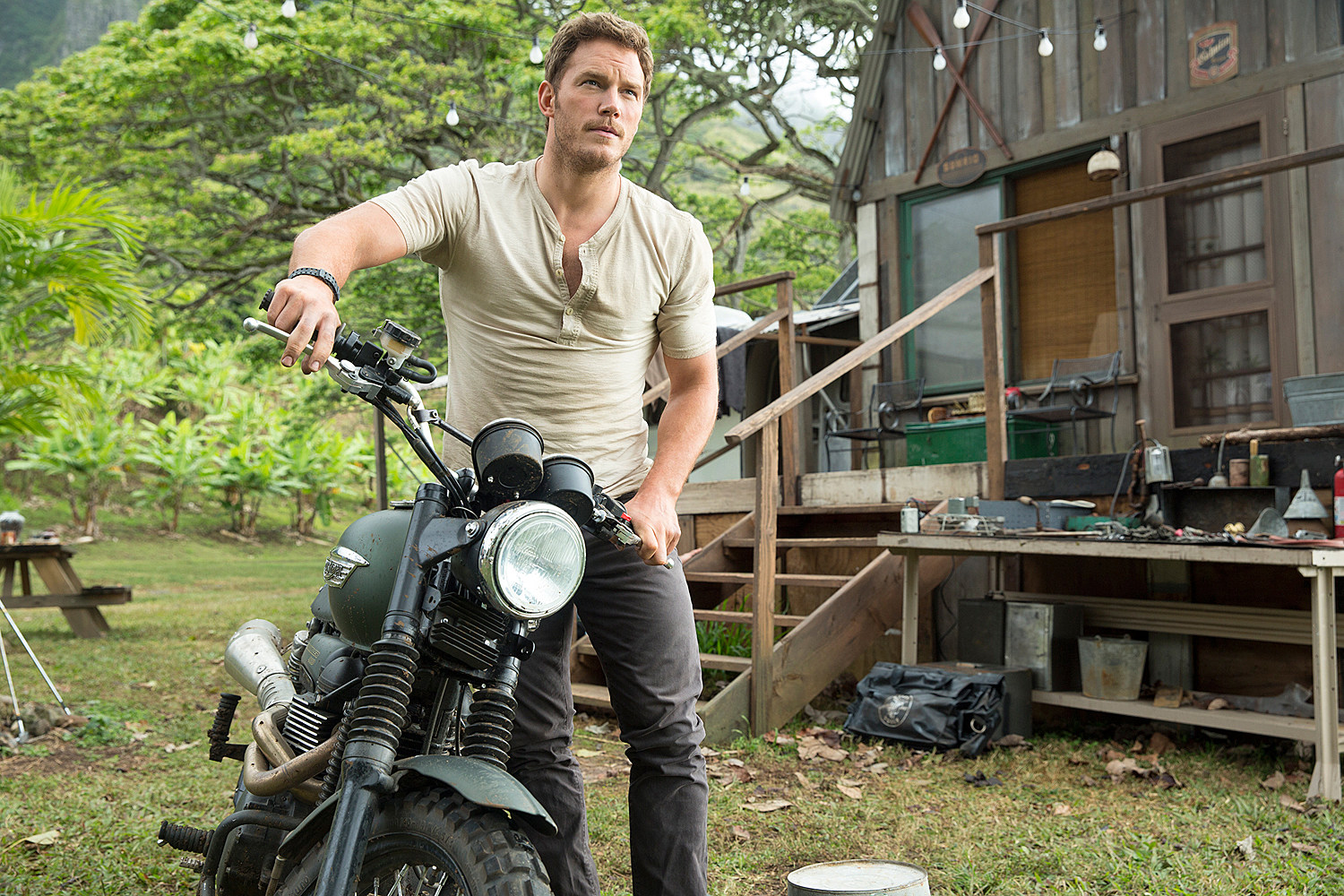
Chris Pratt chills with a motorcycle in a scene from "Jurassic World." Copyright Universal Pictures.
Of the several missteps “Jurassic World” takes toward mild entertainment, the brassiest and most regrettable is a direct challenge to “Jurassic Park” amid a pair of grand symbolic gesture. “Jurassic World” would be an OK movie if it hadn't thrown the proverbial gauntlet, but going after the big dinosaur is a mistake, and the resulting comparison creates expectations “Jurassic World” can't possibly meet. The two may be dinosaurs, but they’re leagues apart along the evolutionary scale.
Calling the titular theme park a world is a stretch, although it is a rather large island and the same one the action from the first film occurred more than 20 years ago; it even includes a pair of familiar faces in B.D. Wong's Dr. Henry Wu and a cameo by Mr. DNA. Everyone else is brand new, which helps explain why nobody learned the lessons wrought from the first time John Hammond tried to build this park. Hammond has passed on, leaving new owner Masrani (Irrfan Kahn) and park manager Claire (Bryce Dallas Howard) in charge of a facility with more than 20,000 visitors a day and a plethora of manufactured dinosaurs. The batch of dinosaurs includes a pack of velociraptors (seriously, didn’t anyone learn anything from the first film?) handled by professional trainer/requisite badass Owen (Chris Pratt) and his partner Barry (Omar Sy).
Surprisingly (or perhaps not), the original dinosaurs become a little boring for park visitors – as Howard puts it, “No one's impressed by a dinosaur anymore” – so Wong and his team create a new dinosaur, the Indominus rex, to drum up business. It's a stupid name for a dinosaur (a point the film comments on) but the creature is big, mean, smart, dangerously amalgamated and anxious to cause as much chaos as possible to the island, and she gets the opportunity to do so when she cleverly escapes captivity. The timing is pretty terrible: Howard's nephews (Ty Simpkins and Nick Robinson) are visiting and the nefarious Hoskins (Vincent D'Onofrio) lurks in the background waiting for an opportunity to convert the velociraptors into military weapons. Dinosaur-related shenanigans ensue as Howard and Pratt search for the nephews and the new rex devours humans and dinosaurs alike. 
 
                                                        And the raptor squad too.

Elements of “Jurassic Park” are plucked and recycled to complete “Jurassic World.” Some of of the reuse works pretty well – John Williams’ glorious theme song remains intact and people are consumed frequently – although other parts probably should have remained in the recycling bin. A few shots from the original are given homages (think the side mirror scene from “Jurassic Park”) without the cleverness or thoughtfulness, and Howard's subplot with her extended family blends John Hammond's grandchildren with Alan Grant's parental storyline with the kids. Things get a bit mangled in the mixing though – “Jurassic World” chastises Howard's Claire for focusing on her career instead of starting a family, an indignity the rugged but charming Grant (played by Sam Neill) never suffered through. Grant also received a fair amount of quality time with those kids to make his transformation believable; Howard never has the time with her nephews to forge the same natural, emotional bond.
It's a problematic subplot, but one possible to overlook if the on-screen spectacle is impressive enough. “Jurassic World” does go for size and strength, making the dinosaurs bigger and faster than before and adding more potential victims for them to munch on. But the size doesn't encompass grandeur; there's nary a moment when the viewer can stare awestruck by the creatures’ pure impossibility because the dinosaurs are missing a dash of reality. The film relies far too heavily on CGI to create an unnatural majesty the original earned by combining digital technology with animatronics and the occasional costumed performer. 

                                                               Just like this.

“Jurassic World” lacks contrast: it lacks contrast with the technology, and it lacks contrast with a tone that puts more emphasis on comedy than fear. Much fun is had picking out the people most likely to be eaten and rooting for appearances by certain dinosaurs, but the moments intended to scare frequently elicit laughs instead. That's the one little trick “Jurassic World” didn't pick up from “Jurassic Park” – very few moments of safety exist when things go sour in the original, and the biggest scare of all takes place once things start going right again.

Review: Three out of Five Stars

Click here to see the trailer.

Rating: PG-13
Run time: 124 minutes
Genre: Action
 
Ask Away

Target audience: Apparently everyone.

Take the whole family?: A lot of people get eaten in this bad boy; best to leave the kids at home so they don't cower in the small, unsafe theater bathroom like certain children did during “Jurassic Park.”

Theater or Netflix?: If you do plan to go to the theater, don't pay extra for the 3D; the world depicted in “Jurassic World” isn't grandiose enough to earn it.

Still on board the Chris Pratt train?:  Very much indeed. The man formerly best known as Andy Dwyer again showcases some serious action-movie chops and finds the balance between levity and verve the film misses. He's a highlight of the film, along with bits between Jake Johnson and Lauren Lapkus and Vincent D'Onofrio's incredibly edible face.

Scrumptious.
Watch this as well?: Go rent “Jurassic Park” or stream it if possible. I'll also recommend “Lost World,” which is also a step down from the original but is worth watching just for the long grass sequence; God does that moment work so, so well.