Friday, July 10, 2015

Following the leader for eternity

Bob, Kevin and Stuart in a scene from "Minions." Image courtesy Universal Pictures.
There is something to be said about a film that doesn't try too hard to be anything more than a vehicle for entertainment, something to divert the audience’s attention for 90 minutes or so. Admittedly, that's not the most flattering compliment, although for a movie like “Minions,” the description is a tip of the cap to a product that is shiny, passingly clever, and keeps the kids engaged for an hour and a half.
A workmanlike spin-off/prequel from the “Despicable Me” films, “Minions” provides the (moderately awaited?) background story for the tiny, adorable assistants to evil mastermind Gru. As the film's title sequence and first act show, the eponymous creatures have survived for millennia through sycophancy, following the biggest, strongest and (occasionally) most evil/despicable being around until the minions inevitably cause harm to their master. After angering Napoleon during a snowy battle, the little misshapen corn dogs find solitude and some happiness alone in an ice cavern for around 150 years. That is, until they develop a deep, unshakable ennui from their inability to follow their raison d'ĂȘtre.

Lost, like this kitty, in a miasma of existentialism.
 To get out of the funk, three minions – Kevin, Stuart and Bob, all voiced by co-director Pierre Coffin – journey to find a new leader to worship and serve. After a brief excursion to New York City circa 1968, the trio road trips down to Orlando, Fla., for a villains' conference and a possible encounter with the most evil person in the world, Scarlett Overkill (Sandra Bullock). Things inevitably work out well for Kevin, Stuart and Bob, as they become enlisted to be their new boss' flunkies and are whisked away to London to meet her inventor husband Herb (Jon Hamm) and given their very first task: To steal Queen Elizabeth's crown. As you can gather, shenanigans of various sizes and calamity ensue, actions that come with a side helping of characters voiced Michael Keaton, Allison Janney and Steve Coogan. Oh, and Geoffrey Rush stops by to narrate for a bit.
I've advocated in the past for a movie about the minions, who can be quite charming with their goofy denim overalls and amalgamated language (I picked up Spanish, Yiddish, English and French), and an origin story isn't a bad way to go about it. Even after watching it, I’d still like to learn more about their background, including how, exactly, do they multiply.

                                     This might be as good an explanation as any.

“Minions,” however, proves the little jaundice critters remain best served in a supporting role, as their banana-frenzied antics become a little obnoxious after about 30 minutes. (I'll amend my request to a show along with the penguins from “Madagascar” like “Garfield and Friends,” in which each group gets 11 minutes to shine.) The issue is the comedic nature of the characters is based so much on incessant, incoherent chatter – silence is not golden for these guys – it drains the viewer. They're still fun and all, but without a strong central figure to bounce off of or work around, they lose their appeal quickly.
“Minions” doesn't give the self-aware  Twinkie defects that leader to work with though. Bullock's Overkill is an interesting idea on paper, a proto-Baroness capable of taking the world down on a whim and with some terrific style. Alas, Bullock's vocal work never quite fits a character who should be more terrifying and explosive than sweet; she fits the latter personality trait when it arises, but one of the proverbial America's Sweethearts from the last two decades doesn't do evil. Voice casting matters (it's a reason why “Inside Out” is so great), and miscasting Bullock and the disappointingly shoddy Hamm adds unnecessary limitations to what could be a good film.
Or, at least, what would be a good film with less padding (it could justify 75 minutes easy) and fewer dips into the bottom of the comedic barrel with poorly executed fart jokes and lazy cross-dressing humor. The downer is “Minions” is quite hilarious when it puts a little effort into it: there's a pretty clever sight gag at Orlando's expense, along with a really great time travel joke befitting “Rick and Morty,” fortunately among others. It’s smart when it wants to be, although I wish it wanted to be that a little more often.
As it is, “Minions” is acceptable and sometimes more than that, something to keep the kids satisfied without running around the theater too much. It’ll become annoying for parents once they have to purchase the thing on DVD or online and rewatch in about six months, but the first watch offers a small blessing: 90 minutes of relative peace and quiet, along with a touch of fun.

Review: Three out of Five Stars

Click here to see the trailer.
 
Rating: PG
Runtime: 91 minutes
Genre: Animated

Ask Away

Target audience: “Despicable Me” followers, along with families.

Take the whole family?: It's bright and shiny enough for the wee, wee ones, so all clear on this one.

Theater or Netflix?: If you want to take the kids (and I’d recommend “Inside Out” first), go the matinee route and avoid the extra accoutrements. Along those lines ...

Why is the 3D even needed?:  Funny story on that one: “Minions” actually does make use of the technology, albeit at the very, very, very end of the film. It's a little post-credit song that's slight but cute and at least engages the audience in the old 1950s-style 3D bonanza. That does lead to one question though: Why not do that for the entire film, dagnabbit?

My inner prospector, pictured.
Watch this as well?: I'll vouch for “Despicable Me 2” being pretty solid – I skipped over the first one due to certain family members getting too old for such things though. Aside from the franchise, rent “The Iron Giant, “My Neighbor Totoro” and “Spirited Away” for some high quality family entertainment.

Friday, July 3, 2015

Taking the good with the bad

Imogene Wolodarsky, Mark Ruffalo, Ashley Aufderheide and Zoe Saldana in a scene from "Infinitely Polar Bear." Image courtesy Sony Pictures Classics.
“We were happy,” Imogene Wolodarsky's character, Amelia Stuart, reflects in the opening narration to “Infinitely Polar Bear.” “I know there's more to it than that. There always is.”
What a perplexing sentiment to open a movie with, a  sentiment that's both loving and wistful, sanguine but with just a touch of sadness to it. The perpetual hope is at the forefront, a reminder that whatever negative moments come next are always overshadowed by an overwhelming optimism rooted in love. She comes from a dysfunctional family always on the verge of falling apart, yet she maintains her inherent optimism even throughout the constant turmoil, and the experiences have made her stronger than before.
It's not quite the case with the film itself – “Infinitely Polar Bear,” is irrevocably hindered by its obvious flaws – but the film's overt optimism, humor and underlying sweetness shine through and make it an endearing little trip down the director’s memory lane. 
    A Google image search found a literal memory lane.
Everything of this takes place in and around Boston circa the late '70s, where Wolodarsky, her sister Faith (Ashley Aufderheide), and her parents, Cam and Maggie (Mark Ruffalo and Zoe Saldana), are living a nice little life just outside the city. The good times end when Ruffalo, who is diagnosed with bipolar disorder (the title is based on a mispronunciation of the disorder by Aufderheide), suffers a breakdown and is subsequently hospitalized. The lack of consistent income forces Saldana, Wolodarsky and Aufderheide to move to nearby Cambridge and into a dingy apartment complex as Ruffalo undergoes treatment. 
Saldana realizes she cannot earn enough money to support the family with her current station in life, so she decides to invest in herself and pursue a master's degree from Columbia University. The program should wrap up in 18 months, although pursuing the degree means Ruffalo, who is in a fragile state, has to watch the kids by himself for almost two years. Once the plan is settled, the film follows the episodic adventures of Ruffalo’s attempts to tend to his daughters, coping with his biploar disorder, and trying to rekindle his relationship with Saldana. Saldana faces a litany of issues in her own pursuits tied to overt sexism and racism.
“Infinitely Polar Bear” mentions those two topics frequently, along with concepts of feminism and the definition of manhood. Those are rather complicated issues to tackle and discuss, topics that were notable then and have become a huge part of today's cultural environment, emphasizing the point that there may never be any finality to discussion on those points. The film's problem is the way it addresses those subjects, mostly through heavy-handed exposition that feel jammed into an otherwise tight script. “Infinitely Polar Bear” has its characters state explicitly what its already showing, negating any sense of subtly and shifting the focus away from the Stuart family. That’s a shame, given how interesting and complex the family is.
“Infinitely Polar Bear” is at its strongest when it focuses on the family members, in particular their interactions and the smaller moments in their lives. There's a lived-in appeal to the quartet of actors portraying the Stuart family, a level of trust and camaraderie forged by love and survival. And they're all pretty great as well: the kids don't fall into that overly cute child actor trap; Saldana has verve and pathos in what has become a rare human role; and Ruffalo retains a bit of bite underneath his character's charming goofiness. He shines without trying to shine too hard in a role many actors would chomp to bits.
What they create is a reenactment of writer/director Maya Forbes' childhood in Boston, and they express her adult view of her past. “Infinitely Polar Bear” works best as a film about how people define their memories, how much nostalgia a person should have when reminiscing about a distant time in his or her life. The further back a person looks within his or her memory, the softer those memories become. 
Stock photos about memories are the best photos.
From the movie, its clear Forbes' view of a difficult childhood is honest; her surrogate, Amelia, is well aware of her family's state and is cognizant of the circumstances that could hold her back. Yet she never falls into the negativity; her memories are optimistic at heart, centered on the love she received from her parents and sisters and not the hard times surrounding them. She was happy, and that's all that matters.

Review: Four out of Five Stars

Click here to see the trailer.

Rating: R
Run time: 90 minutes
Genre: Drama

Ask Away

Target audience: Independent film fans and people who really like Mark Ruffalo.

And who doesn't like Mark Ruffalo?
Take the whole family?: I'm not a huge fan of the “R” rating on this one; there's a bunch of swears dropped in for sure, but nothing oh my goodness awful. Interested teens would be fine with it.

Theater or Netflix?: You can probably wait for Netflix; it might come out online in time for the annual Academy Awards buzz season. Speaking of which ...

Mark Ruffalo, Oscar winner?:  His role has Oscar bait written all over it, so it depends on whether or not he’s dinged or credited for what he does with the role. Considering his performance is generally understated, he might get more credit from Academy members and could garner a nomination for the second year in a row.

Watch this as well?: Another Ruffalo vehicle, “You Can Count on Me,” shares the theme of finding function in a dysfunctional family and sports amazing performances by Ruffalo and the great Laura Linney.

Thursday, July 2, 2015

A few questions with 'Infinitely Polar Bear' star Mark Ruffalo and writer/director Maya Forbes

Zoe Saldana, Mark Ruffalo and director Maya Forbes are pictured on the set of "Infinitely Polar Bear." Image courtesy Sony Pictures Classic.
Nothing comes easy for the Boston-based Stuart family in “Infinitely Polar Bear.” The father, Cam Stuart (Mark Ruffalo), has bipolar disorder and struggles to maintain control of his life. The mother, Maggie (Zoe Saldana), moves to New York to pursue an MBA so she can improve her family’s situation. And the children, Amelia (Imogene Wolodarsky) and Faith (Ashley Aufderheide), are trying to make the best of the situation after an abrupt move to an impoverished neighborhood and dealing with their father’s eccentricities. The events depicted in “Infinitely Polar Bear” are based on the life of writer/director Maya Forbes, who uses the film as a means of investigating her past and measuring how how her childhood shaped her adulthood.

Ruffalo and Forbes sat down recently for a group interview to discuss the film and a slew of topics ranging from depicting bipolar disorder on screen and the way people see their memories to the difficulties of pretending to be a blue-blooded Bostonian. Audio from the interview is available here.

Q: With your past medical issues, do you think it's easier to relate to your character?

Mark Ruffalo: Probably. I hadn't really thought of it like that, but I definitely understand what it is to be fearful and out of control of things that are way outside of your purview and are existential.

Q: What made you finally want to share this story?

Maya Forbes: I like personal stories – a movie like “The Squid and the Whale” was a movie I loved. When I saw it, I thought “I love this kind of movie, so why don't I write this kind of movie?” And when my daughters got to be about the age I was when my father had his really big breakdown that sort of changed our lives, in seeing these two little girls interacting with each other, what it was like taking care of them, I was sort of catapulted back into my memories. And one thing that was notable for me is the culture my girls were growing up in, parents today get a lot of fear pushed on them. Everything's going to crush your children, they can't go outside alone, they can't do anything. It's like fear is lurking all around and kids need to be protected constantly.

And when writing it, I was sort of revisiting this idea that kids are actually very resilient and they're very capable. And looking at the gifts I received from a hard period of my life – and it was certainly a hard period, it was hard for everyone – I felt that I had grown a lot, I'd become a more self-reliant person, I'd become a compassionate person, I became a person very interested in people and things they do. The hard times made me who I am today, and I wanted to write a movie where people reconnect with their past, re-evaluate their past. Just reconnect with your own memories and reflect on your family and what made you who you are, the good times, the bad times, the flawed people in your life who you love, those ambivalent feelings. That's what made me want to do it.

Q: Did you feel creative risk while making this?

Forbes: I felt I had avoided for a long time writing something I was really powerfully, emotionally connected to. I like the work I do in Hollywood, but writing “Monsters vs. Aliens” is much less risky than writing something very personal about people you love. I felt like I'd been avoiding writing movies that I really cared about and taking that risk. And in terms of the directing, I felt I was always telling my daughters to be bold and to try to be the boss. We know there are very few women directors, and I felt like why am I not doing this? I'm telling my daughters to go do it, I have to be a good parent and show them. I can't keep saying it if I'm not going to try it.

It was definitely leaping off into a place where I was taking these emotional risks, the risk of offending everyone I know, of offending people, of making a terrible film about an issue I feel very strongly about. I wanted to humanize this issue and show when you have a bipolar family member – whether its a father, mother, child or sibling – it becomes a family issue, it's not solo. Everyone's involved in this. So that was a risk I didn't think about, until it comes out to the world and you start thinking, “Oh my God, I hope I did this right, that I connected with people.”

My family was very understanding; they're used to me writing about things that are personal, outside of Hollywood things; I've always done that. My father died in 1998, but my mother, who started out in the theater before she went and got her MBA and worked in finance, she loves drama and art and so she saw it as my story. She embraced it.

Q. What about the pressure of playing your director's father?

Ruffalo: I think it could have been a lot worse if Maya wasn't so charming and smart and talented and equanimical in the way she saw her father and even herself as a young girl. My job was to be as honest as I possibly could to her dad and who he was, warts and all. That's what I knew Maya was asking of me, and so the risk was the easy part because the further I played from myself, the riskier it was, but that's exactly what she was asking of me. So the risk all of a sudden wasn't so much a risk in our relationship, but more would people buy me in this part and would the bipolar stuff work. I have family members who are bipolar, and there's mental illness and depression as well, so I felt like I knew that part. But what was more difficult for me was the brahmin, blue-blood Bostonian. Maya's family came over in the Mayflower a couple of hundred years ago, and my family basically rowed a boat here like 40 years ago.

Q: With or without oars?

Ruffalo: More like paddle boards. That part was really different for me.

Forbes: But, to that, a great thing happened in that Mark started to tell me things that are true. The scene where he picks up Zoe Saldana at the bus station, he was like, “I'm not sitting in the car watching her come here. I'm getting out of the car. Cam would never sit in the car; he's a gentleman, he's going to get out of the car.” And I was like, “You did it! You are correct!”

Ruffalo: That was a great day.

Q: Was that your father he got or was it the character?

Forbes: It was my father. My father always brought flowers, he was always romantic. He was thinking of the character and he bested me.

Ruffalo: No I didn't; I came into alignment with your vision.

Forbes: I should have worded it that way.

Ruffalo: We did have one disagreement. It was a scene and she came over and said “I think it's great.” And I said “yeah, but?” She's like “Well, I just have one note.” And I said “what?” And she said “I think you need a cigarette.” I was like, “Maya, I had a cigarette in the last scene and the scene before that.” She's like “I know, but it's right.” And you were right again.

Q: Mental health issues aren't the only topics you tackled. There's disparity in class roles, reversal of gender roles, and race. What was the key to portraying all these issues so it remained authentic?

Forbes: I guess just relying on my childhood and the truth. I was trying to tell the truth and I wanted to put all these things in because those are all issues families deal with. My mother is black, and I don't look black ... I wanted to show as a little kid you don't think about it, and then as you get older the world tells you it matters and then you wrestle with that. Especially because the mom has gone away, there's something very poignant with me in that the daughter is wondering how much am I identifying with my mother and how much am I identifying with my father. What is the mother giving up in terms of connection with her daughter about this subject? It's part of life, so I wanted to have these things be part of the life of this movie without becoming an issue movie. For me, it was always I wanted to tell a family story and all the different things people struggle with while being authentic.

Ruffalo: If you know bipolar, it's something like 3 percent of Americans are bipolar (editor's note: a really good estimate, as the National Institute of Mental Health's estimate is 2.6 percent), and that's supposedly a very low estimate. That means three out of 100 people, which is a good chance that any one of us at any given time has probably come across a bipolar person. Do we necessarily know they're bipolar? No, because it's not like a light switch turns on and off and they're not acting zany; it's an intensification of already certain qualities in who they are. The most important thing was finding out who Cam was and just stay as honest to that as possible. I knew the stories, it was written into the script how far out he'd go in one direction or another. So take it that far out but stay tethered to some reality even if I wanted to go farther as a performer because it would be more fun to do or it would be more flashy to do at times. It just wasn't honest. I think that's what we set out to do was to keep it honest and the rest would take care of itself.

Q: The film is a documentation about how we see memories, whether they're positive or negative. What do you think of the view of your memories?

Forbes: What's important to me is the story you tell about your life. You get to tell your version, and you can tell whatever version you want. You can tell them the bad version or you can tell the good version. I didn't want to tell the good version, but I wanted to tell the real version which is that I'm grateful for my childhood, I love my parents. We've been through some really hard times; my father was a very difficult person, very flawed, also a wonderful father. So how do you take all of those things and make them into a story?

Yes, it's how are you going to look at your life. Are you going to look at it in a way that makes you grateful for who you are and excited to move forward? Or you can look at it in a different way. I feel like my sister and I, we both got a lot out of our childhoods. My father had a lot to do with what I do for a living and for what my sister does for a living, but even more important than that I think we have loving relationships in our lives. So I think that's the real measure of my childhood, I guess, that I have a lot of people in my life that I love.

Q: You seem to be a very optimistic person.

Forbes: I am optimistic. I guess I'm a happy person. Maybe I'm just wired that way.

Ruffalo: You're lucky.

Forbes: Aww … I have down moments, believe me.

Ruffalo: Yes, I know.

Forbes: I like to cry a lot. I cry a lot, but I'm comfortable crying, so I experience the sadness.

Ruffalo: It's nice when you cry.

Forbes: I appreciate feeling connected emotionally to the world.

Ruffalo: I'd known I did a good job when I looked over at the monitor and see you crying.

Forbes: Oh yes.

Ruffalo: Or laughing. That's a great laugh.

Q: You talked a lot about playing Cam as honest as possible. How did you want Maggie (Saldana's character) to be portrayed?

Forbes: I wanted her not to be crushed by these circumstances. She is a fighter – I guess I would say maybe I get some of that from her, because she's an optimist – and these were really hard times for her. Now that I have three children of my own, my feelings about my mother changed because I recognized how hard it was for her to come every weekend from New York with work and all the stuff she was doing. She came, and she came with a good attitude, and she never was complaining about her situation. She came and participated in the family and then she left and went back to work. It was really hard, but she always maintained this positive attitude. Both my parents I would say are feminists. My father was always wanting us to fight with everybody. Obviously, he was a combative person himself, but he encouraged us to get out there and fight, as did my mother in her own, much more charming way.

The most important thing to me was that she be a person with a lot of spirit, and that's what drew me to Zoe Saldana. She's so strong, and she's such a feminist, and she has a great laugh and a great smile.

Ruffalo: (She’s) Indomitable.

Q: How do you feel about the portrayal of bipolar disorder by other media, like “Homeland”?

Forbes: I like “Homeland.” I've only seen the first season I think … I like the way it's done in “Homeland.” It's just an interesting milieu to put a  bipolar person into. Tom Wilkinson in “Michael Clayton” I think does a great job.

But it's a tricky thing. I don't like crazy when it's kind of cute, but I think it's funny when Cam is so annoying. I mean, he's annoying. It's a hard thing to portray, I guess, it's a tricky thing to get right. So I try to draw it from my own experience; it's not just my father, I have more bipolar people in my family, so I got to see it as a little kid and as an adult. It's definitely different as an adult; as a kid, it seemed just often very annoying. Sad too, when he was hospitalized and heavily medicated; those were like horror movies as a child. But it has been interesting to see.

When someone's getting manic, you don't always know if they're just in a great mood or if they're just having a great day. And you don't want to come down on them and say you're crazy right now. But it's like I'm happy for the first time in weeks, now you're going to say there's something wrong with me.

It's a really delicate thing because it's confusing; it's confusing to know where the line is for people. I think that was something everyone was always wrestling with my father; is he just in a good space right now or is he heading somewhere that's more disturbing?

Q: Why did you have to shoot in Providence instead of Boston?

Forbes: I really couldn't shoot in Boston because it was expensive.

Q: But you used a lot of Boston actors and talent though.

Forbes: And crew. We were very Boston-centric, but Providence looked very much like Cambridge of that era. It looked more like it than any place I could find here.

Q: It's Boston adjacent.

Forbes: It's Boston adjacent. It was evocative of that era. And they have very good food.

Ruffalo: You could walk to each restaurant in Providence. I got to walk to work every day.

Forbes: I'm pro New England.

Q: What is it about being a Boston person you have trouble playing?

Ruffalo: The blue collar part of Boston I feel very comfortable in. It's the blue blood part that I don't. Other than Maya and several generations away, I haven't really come in contact with. I never went to college – I'm not proud to say that – so I never had that preparatory or even scholastic or collegiate kind of influence. It was so far from what I knew, and that's only because I just didn't come into contact with it. But if I could spend a little time with it, I could pretty much pick it up pretty quickly; I'm a pretty good mimic that way, and that works well for me as an actor. Really, it's a matter of not being in contact with it in any way I could soak it up. I was playing catch up … it's just a whole way of looking at the world that's very alien to me. There's a lot of weird, strange rules, and seeing the world through a filter of class that I just didn't understand. Only looking up I could understand, but I couldn't understand the looking down part.

But I think Cam, funny enough, he can play in that. He can go from changing the oil on a broken-down car in one moment and then walk into a very posh restaurant and put on his bow tie while having an argument in another. That, I thought, was very exciting; I think Cam was somebody who didn't really feel comfortable in that world, and that put a lot of pressure on him. I would even go so far to say it was triggering him in a lot of ways.

Forbes: Yes. He knows my father better than me.

Ruffalo: No I don't.

Q: You've had a very diverse career. Do films like this keep you grounded as an actor? Is that why you come back to smaller indie films.

Ruffalo: I feel like you're doing the same thing whether it's a big movie or a small movie. Little movies, the energy stays really compact.

Forbes: You have to keep moving; you can't get bogged down.

Ruffalo: I like the familial, intense, really vulnerable feeling of making small movies. I like that kind of experience more. But, I mean, the creature comforts of a big movie; there's a lot of pros in that world too that are nice to move between.

Q: Is it a relief to see it finally going into theaters since you've been working on it for so long?

Forbes: Yes, yes. We shot it in 2013, so it's been two years since we shot it. It's been a huge relief. It kind of feels like it's hard to move on; you know it's coming, and it sort of just has to do whatever it's going to do. It'll have its life, whatever it is. But yes, it's a huge relief.

Q: What advice would you give to young, female directors?

Forbes: For years, I tried to write what I thought would work in Hollywood, you know what I mean? I wasn't trying to put out my specific and unique vision. I could always get jobs and work in the studio system, but I wasn't moving forward with my own personal stuff.

First you try to write something for you, and then you share it with some people and get some feedback. You're not ever going to write it just for you; you want to be open to the creative process with other people. But start with that, because there's an audience. I feel like every time a movie with a female protagonist opens and it does well people are like, “Oh my God, women want to see movies.” And of course they do; it's insane. I just wish I started 20 years ago writing. I did write a couple of early ones, and don't give up. But do be specific to your unique vision and what you want to see, because there is an audience for that.

As for the directing, the great thing about directing is there really aren't rules. When you're running a set, you get to make it how you want it. Early on, when I was meeting with various people for finance things … are you going to be able to fire people, you know? That's not the right way to look at it. Can I communicate my vision to people and can I make decisions? And yes I can fire people.

Ruffalo: That's totally a misogynistic question, by the way. They'd never ask a guy if he'd be able to fire people.

Forbes: If you want to make a movie, put that down as a goal and do whatever you have to do to get to that. Don't think about anything else. I didn't think about what would it be like if I cast my daughter, if that would be a nightmare. What it would be like for my family if I have to leave one daughter in L.A. And bring the rest of the family, and how's that going to work? For me, it was so chaotic from a family point, but I knew I wanted to make a movie, and that stuff worked itself out. It's sort of like the lean-in argument; just keep going for the goal and the other stuff you'll figure out as you go.

Wednesday, July 1, 2015

No better time to fight the machines than the past, present and future

Emilia Clarke and Jai Courtney shoot at a Terminator in "Terminator Genisys." Image by Melinda Sue Gordon, courtesy Paramount Pictures.
During its best scene, “Terminator Genisys” brings the entire franchise back to its comparatively humble roots that trace back 31 years now. It's the closest the film comes to hinting at the underlying terror behind the whole “Terminator” premise – one I’ll dip into later –  and it adds a little ferocity to a franchise that has plunged a little deeply into the Looney Tunes bin.
More of moments like that would push the film up to the echelons of “Terminator” and “Terminator 2: Judgment Day,” but “Terminator Genisys” is at least a little better than average summer action flick, and it will lead to innumerable arguments in the coming weeks. 
First image to pop up when searching "nerds arguing."
The worst thing about discussing “Terminator Genisys'” plot is the inability to avoid the big twist because the previews already revealed it. So to get it out of the way, the formerly heroic John Connor (Jason Clarke) becomes a Terminator hybrid after he is essentially infected by a cyborg virus courtesy of the embodiment of Skynet itself. This comes shortly after the human race's victory over the machines, albeit a win hindered by the computer system's last-ditch effort to send a Terminator, a T-800, back in time to kill Clarke's mom. Clarke responds by sending soldier Kyle Reese (Jai Courtney) back to 1984 to save his mom from the Terminator.
That's where the story set in place by the original “Terminator” ends, as mother Connor (Emilia Clarke) is more than capable in this timeline to defend herself from a T-800. More time traveling shenanigans have resulted in another Terminator, dubbed Pops (Arnold Schwarzenegger, back in action), going back even further in time to protect Emilia Clarke for about a decade before Courtney’s arrival. After dispatching the Terminator sent to kill Emilia Clarke in 1984, along with a T-1000 (Byung-hun Lee) sent to murder Courtney, the two humans travel ahead to 2017 to stop the mysterious Genisys program from evolving into Skynet and destroying the world. An even older Schwarzenegger meets them there, along with a metallic Jason Clarke, a cop who Emilia Clarke and Courtney saved back in 1984 (J.K. Simmons), and a rather angry computer system that will protects itself at all costs.
It takes about two hours to sort all of that out, or at least come as close as humanly possible. Trying to unravel the time-travel logic behind “Terminator Genisys” is not a task for the faint of heart or the annoyingly logical; so many holes exist that the film's attempt to address and gloss over that point still doesn't make sense. The original’s time traveling mechanics are complicated enough, although admittedly half the fun of the first three Terminator films comes in the form of countless arguments about the logistics.
If not knowing is half the fun, the spectacle of the film serves as the other half. As an action film, “Terminator Genisys” hits all the requisite notes with aplomb and good quality, mixing the necessary CGI alongside a few nifty and practical live-action stunts to form an engaging viewing experience. One notable technological problem stems from the attempt to make old Schwarzenegger look young again with some digital manipulation – it definitely doesn't cross over the uncanny valley.

At least it's a step up from this.
“Terminator Genisys” looks pretty good, but the circuitry below the exoskeleton is a little wonky. It hits the fatalism theme – the idea that Reese and the Connors are controlled by destiny – with too much force, eliminating a more honest ambiguous answer for a more certain and comfortable resolution. The film also never does quite enough to develop the Kyle Reese/Sarah Connor relationship, although some of the problem is a lack of romantic rapport between Emilia Clarke and Courtney. They kick ass together famously, but their relationship lacks sexual spark. Then again, it is nice to have Schwarzenegger back, and, while this is strange to type, the man performs his role as a human killing machine with nuance and a dash of longing.
And to complete the time jump from the opening graph, “Terminator Genisys’” highlight is a simple scene in which Courtney has to face off against a T-800. He's clearly outmatched by the relentless metallic beast with soulless red eyes and a driving urge to kill, and a look of fear rends itself on Courtney’s face as the monster man gets closer and closer and the space between them diminishes.
The scene is a reminder that, yes, there was a time when the Terminators were totems of horror,  I have to say it was nice to be scared of a Terminator again, if only for a moment.

I just want a hug ... and to rip your spine out.
Review: Three and a half out of Five Stars


Click here to see the trailer.

Rating: PG-13
Run time: 125 minutes
Genre: Action/Sci-Fi


Ask Away

Target audience: “Terminator” fans and people with a rooting interest in Arnold Schwarzenneger's career.

Take the whole family?: All sorts of murder and mayhem occur on screen, certainly more than enough to scare off the really little kids.

Theater or Netflix?: If you do see it in theaters, don't spring for the IMAX or the 3D glasses.

Do you need to watch any of the prequels?:  I already skipped part four and suffered no repercussions for doing so, and you can definitely avoid round three without losing track of anything . The original “Terminator” is really the only one you have to see to understand what's going on, but you should still watch “Judgment Day” because it remains a genre masterpiece. Speaking of which ...

Watch this as well?: Revisit “Terminator” one and two, and step back a few years to check out the Bruce Willis/Joseph Gordon-Levitt time-travel vehicle “Looper.” Watch “Primer” too if you want a time travel flick that will just blow your mind.

Dancing your troubles away

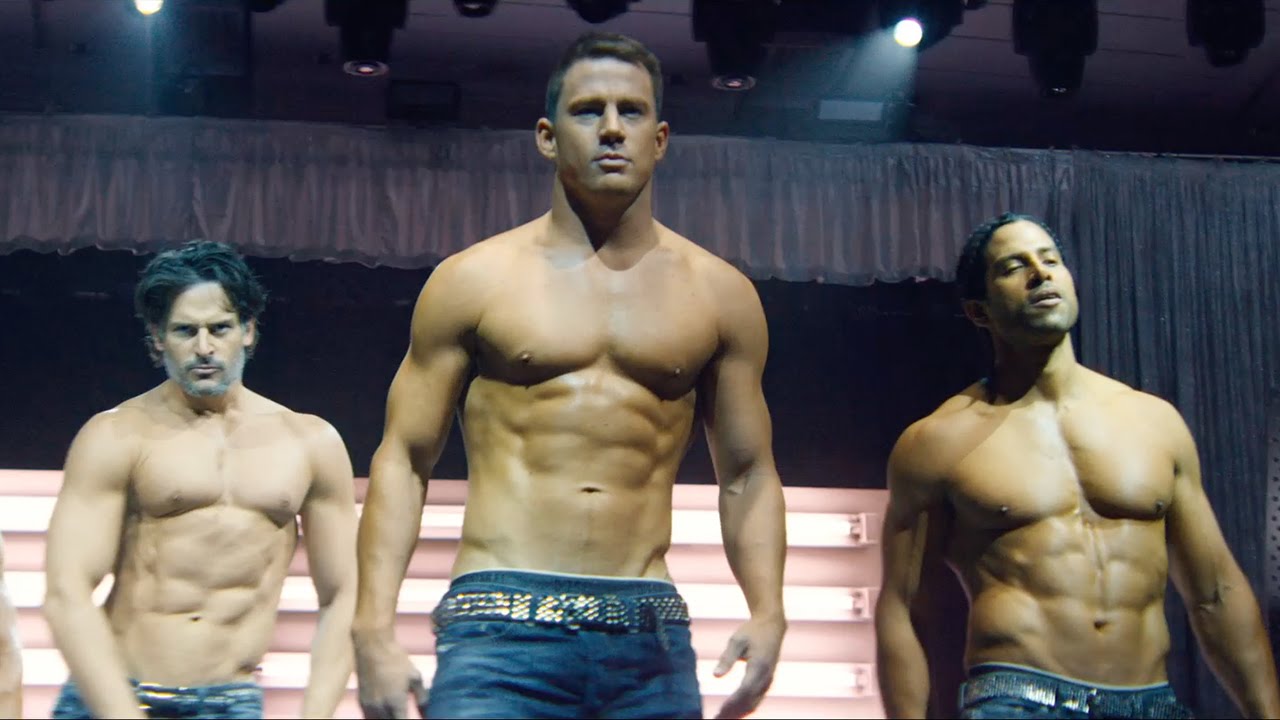
"Magic Mike XXL's" stars begin one of their routines. Photo courtesy Warner Bros.
Nothing happens in “Magic Mike XXL.” I mean, there's the traces of a story that leads to a conclusion, but the stakes are almost nonexistent and the adversity the characters face are minimal. It's a funky little film, a celebration of everything the original “Magic Mike” rallied against.
Strangely enough, the sequel is better off for veering away from the trodden path, especially after losing the dangerous magnetism of Matthew McConaughey's Dallas. Replicating the original’s darkness without McConaughey would be a fool’s errand, so it made sense to take the action in a new direction and creating an audacious, silly, sexually charged, lovable romp with a just a hint of depth.
“Magic Mike XXL” is a road movie at heart, following the minor misadventures of the titular Mike (Channing Tatum) and a few of his old club friends (Joe Manganiello, Adam Rodriguez, Kevin Nash, Matt Bomer and Gabriel Iglesias). Tatum's buddies are on their own now – McConaughey's Dallas and Alex Pettyfer's Kid absconded to Macau – and amid a sojourn to a stripper convention in South Carolina for one last ride. (If that sounds familiar, the mantra is employed in another summer flick, “Furious 7.”) Tatum is intrigued by the idea and decides to join his comrades after a three-year stripping sabbatical because you can't take the dancer out of the man. On the road they go, reinventing the act McConaughey forced on them and finding out a little more about themselves while preparing for that last big performance before they go do … something else. Those details remain unclear and really don’t matter.
The group also meets friends both new and old along the way. Jada Pinkett Smith pops up as Tatum's former employer, lover and emcee; she’s joined by one-time “Community” star and current rapper Donald Glover and long-time New York Giant defensive end Michael Strahan, both of whom bust a few moves. There's a new, quasi-love interest for Tatum in Amber Heard's character, Zoe, and Andie MacDowell provides an overnight refuge, a large southern accent, and a rather unsatisfied libido. Oh, and Elizabeth Banks makes an appearance as part of the Summer of Banks.

Seriously, Elizabeth, you deserve a break.
“Magic Mike XXL” gets off to a slow and kind of frustrating start. The justification for inserting Tatum into the group’s proceedings is opaque at best and very much shoehorned; sure he still loves dancing, but he knows moving on was the right decision, and it doesn’t feel like he’d decide to take two steps back just because. There's also a missing level of complexity and darkness that made “Magic Mike” such a compelling film.
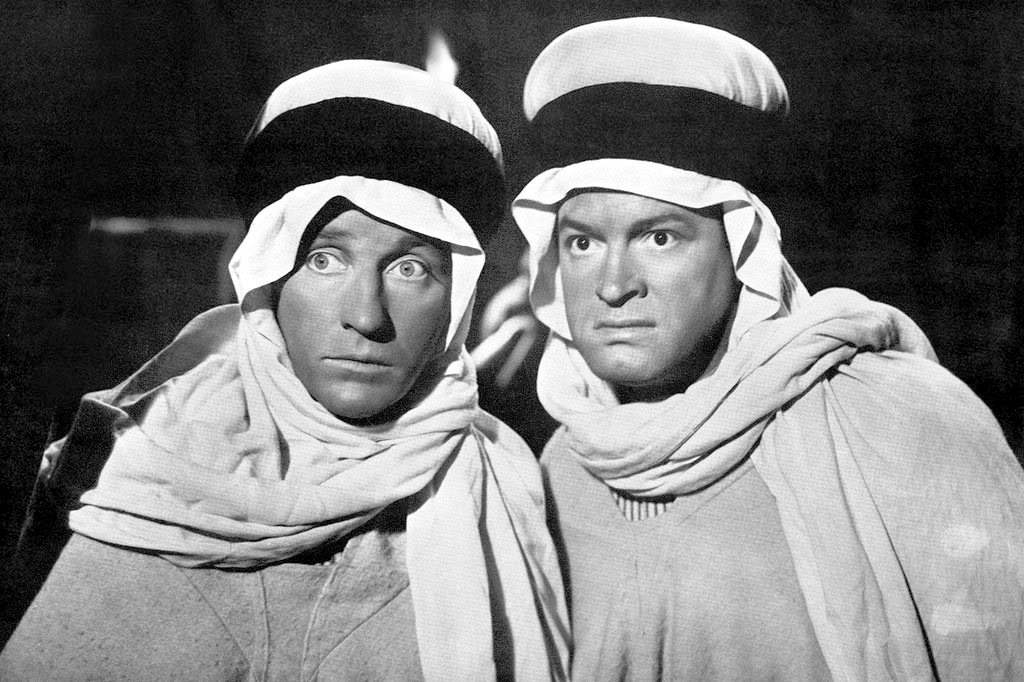
The tonal shift between the two films is jarring and difficult to account for, but the sequel really begins to take off once the characters hit the road and partake in their shenanigans. “Magic Mike XXL” has a thing plot that serves as an avenue to hop right into the delightful, wonderful and occasionally magical dance sequences and engage in some harmless ogling. (I may or may not have tossed 10 imaginary singles at the screen during Tatum's routine.) It’s sort of like a Bing Crosby/Bob Hope road movie, but with much less singing and a little less sexiness.

More than 70 years later and you can still feel the tension.
A good portion of the fun of “Magic Mike XXL” – and the movie is an utter joy – comes when watching the central dancers just mess around while traveling, reminiscing about the past and supporting one another in professional and intimate engagements. They’re a likable collection of people, the kind of guys who would make any party far more interesting without messing up the vibe.
In other words, “Magic Mike XXL” is a straight-up bro film, albeit one in which the characters are focused more on celebration than conquest. That’s due in part to a strong feminist underpinning (something along the lines of a feminist bro movie) in which the women are, more often than not, the ones in control, the characters engaging in the fun times normally associated with male behavior. At one point, MacDowell's character laments a life with only one lover as Nash waxes ruefully about wanting the exact opposite. It's a clever twist for a film otherwise engaged in goofy fun.
Any praise I have for “Magic Mike XXL” is coupled by acknowledgement that it is a lesser film than its progenitor. There’s little bite to be found in the sequel, no grittiness or roughness in this new version and a little less charisma without McConaughey (even though Tatum is a sweetheart). Still, there’s always a place for fun in film, especially when watching characters follow their bliss with such glee. As “Magic Mike XXL’s” final scene shows, there’s nothing more satisfying in life than winning your dream.

Review: Four out of Five Stars

Click here to see the trailer.

Rating: R
Run time: 115 minutes
Genre: Comedy

Ask Away

Target audience: Very much a female-oriented film with a corresponding viewership, although guys with a little sexual leniency will like it.

Take the whole family?: Probably not for the kids, but your cool aunt will have a blast if you're kind enough to take her.

Theater or Netflix?: It's fun enough for a screening as long as it has a bar with it; this might be the perfect mimosa movie.

How much does the film miss Steven Soderbergh ?:  He's still on hand as a cinematographer and producer, but the film's tonal change is due in large part to his absence from the director's chair. There's a sense of heaviness missing from the sequel, a burden that brought out the best of Channing Tatum (he's still good, but not at the same level). Soderbergh is a rare director who can do crowd pleasing when needed alongside a satisfying edge.

Watch this as well?: Watching the original helps understand the motivations for this one, and “Magic Mike” is also a much, much better all around film than its sequel. Another interesting but less aesthetically mesmerizing option is “The Full Monty.”

Then again, it really depends on your taste.