Friday, August 28, 2015

Lessons for the road through life

Ben Kingsley and Patricia Clarkson in "Learning to Drive." Image courtesy Broad Green Pictures.
I’m not sure if anyone does this anymore given access to the Internet just about everywhere, but there was a time when people would pop by a cineplex and dither about which film they wanted to see. The battle could get a little heated if one party, say an older and larger brother, didn't hold more sway over the other, and the multitude of options at the 20-screen theaters only made the process that much more difficult.
I bring this up because “Learning to Drive” is the perfect settle film, a movie the attendees – more likely than not a couple – have a passing familiarity that feature actors on the poster they feel comfortable watching. Settle films like “Learning to Drive” aren't memorable pieces of cinema, but they have just enough to keep an audience engaged and satisfied for at least 90 minutes, and nobody leaves the theater overly upset with what he or she just watched.
One thing “Learning to Drive” has going for it is a title that isn't a misnomer: the film is literally about Sir Ben Kingsley teaching the great Patricia Clarkson (one of the few actors to earn the word “great” as part of his or her title) how to navigate an automobile. Clarkson never had a reason to learn before – as a native New Yorker she relied on subways and other people – but is inspired to do so after her husband (Jake Weber) leaves her for another woman. Taking a few driving lessons offers Clarkson an opportunity to escape her post-marital woes while at the same time serving as a means of connecting with her Vermont-based daughter (Grace Gummer, the GREAT Meryl Streep's daughter). 

Also in that category: the Great Laura Linney.
As Clarkson struggles with the end of her marriage, Kingsley is trying to create a domestic life of his own. An Indian Sikh who fled to America seeking political asylum, Kingsley works both as a driving instructor and as a taxi driver to support his nephew (Avi Nash) and his new wife (Sarita Choudhury) from an arranged marriage. Kingsley swears by the arranged-marriage system, although the match starts off on the wrong foot due to an initial intellectual and cultural divide between the newlyweds.
As you probably guessed, the title “Learning to Drive” works as both a literal description of the film's plot and a symbolic representation of what the act of gaining independence does for Clarkson's character and what domesticity does for Kingsley. It’s a little less than subtle for sure, albeit a name that does serve as a pretty good indicator of the film's tone. “Learning to Drive” is exactly as agreeable as it sound, complete with soft-chuckle inducing comedy (there is one exception courtesy a filthy Samantha Bee joke) and inoffensive drama in which the results perfectly satisfy what the audience would want given the circumstances. Surprises or any true sense of concern and danger do not lurk in the shadows of this film.
It loses a few points for lacking such things, as well as a weird undertone of sexism with Kingsley's character. (He gets upset at his wife for not leaving the apartment, even though it remains unclear whether he at least gave her a tour of her new neighborhood or not). Issues abound too with unnecessary dips into magical realism and the disparity between the moderately rich literati lifestyle Clarkson lives against the poverty Kingsley lives in; while it's not quite snobs vs. slobs, the filmmakers do put a little more weight on Kingsley's problems for economic reasons.

Ted Knight is not around to flaunt his mysterious wealth either.
 Those issues are more like hills than mountains though, concerns worth stewing over without impeding upon the film's enjoyment. The fun comes from watching Clarkson and Kingsley, both of whom are nothing less than terrific and put in nuanced performances that, in Clarkson's case, only reach histrionics when the moment calls for it. They also have a terrific rapport, saying very much to each other without speaking more than necessary; the moments of silence both calm and awkward serve as their own form of communication.
Director Isabel Coixet and writer Sarah Kernochan have crafted a perfectly lovely little film with “Learning to Drive.” Their movie makes for a short pleasant trip to the theater – or a solid Netflix rental accompanied by an OK Portuguese pinot noir and a good acquaintance – that doesn't leave too bitter a taste in the mouth afterward.

Although you might want to watch out for the dreaded wine headache.

Review: Three and a half out of Five Stars

Click here to see the trailer.

Rating: R
Run time: 90 minutes (One hour and 30 minutes)
Genre: Drama

Ask Away

Target audience: Anyone down for spending 90 minutes with the marvelous Patricia Clarkson.

Take the whole family?: One of those films were the content is barely in the “R” territory but the tone and nature of it makes it for older audiences regardless.

Theater or Netflix?: Really, really excellent for either an adult date night or just a night in, so either works as long as a hint of vino is involved.

Academy Award odds?: Ben Kingsley has a decent shot if the best lead actor field doesn't get too crowded (the last couple of years have just been insane) and if someone like Paul Dano gets bumped to supporting actor. Patricia Clarkson might have the better shot for the same award in the opposite gender though given the comparatively low competition level and for the moderate intensity of her performance.

Watch this as well?: Considering how much of an acting showcase this is for Clarkson and Kingsley, it feels apropos to recommend two other films in which both shine: “Pieces of April” for the former and “House of Sand and Fog” for the latter.

Wednesday, August 26, 2015

White people in peril

Pierce Brosnan and Owen Wilson in a scene from "No Escape." Image courtesy the Weinstein Company.
Society in the unnamed southeast Asian nation in “No Escape” has fallen asunder completely. A collection of brutal rebels have assassinated the country’s ruling despot, which results in mass rioting, chaos and murder on the streets. No citizen, soldier or tourist is safe from the roving mass of destruction consuming the streets, much of which is depicted with the darkest shades of red pouring onto the streets.
Such an interesting premise, one overloaded with potential to document how people slip into brutality and vengeance so easily. Unless the people filming it are say sibling filmmakers John and Drew Dowdle, who instead focus on what effect the perils of a country at war with itself has on a family of attractive white people.
Sure, the American family in this film are indeed quite fetching. Occasional (cinematic) model Owen Wilson stars as an engineer moving his brood (lovey wife Lake Bell and obnoxious daughters Claire Geare and Sterling Jerins) to the undisclosed nation (although my money is on Cambodia for geographical and historical reasons) to begin work on a water facility. But, wouldn't you know it, the family has just the worst timing: Wilson, Bell and the kids move across the world the very same day a revolution breaks out in the host country, leading a contingent of rather devoted rebels to hunt down and slaughter every foreigner they can find. Wilson is a prime target given his connection with the unpopular water project
All the family can do now is try to survive and escape through the dangerous streets of the chaotic city, forced to rely on ingenuity, desperation and a and a little help from mysterious British raconteur Hammond (Pierce Brosnan). Shenanigans involving clubs, tanks, small boats, guns, angry foreigners, and film clichés ensue.
White people trying to survive angry foreigners sums up the fears of many an American tourist going abroad, and “No Escape” cranks those worries to 11 before breaking the freaking amp due to overuse. A majority of the non-white characters are portrayed as sinister beings intent on destroying this poor, innocent family caught up in the middle of political machinations. Any sympathy for the rioters is mentioned via exposition by Brosnan as a passing thought before depicting more acts of anti-American violence. before its left behind for more anti-American bloodshed. Realistically, the fear is rather silly; I'd be far more worried about the evil lurking within the Danish people than any Asian nation.

Any country this happy is automatically suspicious in my book.
Wading through the film's overwhelming xenophobia and abundant racism, “No Escape” drops the ball when it comes to presenting a tense ambiance, even amid the aforementioned chaotic backdrop. The issue isn't the milieu – that, once again, is established effectively – but to the Dowdle boys' continued insistence of shooting themselves in the foot over and over and over again by using expired tropes and ridiculous shots to establish something resembling tension.
Good tension, the kind of thing that leaves audiences gripping their soda pop cups or armchairs, requires an element of uncertainty “No Escape” just doesn't produce organically. What the film does instead is fallback on a few old filmmaking crutches, like having a wind chime stop when things start to go down and introducing a character just to kill him off as part of a short redemption arc. The average viewer will know Brosnan is doomed the moment he picks up a little girl's stuff animal.
Plus, it doubles as a "save the cat" moment, like the one pictured here.
I personally like playing the count the cliché game, although it does distract from involvement in the film's proceedings. So too does, say, littering the entire film with enough Dutch angles to drop Holland beneath the sea and inserting some really, really silly slow-motion scenes into the mix just because they look cool, a la Zack Snyder. Having so much of both, especially the slow motion, creates confusion as to what the film's tone actually is, and it makes it clear the Dowdles aren't quite sure of what they're working with in “No Escape.” The film could, and should, be a tight thriller along the lines of the John Dowdle helmed “Quarantine” – a very solid remake of an excellent Spanish horror flick – the kind of film in which the characters can't quite trust anyone around them and the moments are tight and taut. Instead, you get a tank blowing things up and a lot more booms than a film like this needs.
Then again, at least movies like “No Escape” ensure actors like Bell – who does exceptional work with a very thin role – earn a few bucks to perhaps helm another film of her own. And it is always nice to see Brosnan have a good time while knocking out a few bad guys, even if his inevitable demise is shot in a more comedic fashion than intended. But they, and the audience by extension, are certainly capable of doing better than this.

Review: Two out of Five Stars

Click here to see the trailer.

Rating: R
Run time: 103 minutes
Genre: Action/Thriller

Ask Away

Target audience: Anyone expecting a Lake Bell/Owen Wilson romantic comedy, maybe?

Take the whole family?: One of the weird little quirks is while the film earns its “R” rating, it still somehow holds back a bit too.

Theater or Netflix?: Wait for Netflix if you must watch it.

How far is “No Escape” off tonally?:  I alluded to it in the last paragraph, but man does this thing bounce all over the map and then some. Aside with the issues between the action and thrills, the film has a weird habit of dropping into comedy at rather inappropriate times through either silly line readings or death scenes seemingly inspired by the antics of one Tom Cat.

Watch this instead?: If you're going to watch a white person's view of the disintegration of an Asian country, you might as well go with Sam Waterston's recollection in “The Killing Fields.” I'm also going to add “The Matador” for anyone wishing to see Pierce Brosnan act chill and awesome while deconstructing his Bond persona.

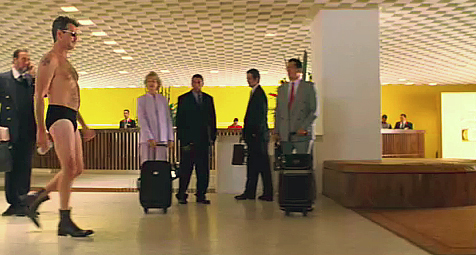
The man knows how to rock a Speedo.

Tuesday, August 4, 2015

Lost in existential woe and mediocrity

Emma Stone and Joaquin Phoenix star in "Irrational Man." Image courtesy Sony Pictures Classics
The nicest thing a person can say about “Irrational Man” is it's strangely comforting to know Woody Allen is still around, still pumping out films as his 80th birthday approaches. It's not that the film in question is bad, but it's depressingly bland and uninspired, plagued by the flaws that have hindered the director's work over the past decade while wasting the talent of its two terrific lead performers.
“Irrational Man” is one of Allen's least personal films – a pretentious comment to make, but one that describes how a man with his talent can go through the motions – about how the titular irrational fellow, Joaquin Phoenix's moody philosophy professor Abe, tries to get his groove back. He's lost to depression and existential woe when he starts teaching at a small, fictional college in Rhode Island (it's based in Newport, the kind of place where people used to “summer”). Despite a nonexistent sex drive and a notable potbelly, Phoenix's intellect and accidental charm is more than enough to lure in another faculty member (Parker Posey) and draw the interest of bright, wide-eyed philosophy student Jill (Emma Stone).
Still, the hopelessness of life consumes him, at least until he ovearhears a woman's complaints about a crooked judge at a diner, which serves as the inspiration for a rather wicked plan to solve the woman's problems for good. As the plot develops and the time to act draws near, Phoenix finds a level of zest for life he had never known before, albeit at the cost of his sense of humanity. Murder is never an easy thing, and the question becomes whether or not Phoenix can get away with his dastardly deed.  

Not quite this Dastardly, but close.
The film's plot has the potential to be either a serious drama or a light caper comedy, one in the vein of Allen's wildly enjoyable and silly “Love and Death.” “Irrational Man,” however, chooses both and achieves neither; the drama never goes deep enough, while the comedic portions are never quite as funny as he hopes. This isn't the first time he's tried to incorporate elements of both into his films – one of his best films, the gorgeous “Stardust Memories,” does so exceptionally well – but it falls flat this time around.
So what's the difference between the two? Why does it work so well in “Stardust Memories” but fail in “Irrational Man”? The former has an element of romanticism, a bit of dreaminess and a lot of Allen reflecting on his station in life, that ties everything else together. “Irrational Man,” like much of his recent output, is more of an exercise, a challenge to himself to show that, yes, he is able to write and direct his annual film, even if the returns become more and more slight over the years. It's as if he's trying to stay a step or two ahead of his demise in lieu of taking a year off to re-energize and find a story worth telling.
Allen still has the cachet to pull in some terrific actors and actresses, and he snags two of the better ones out there in Phoenix and Stone. The problem, though, is he isn't quite sure what to do with them, with the unbalanced tone affecting their respective performances; both acquit themselves well, as does the lovely Posey, but their characters lack the depth and interest needed for great performances. Even actors with their talent levels need something to build upon, and a pair of moderately interesting ciphers doesn't cut it. (It's important to mention the 14 year age gap between the two, which continues his trend of putting older actors with much, much younger actresses. I'm keeping it as an aside because people with a far better grasp of these things have written in depth about that creepy predilection.)
Then again, even a mediocre Allen film contains something to praise, including at least a few laughs on the comedic side, a solid bit of storytelling 101, and one really subtle sight gag that came ever so close to pushing the film firmly into parody. The man has a bit of fight left in him as a filmmaking, and it does come to the forefront on occasion in “Irrational Man.”
It’s why I keep waiting though for that lion in winter moment for Allen, the one burst of energy to end what has been a magnificent career with one grand gesture (and no, it’s not “Midnight in Paris”). “Irrational Man” shows he's capable of it; he just needs to find his place in the universe and build a film from there.

Unless he did it already.
Review: Two and a half out of Five Stars

Click here to see the trailer.

Rating: R
Run time: 96 minutes
Genre: Drama

Ask Away

Target audience: The people who are still excited for a Woody Allen release.

Take the whole family?: A rather undeserved “R” rating for content, but 17 year olds probably aren’t interested in such films.

Theater or Netflix?: Wait for Netflix or whatever streaming service you use.

Ever been to Newport?:  Several times during the summer as a child, which I bring up to mention how Allen missed a terrific opportunity for some aesthetic pleasures in his film from the coastline to the houses where, again, people used to “summer.” Allen is capable of terrific cinematography – “Manhattan,” for example, is divinely shot – and it's strange that he missed the opportunity to incorporate the place more into his film.

 I mean, come on, look at these places.
 Watch this instead?: The old stuff – almost everything pre-2000 – is gold. Of Allen's recent slate of films though, the ones worth checking out are the unnerving “Match Point” and the intriguingly goofy “Vicky Cristina Barcelona.” “Blue Jasmine” has its moments, but it serves more as an actor showcase for Cate Blanchett and, of all people, Andrew Dice Clay. “Midnight in Paris” is also kind of cute, if a bit overrated.

Friday, July 24, 2015

When Stanford students go wild

A scene from "The Stanford Prison Experiment." Image courtesy IFC
The chaos and mayhem depicted in “The Stanford Prison Experiment” begin with the sounds of a typewriter writing a request for volunteers for what became an infamous experiment at Stanford University. It's a modest way to begin a film with such heavy moral and psychological complexities, yet it reflects how one small act built on good intentions can result in utter catastrophe captured beautifully in this engaging, frightening film.
Anyone who has taken Psych 101 in college – or even an AP psychology class in high school – has at least a passing familiarity with the titular experiment, in which 24 Stanford students pretend to be prisoners and guards in a mock prison. The purpose of the two-week experiment, conducted by Dr. Philip Zimbardo (Billy Crudup), is to study how and why prisoners are abused in the American prison system. Half of the students – Ezra Miller, Thomas Mann and Tye Sheridan among them – are thrown into unflattering sheets and locked up in the basement of a Stanford building, while the other dozen dress up as guards and given shifts to manage the prisoners. The second group operates under specific guidelines; they can't hit the inmates and can only punish them with jumping jack, push-ups and verbal abuse, among other regulations. Involvement in the project extends to Crudup his other researchers, including his girlfriend played by Olivia Thirlby, who act as prison officials and even serve on a parole board. As Crudup’s Zimbardo says before the experiment goes haywire, “We're trying to do something. We're trying to do something good.” 

Such an ominous phrase, although this Google image makes it sound so cute.
Going back to the memories of Psych 101, the experiment only lasted six days because the guards and prisoners both got a little too into their respective roles. As “Stanford Prison Experiment” shows, the incarcerated students lose their grip on the reality of the situation and the watchers break the rules and dive headfirst into unadulterated sadism as Crudup watches the proceedings from afar.
It really doesn't take that long for the faux prison society to breakdown – a major rule is violated on the first day – and where “Stanford Prison Experiment” excels is depicting how easily things begin to fall apart. It's an intense situation depicted brilliantly by director Kyle Patrick Alvarez, who uses the claustrophobic environment of the mock prison as a means of forging unrelenting intensity every time the action shifts back to the holding area. The film revels in minimalism, using the main set in the Stanford basement to nurture fear and worry for the 12 imprisoned students, as well as the audience watching them lose their mind and place. Then again, the audience is much more like Crudup's Zimbardo in this situation, with the film working as a vessel of voyeurism to watch humanity resort back to its worst nature and practices. Any disgust for the horrible circumstances the student guards put their classmates through is hidden behind the experiment's inherent thrill; like watching a car wreck, a person can't quite look away and get a little enthralled by the carnage.

Just looking at images online is addicting.
The feeling is particularly true with the people involved in the experiment, a point Alvarez and writer Tim Talbott bring up to match up with one of the more prominent points of the prison experience. These are still Stanford University students, erudite kids who are often among the top of their class in their respective high schools and have a reputation (possibly unearned) for civility akin to the one found at an Ivy League campus. The theory is they're capable of much better behavior than the incarcerated and the guards – the education level is higher, and the hints of subtle racism tied to that thought exacerbate the image – but, as the filmmakers emphasize, human depravity isn't unique to the people classified within the lower end of the societal scale.
This analysis feels more like an academic paper than a proper review or critique because of the subject matter, but “Stanford Prison Experiment” wouldn't succeed without the uniformly terrific performances from the students, guards, researchers and especially Crudup, whose performance captures the axiom of what, exactly, paves the road to hell. Even with the superb directing and strong script, the intensity brought by those prisoners and guards is unparalleled and pretty much perfect.
The result of their efforts is a chilling film, a dramatic recreation with a few elements of horror and a discomfiting vibe. Like the participants in the experiment, audiences won't leave a screening of “The Stanford Prison Experiment” the same as they entered.

Review: Four and a half out of Five Stars

Click here to see the trailer.

Rating: R
Run time: 122 minutes
Genre: Drama
Ask Away

Target audience: Psychology majors.

Take the whole family?: The “R” rating is a little strong and very unnecessary; this is more than fine for high school students taking an AP psychology course.

Theater or Netflix?: Worth a theater viewing if you can find it, but you might be stuck streaming it from somewhere.

Any nits worth picking?:  One area I wish the filmmakers had hit on was whether or not the breakdown was caused in part by the violation of the rules of the game. Essentially, did the prisoners' mental collapse come from the imprisonment and actions of the guards, or was the fact that the rules were broken cause the problems. It's an interesting point, and, again, one I wish had been touched upon in more depth.

Watch this as well?: I recommended this one a bit ago, but “Bronson” is another film that analyzes the effects imprisonment has on people. I'll also add in “Brubaker” and “American History X” as other prison movies with similar vibes of hopelessness.

                               A little bit from "Brubaker," which is just terrific.

Hitting as hard as a phantom punch

Jake Gyllenhaal acts next to professional water salesman 50 Cent in "Southpaw." Image courtesy The Weinstein Company
To paraphrase legendary wordsmith Yogi Berra, watching “Southpaw” feels like déjà vu all over again. It's a Frankenstein's monster of a movie, taking the notable elements from classic boxing films and mashing them together into one ugly, misshapen, kind of racist and truly uninspiring film. It also wastes two rather good performances from Jake Gyllenhaal and Rachel McAdams while providing an inordinately sizable amount of screen time and dialogue to aqua mogul 50 Cent.
When I say “Southpaw” is a compilation of pretty much every boxing movie to come out in the last say 40 years, I mean it's essentially “Rocky,” “Raging Bull,” “The Fighter,” and “Mike Tyson’s Punch-Out” mixed in one easy to drink Capri Sun pouch. It’s not exactly the most imaginative mix either: Gyllenhaal is an orphaned, aging albeit undeafeated fighter who enjoys getting punched in the face as part of a strange ascetic ritual. His orphan wife, McAdams, keeps the family afloat until she dies in a shooting at a charity benefit. Gyllenhaal proceeds to fall apart, has his daughter (Oona Laurence) taken by the government, and must rebuild his career with help from trainer and Bagger Vance equivalent Forest Whitaker. Some training montages occur, another character is added so the filmmakers can kill him off, and Naomie Harris stops by to say hello.
“Southpaw” goes on like this for about two hours of painful stupidity, interrupted periodically with some uninspiring boxing scenes featuring poor Gyllenhaal screaming just before he gets punched in the face. Not sure if getting punched in the face repeatedly is the best tactic for winning a fight, but it does work as a parallel for his life before he learns how to fight with a modicum of self preservation and intelligence. And it is kind of funny to watch him scream in slow motion as a punch comes at his face as if he were Little Mac facing Mr. Dream. 

Also a better fight scene than anything offered in "Southpaw."
What it doesn't make for though is compelling cinema, especially given the lack of originality within the story. I complain frequently and vociferously about films that use the paint-by-numbers approach in their plotting; it's a problem of strong annoyance when movies take the standard storytelling tropes and do little to nothing to do something with those cliches. And yet here we are with “Southpaw,” which straight up lifts scenes from “Rocky” and even uses the contrasting training montage in “Rocky IV” – you'll know it if you opt to actually see the movie – to emphasize how Gyllenhaal's back-to-basics training is the purer way to prepare for the requisite big fight against the big, mean opponent.
That last point touches on “Southpaw's” biggest problem, and really an issue with many boxing films. The character the audience is supposed to root for – the scrappy underdog who has little chance of winning but does anyway – is almost always the white guy facing off against the faster, stronger black or Hispanic athlete (in this case Miguel Gomez's Miguel Escobar). The racist undertones are more like overtones, with the stereotypical traits of the minority character playing into his strengths as a boxer, which plays on the fears of a minority presence, the need for the white person to protect himself from invading forces outside of his or her control. In other words, it's like the filmmakers urge viewers to be afraid of the scary people of color.

He technically causes Mickey's death in "Rocky III."
What “Southpaw” does have working in its favor are the performances of Gyllenhaal and McAdams. The latter blends verve and tenderness into her fleeting minutes on screen while Gyllenhaal, who bulked up after losing all of the weight for role as Louis Bloom in “Nightcrawler,” lumbers and mumbles his way through the film as a borderline punch-drunk fighter fully cognizant of his aging body and diminishing skills. He doesn't have much to say, yet he remains surprisingly mesmerizing just through his shuffling and persistent disappointment.
Whatever heart “Southpaw” has is rooted in their performances. Unfortunately, all the right they do cannot overcome the miasma of clichéd crap that surrounds them for just a shade over two hours.

Review:  One and a half out of Five Stars

Click here to see the trailer. 

Rating: R
Run time: 123 minutes
Genre: Drama

Ask Away

Target audience: Boxing fans and people who like Jake Gyllenhaal, Antoine Fuqua and “Sons of Anarchy.”

Take the whole family?: Some minor cursing pops up on occasion, and the non-boxing violence is a little bothersome. It's not an Antoine Fuqua film if someone doesn't get a gun to the head.

Theater or Netflix?: Don't blow the money on a trip to the movie theater, unless you want to watch one of the many other offerings still in theaters.

How awful is 50 Cent?:  My goodness is he an atrocious actor. The man has absolutely zero charisma on screen, which makes for a rather sizable problem given his role as a charismatic fight promoter in the vein of Don King. Every line he utters drags the film further and further into the abysmal abyss – it doesn't help that the filmmakers tossed him a few lines of exposition in key moments for reasons that shall forever remain a mystery – and it makes viewers wonder if the film's quality would improve with a better actor in that role. To use a Twitter insult, the dude should stick to Vitamin Water.

Watch this instead?: The “Rocky” series and “Raging Bull” remain the gold standard for pugilism flicks. Another less heralded but still interesting option is the “Great White Hype,” starring Samuel L. Jackson as a Don King proxy.

Just look at this outfit.

Friday, July 17, 2015

Falling in love isn't so easy

Amy Schumer and Bill Hader in "Trainwreck." Image courtesy Universal Pictures.
All of the essential, on-screen elements of “Trainwreck” work swimmingly. It's a wicked funny film packed with terrific performances (including a couple from unexpected sources) and has one of the best central pairings in recent romantic comedy history. And yet, it's still a somewhat underwhelming viewing experience, an issue that lies not in the fault of its stars, but of the man behind the camera.
The title “Trainwreck” refers to the life of the main character, Amy (played by rising comedienne Amy Schumer, who wrote the film as well) – a heavy-drinking, pot-smoking writer for a trashy New York magazine, S'nuff, run by the intense Dianna (Tilda Swinton). As Schumer describes it, her life is pretty sweet: She has a rocking apartment; a hunky boyfriend (John Cena); at least one pretty good girlfriend at work (Vanessa Bayer); a friendly neighborhood derelict (Dave Attell); and a prolific sex life. The lifestyle isn’t embraced by Schumer’s family though, consisting of younger sister Kim (Brie Larson), Larson's husband and stepson (Mike Birbiglia and Evan Brinkman, respectively), and an ailing father (Colin Quinn).
Everything changes when she's assigned a profile piece on a milquetoast sports medicine specialist (Bill Hader), whose clientele includes the overly genial LeBron James (played by James himself). Schumer can't help but fall for the charming Hader, and they soon begin a journalistically unethical relationship that brings out the best from each of them. At least, it does for awhile, as life events conspire to make each question whether or not they're committed to each other for the long haul. Will they work through their overwhelming differences, or will their drastically differing lifestyles tear their relationship apart?
Audiences will have a pretty good idea what the answer to that question is – a point I'll hop back into in a bit – although the voyage “Trainwreck” takes to the final destination is a worthy one. The film is consistently hilarious, filled with an abundance of well-crafted one-liners and jokes that build up more and more as the actors and actresses keep talking (sort of like verbal avalanches). Amid the one-liners and some wicked offensive jokes – ones directed not at the group insulted, but at the person doing the insulting – are some rather offbeat, bizarre bits, including a movie about dog walking and a clever, subversive montage that's probably the funniest part of the entire film. Both fit right into Schumer’s brand of comedy: Anyone familiar with her Comedy Central program, “Inside Amy Schumer,” will recognize both the style of humor and the underlying intelligence residing within those jokes. Schumer loves to deconstruct tropes, cultural norms and societal mores, and the best parts of “Trainwreck” follow that blueprint. 

For example.
Schumer’s pretty great in her role too, but she gets some from costars Hader and Larson, both of whom are more than capable of keeping up with the star. Hader serves as a terrific sparring partner, capable of playing the straight man when needed and stepping out of that role and serve as a comedic delivery man (something he did on “Saturday Night Live” for years). Larson gets a few jabs in on occasion (and she really deserves a lead role of some sort), although she does her best work as the film's emotional center and as a frequent check to Schumer’s antics.
Much of the delight of “Trainwreck” doesn't come from the expected sources of humor like Schumer, Hader, Birbiglia, Quinn, Attell or even Larson; rather, it's the athletes who tie everything together. Cena, the WWE star and sentient oak log, reveals a surprising knack for comedic timing, while the usually leaden James commits himself to his role as Hader's buddy and protector. He displays a level of charisma one wouldn't expect he possessed.

He's always awesome on the court though.
So much of “Trainwreck” goes right it's an outright disappointment when it reverts back to the comedy tropes it skewers so well, succumbing to the genre's comforting predictability while going on longer than it ought to.That’s what happens in films involving director Judd Apatow, whose cynicism is a thin patina to mask his enormous heart (not unlike James L. Brooks). While it works in films like “Knocked Up” and “The 40-Year-Old-Virgin,” it doesn’t fit the vibe for a film like “Trainwreck,” a film built to bomb those clichés from above.
It’s good that a film like “Trainwreck” exists; the film is the rare romantic comedy that fits both criteria, and it’s a funny and charming and genuinely winning piece of filmmaking. But it’d be an exceptional film on par with “Annie Hall” if Schumer’s influence shined brighter than Apatow’s.

Review: Four out of Five Stars

Click here to see the trailer.

Rating: R
Run time: 125 minutes
Genre: Comedy

Ask Away

Target audience: An adult audience and women searching for a more off beat romantic comedy.

Take the whole family?: Let's just say “Trainwreck” earns its “R” rating.

Theater or Netflix?: Solid enough for the centerpiece to a date night.

Will Amy Schumer be the next big movie comedienne?:  Her show, “Inside Amy Schumer,” has some of the smartest and funniest comedy sketches around, and she shows enough versatility in “Trainwreck” to kick off a big screen career. She doesn't quite have the physical chops of Melissa McCarthy (a $100 million box office guarantee) or Kristen Wiig, but Schumer has the rare ability to remain likable even in her obnoxious moments.

Not an example of her being obnoxious; I just wanted to get this clip in here.
Watch this as well?: “Trainwreck” references a few older romantic comedies worth seeking out, including Woody Allen's “Manhattan.” I'll also recommend Albert Brooks' great “Modern Romance” and the sweet, raunchy and rather funny “For a Good Time, Call...”