Friday, October 24, 2014

The bumps in the night are stale and poor in 'Ouija'

Douglas Smith, Ana Coto, Olivia Cooke, Daren Kagasoff and Bianca Santos are pictured in a scene from "Ouija." © 2014 Universal Studios. All Rights Reserved.

I never used a Ouija board as a kid, but I gather the thrill of the experience corresponds with the fun gleaned from reciting “Bloody Mary” in front of a mirror three times. It's the fear struck from anticipation from what could happen, from the simple potential that there is something beyond the ethereal plane a person can summon with little thought put behind it.
“Ouija” — the movie based off the board game by Hasbro — kind of, sort of, tries to follow the concept of fear through anticipation, but it lacks two key ingredients to turn the concept into reality: any idea of how to create and sustain tension and anything worth being afraid of in the first place. “Ouija” is a horror film without the horror, which is a moderately nice way of calling it an idiotic muck of accidental comedy.
“Ouija” features a collection of 20-something actors with minor resumes (default lead Olivia Cooke stars in the much more interesting “The Signal” that came out this summer) paid to look and act like high school students before dying a terrible, terrible death. Spirits are involved somehow, and the eponymous preteen slumber party staple is used as a means of communicating with those dead spirits. Respected mediums Haley Joel Osment, Jennifer Love Hewitt and Patricia Arquette apparently were unavailable to moderate peacefully the discussions between the dead and the dull living. Also, many a shenanigan involving ghosts, games, geriatrics and gas lighters ensue to pad out the runtime.
“Ouija” is a terrible film on so, so many levels for so, so many reasons. Horror, though, is one of the more flexible genres, so usual deal breakers like bad acting, dialogue and even special effects – all on display here – can be glossed over with a solid atmosphere and a couple of decent jump scares to provide at least one frightening viewing.  
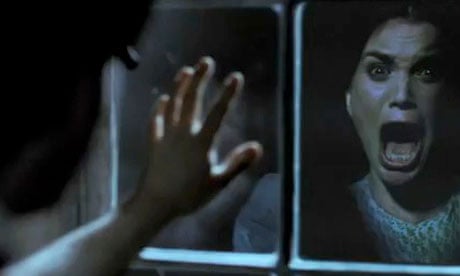
Even "The Woman in Black" had one decent scare in it.
That could have been the case had the filmmakers — writer/director Stiles White and co-writer Juliet Snowden — been able to, you know, throw in a few horrors every then and now to give contrast to the hilarious awful. What the filmmaker don’t possess (aside from way to break through the horror death knell that is the “PG-13” rating) is a talent for cultivating good horror. It seeps out during every moment of murderous climax, which they sell short by explaining the impending moments of doom and fear to the audience first. Take a scene in which a shadow just appears behind a character; instead of having the shadow jump at the poor schmuck that occurs anyway, White lingers on the image for several beats too long and allows another character to point out that it's right behind him before the attack begins. 
Also, perhaps setting a large amount of action to happen in the daytime in lieu of the evening or night would do a better job of establishing mood, as would a more discomfiting opening death and a plot that doesn't hinge entirely on people behaving like idiots. Those moments coincide with the multitude of plot holes that rise and flow like the waves on a beach of stupidity. 
In the deepest, deepest nether regions of “Ouija's” existence is a kernel of an idea of a notion for a theoretically pretty OK short horror film, one of those seven-minute, low-budget Youtube specialties that result in a nod of appreciation for the filmmakers behind it. That's still nowhere near enough to justify a feature-length film, especially one that fails on so many levels to evoke fright as this calamitous contraption of crap as “Ouija” does.
At least “Ouija” fails spectacularly, albeit not in a manner indicative of unreached grandiose aspirations and dreams. Rather, “Ouija's” failure is rooted in incompetence from just about everyone involved and it results in a pretty comical viewing experience with the right audience, like say a theater full of screaming high school girls. 
“Ouija” won't make you reconsider your thoughts on the afterlife or motivate you to keep a light on at bedtime, but it can offer a good time under the right conditions, at least as long as one doesn't pay $10 a head to see it.


Or you could stay home and watch the pros do it.

Review: One and a half out of Five Stars

Click here to see the trailer.


Rating: PG-13
Run time: 89 minutes
Genre: Horror


Ask Away

Target audience: Horror fans searching desperately for something to watch this Halloween season that doesn’t involve Dracula.

Take the whole family?: The PG-13 rating fits pretty well, as kids a bit younger than that might feel a bit perturbed by the loud noises.

Theater or Netflix?: Netflix so you can watch it with a group of friends, some mediocre liquor and an onslaught of jokes at its expense.

Do you believe in the power of the Ouija board? In a word, no. One of the film's funniest subplots though is the repeated undercutting of any critiques against it. The characters state repeatedly in the first half that they don’t believe the thing works. It doesn't take them too long to go all in on the device's power. Even the Youtube video of the man explaining away the Ouija effect is done poorly and, possibly, in a way that’s intentionally funny.

Watch this instead?: “The Shining” and Nightmare on Elm Street” circa 1984 are wicked effective supernatural thrillers, and either the Japanese or American versions of “The Ring” are much scarier than “Ouija.” For a truly memorable experience, though, seek out 1977's “House,” an impossible film to define or forget.

Just try and forget this image.

Friday, October 10, 2014

Taking pride in one's self

Faye Marsay as Steph, George Mackay as Joe, Joseph Gilgun as Mike, Paddy Considine as Dai and Ben Schnetzer as Mark in the film "Pride." [Nicola Dove/CBS Films]
It’s sometimes difficult to remove political or philosophical underpinnings from an artistic review. The goal is to judge a film or book or album or TV show on either artistic or intellectual criteria, but all evaluations are biased by their nature, and keeping the non-critical viewpoints from seeping into the process is a tremendous difficulty.
It’s why I spent an extra half hour driving home from the theater after watching “Pride” to consider whether I liked the film for the merits of its filmmaking or because I agree with its premise and viewpoint wholeheartedly. What came about from a sojourn through Scottsdale and Phoenix was an acknowledgement of the film’s demerits, most notably an unwillingness to venture outside the comfort’s of is genre, but a full understanding that yes, “Pride” is a wonderful film regardless of my view of its stance.
“Pride” takes viewers back to London in the summer of ’84, where 20-something Mark (Ben Schnetzer) is gathering a few of his friends (Joseph Gilgun and Faye Marsay included) to march in the city’s annual gay rights parade, where they encounter the youthfully awkward Joe (George MacKay). The march’s success inspires Schnetzer to expand his activism to incorporate a cause not directly related to gay rights; the ongoing National Union of Mineworkers’ strike.
He forms a group with his friends, dubbed Lesbians and Gays Support the Miners, to try and raise money to help the strikers during hard times. Although the union affiliates reject their aid, the LGSM members get in touch with representatives from the town of Onllywn in Wales, which is hit hard by the labor strife. The arrangement is awkward at first, with the residents of the mining town (consisting of a crew of British character actors like Bill Nighy, Imelda Staunton and Paddy Considine) initially hesitant to accept support from the gay activists; the activists themselves are concerned about a less than stellar reception from the town’s citizens. That all changes once the two sides get to know each other thanks largely to the impeccable dance moves of LGSM member Jonathan (Dominic West), and they begin to work together for a common goal of ending the miner strike. While not everything is peachy keen, the miners and gay activists use the opportunity to learn more about the people on the other side of the societal divide and how minimal the differences truly are among them all.
“Pride” is one of those films that can trumpet some variation of the “based on true events” tagline justifiably; the strike occurred in the United Kingdom for more than a year, and 11 different LGSM groups from the U.K. did support several mining communities during the strike. The downside to that “based on true events” statement is the film invariably follows a simple and rather dull storyline. There’s the everyone meeting up scene, the awkward moment when the two groups meet for the first time, and the necessary down beats that becomes uplifting in the end. It’s a formula that has proven successful frequently, but the filmmakers’ strict adherence to the conventions makes the film a little flatter than it ought to be and causes a bit of drag on the back nine.
While it does get a bit frustrating to watch films bend themselves to fit certain criteria, director Matthew Warchus and screenwriter Stephen Beresford at least hit the notes right and at an emotionally satisfying level, especially for a film soaked in social justice. “Pride” is designed to slap people about with the message that people are, well, just people, that humanity does have at least a modicum of universality to it. I use the word “slap” as more of a descriptor for some of the heavy handed symbolic gestures (a bridge pops up on screen quite frequently) than for the forcefulness of its delivery system. Unlike its thematic sibling “Milk,” “Pride” is more focused on having fun than offering important lessons about diversity and equality. The film is coated in that sensible British humor, meaning jokes that are droll, dry and delivered in a very wry fashion by an excellent cast (Nighy, Staunton, West and Jessica Gunning are highlights) who bring lightness to a ponderous topic.
 
Which is Bill Nighy's raison d'etre.
 Having the softer touch also strips away any sense of self importance or inflation from “Pride’s” attitude. The filmmakers could have made the British version of “Milk” and created a rather good film that is weighed down my its didactic tone and undercurrent of martyrdom for its central character. Instead, they decided to avoid a lecture and just let the kids play and educate through fun and games, which kind of makes it “Adventure Time” for gay-rights activism.
 
And I have a feeling Finn and Jake would be OK with that.


Review: Four out of Five Stars

Click here to see the trailer.


Rating: R
Run time: 120 minutes (Two hours)
Genre: Historical drama


Ask Away

Target audience: Older audiences who might remember the strike or people interested in a chapter in gay rights history.

Take the whole family?:  I’m really not sure how this film justified an “R” rating, so bring early teens along if they’re mature enough to handle the shenanigans of a few smutty old women. The MPAA is just the worst..

Theater or Netflix?: Good for a theater trip if you’re willing to venture out to an indie cinema.

How can you tell this is 1984? The fashion and the music mostly. I’m using the question as a means of expressing adoration for the styles of the era and offer music supervisor Nick Angel props for a killer soundtrack. It’s hard to go wrong with a soundtrack that combines The Smiths, Culture Club and Bronski Beat.

Even Kim Wilde gets her name dropped.
Watch this as well?: “How to Survive a Plague” is a necessity for anyone interested in learning more about the AIDS epidemic from the ’80s, and “The Times of Harvey Milk” is a terrific documentary about the titular gay rights figure. “Milk” is a fine film, but the unvarnished version is much more interesting.


Friday, September 19, 2014

The world is a dark and tiring place

  Liam Neeson as Matt Scudder in a scene from "A Walk Among the Tombstones."  © 2014 Universal Studios. ALL RIGHTS RESERVED.

Painted along the edges of “A Walk Among the Tombstones” is the urgent reminder the end of the world is nigh. That was life in 1999 in the months leading toward the current millennium – a period loaded with paranoia about how humanity will end because of the Y2K virus once Dec. 31, 1999 became Jan. 1, 2000. 

Seriously, Time?
Amid the panic and newspapers headlines heralding the dawning of dread and destruction portrayed in the film is a moment when one character reads one of the hyperbolic headlines and mutters, “People are afraid of all the wrong things.” What makes that line so intentionally effective is how it reveals “A Walk Among the Tombstones’” true intentions. It's not the big catastrophes that are worthy of fear; rather, it's the people flittering about your periphery who should invoke your terror, as you can never know what they can do to you. Or, more importantly, what they can force you to do.
It's worth emphasizing “A Walk Among the Tombstones” is not a Liam Neeson revenge flick, despite an opening sequence that has the human embodiment of lurching despair paired with two shots, a gun, and three armed robbers to shoot. All that action occurs in a flashback eight years prior to the events of 1999, when Neeson's Matt Scudder, now a private detective and recovering alcoholic, is asked by a drug dealer (Dan Stevens) to investigate the kidnapping and murder of his wife.
Neeson discovers the brutal death was the most recent in a spree in which the killers hold the wife of a drug dealer hostage, collect a ransom and then kill her anyway. It's a dark world Neeson has stumbled into, and all he has to help him are his wits, a homeless teenage assistant who references fictional private eyes (Brian Bailey), and a pressing desire to do the right thing. The lattermost attribute pushes Neeson toward a confrontation with the two killers (David Harbour and Adam David Thompson), an encounter he may not come back from alive.
It still may sound like a film befitting Neeson's recent ouevre like “Non-Stop,” but the brooding Irishman is not hyper-violent mode like he is in those (effectively) trashy Luc Besson films. The opening blood splatter in “A Walk Among the Tombstones” instead motivates Neeson to drop the gun and replace it with cunning and conversation – in one scene he defuses a potentially violent confrontation with a threat backed by a haunting glower and his patented gruff. That's all a good shamus like Neeson needs to solve a case no matter how convoluted it is and no matter how many punches he receives for his efforts. 
Good luck laying a good hand on this though.
 That's the primary enjoyment from “A Walk Among the Tombstones,” as watching the weathered Neeson (does any A-lister look as rundown as he does?) attempt to unravel a peculiar and horrifying case is captivating and engaging. His Scudder is not on the same par as other fictional detectives like Sam Spade and Philip Marlowe (they get name dropped by Bailey alongside Daunte Culpepper of all people), but he's a good facsimile and more befitting a world of brutality than the sloppily suave characters played by Humphrey Bogart.
New York City circa 1999 is shown as a rather hopeless place, one in which the presence of the authority is limited to DEA agents of moderate usefulness along with a few whispers of police corruption and competence. Sunlight is blighted by thunderous roars from handguns firing off in the middle of a busy street and men committing acts of wanton cruelty, and the night is flooded by heavy rains and the perpetual threat of murder and death. The only respite comes during overcast days, with the swarming grey blurring happiness and mayhem into a gentle mix of hopeless security.
Yet the danger never really goes away; the illusion of comfort becomes infected by the evil lurking amid the quotidian sights one views while walking a dog or picking up groceries from a shop. In the world of “A Walk Among the Tombstones,” characters should be far more afraid of the TV repairman or the neighborhood plumber than a drug dealer. A drug dealer is, at least, honest in his intentions, while the first hides among the throngs like a wolf in sheep's clothing just waiting for a chance to attack. 


Rating: Four out of Five Stars

Click here to see the trailer.


Rating: R
Run time: 113 minutes
Genre: Mystery

Ask Away

Target audience: Recent Liam Neeson fans expecting another EuropaCorp flick like“Taken,” as well as film noir fans.

Take the whole family?: It's nowhere near as violent as “Expendables 3,” which earned a PG-13 rating, but the content is much darker in tone and more discomfiting. Viewers 15 and up should be OK.

Theater or Netflix?: Not quite worth a full-priced fare, but a nice matinee would work fine.

What about the atmosphere? “A Walk Among the Tombstones” wouldn't work as well as it does without some solid direction and cinematography from Scott Frank and Mihai Malaimare Jr., respectively. The combination of their efforts creates a vibe that bounces between claustrophobic and grandiose isolation that is thoroughly uncomfortable.

Watch this as well?: It’s worth dipping into a couple of the characters referenced in the film in classics like “The Big Sleep” and “The Maltese Falcon” for a primer on the genre. Also watch new spins on the film noir genre like “Brick” or the superb “Out of Sight” to see where modern directors have taken it.
Reason 12 for why the '90s didn't completely suck.

Friday, August 15, 2014

Already far too old for this shit

Randy Couture, Jason Statham and Sylvester Stallone in a scene from "Expendables 3." (Photo by Phil Bray)
It took all of two seconds for me to lose any enthusiasm for the “Expendables 3,” and an additional three seconds to realize how stupid the additional two-plus more hours of screen time would be. It came from on-screen text to inform the audience the train they’re seeing on screen is an “armored prison transport,” which is made quite clear once star Sylvester Stallone and his compatriots start shooting the heck out of that thing. What that reveals is a supercilious attitude of the audience's ability to decipher the action on screen – a habit the filmmakers fall back on repeatedly – and an overarching inability to do something interesting with staid material.
I'm admittedly a novice into what is now the “Expendables” series – I elided right over films one and two – but the gist of the storyline is simple enough. There's a ragtag crew headed by a melting Stallone that includes Jason Statham, Randy Couture, Dolph Lundgren, Terry Crews and new member Wesley Snipes, who are paid to capture a bad guy played by the nefarious Mel Gibson.
The crew inevitably fails because they’re too old, apparently, which leads Stallone to assemble a new team (with Kelsey Grammer's assistance) with younger blood in the form of Ronda Rousey, Kellan Lutz, Victor Ortiz and Glen Powell. I’m still not sure why this is necessary, as Stallone is the one tipping the age scale further to the AARP side of the spectrum, but whatever.
The infusion of youth backfires, of course, and Stallone has to rescue his new younger teammates and maybe get the band back together and make everyone work as a team and a family or something. Oh, and Harrison Ford, Jet Li, Arnold Schwarzenegger and Antonio Banderas stop by to shoot people.
Antonio Banderas pictured at his physical prime
 Three graphs of roundup and I'm already bored with “Expendable 3's” plot machinations, which lumber along at a less than thrilling clip. The film is just overstuffed with abundance and scenes whose only significance is to add screen time for the stars (Gibson has a couple of these instances) or to showcase the stars’ special talents (in this case fight scenes with Statham and MMA star Rousey). “Expendables 3” is an excellent example of the law of diminishing returns: Adding more elements, in this case action stars, to a production of any sort can lead to a reduction in satisfaction after a certain threshold is passed.
Perhaps cutting off a star or two – maybe Couture and Powell – could have boosted the CGI budget to push the special effects slightly above straight-to-VOD caliber. For a film that's major selling point is action scenes, the effects behind those scenes – in particular any helicopters, cars or airplanes – are surprisingly choppy and are more befitting a Star Fox game than a big-budget motion picture.
At the heart of the problem though is, again, an overwhelming lack of interest in making an interesting action film. Director Patrick Hughes – the third director in the series – lacks the chops to stage an impressive action sequence (seriously, how do you make a train escape dull?) nor does he seem all that capable of filming a coherent fight scene. (The latter is a little frightening for fans of “The Raid: Redemption,” as Hughes was announced as the director for the American remake.)
“Expendables 3” is really bogged down by the expectations of nostalgia and mandatory callbacks to the stars’ previous films. That means Schwarzenegger has to bellow out a token “get to the chopper” line while Snipes tosses out a tax evasion joke to make fun of his real-life financial problems. I'm not sure if I should give the filmmakers credit or grievance for avoiding an “always bet on black” reference for Snipes; a small part of the film does take place in an abandoned casino.

 
I'm leaning toward missed opportunity.
That isn't to say the nostalgia method is entirely ineffective; that Snipes line is pretty good, and there are a few other references that land well enough. And despite the glut of actors, there are a couple who get a chance to shine, especially Statham, Banderas, the ice-cold Gibson and even Rousey.
“Expendables 3's” best moment however belongs to Stallone and Grammer, when the two are shooting it while gallivanting about to find new recruits. It hints on the type of film this could have been: a group of aging fighters fighting, chatting and busting on one another with a mix of joy and existential clarity as they prepare for the last big battle. It'd be a very different film, but one with much more to offer than a haggard and sloppy second sequel.


Review: Two out of Five Stars

Click here to see the trailer.

Rating: PG-13
Run time: 126 minutes
Genre: Action


Ask Away

Target audience: The token fans of the first two films and people with soft spots for aging action stars going for that one last paycheck.

Take the whole family?: I'm perplexed as to what contortions this film underwent to receive a PG-13 rating. It's violent as all heck, making the “R” rating more apropos.

Theater or Netflix?: Netflix for this one.

So who gets to be the villain in “Expendables 4”? With Mel Gibson, Jean-Claude Van Damme and Mickey Rourke already dispatched, the filmmakers could continue with the former A- or B-list stars and tab Kevin Bacon, Burt Reynolds, Christopher Walken or, shudder, Steven Seagal. A more interesting route though would be to go deep into the '80s action well and pull up Michael Dudikoff or Kurt Thomas.


Mr. Gymkata in action

Watch this instead?: “The Wild Bunch” employs the aging mercenary theme more effectively and in a far more poetic style. You can also take your pick of the film catalogs of the “Expendables” stars, for example Jason Statham's “Transporter” or Mel Gibson's “The Road Warrior.”

Friday, August 1, 2014

Not much to do in space but fly and fight

A buffed up Chris Pratt stars as Peter Quill/Star-Lord in "Guardians of the Galaxy." ©Marvel 2014
I keep regressing back to 10-year-old Eric mode when thinking about “Guardians of the Galaxy.” That little me, who comes packaged with a Lloyd Christmas haircut and habit of wearing utterly unflattering sweatpants, gets overeager and wicked tongue tied trying to express enthusiasm. The best part of a film or TV show or book was X, and Y, and sometimes Zed and Alpha too.
I'm trying very, very hard to avoid doing so while describing “Guardians,” because, well, I could dip into the rambling excitable boy I used to be. So to sum it up as succinctly as I possibly can, “Guardians of the Galaxy” is the embodiment joyful awesomeness. 
This is the first thing that pops up when searching for 'joyful awesomeness." 
“Guardians of the Galaxy” has the delightful Chris Pratt playing goofy and ripped ladies' man Peter Quill (aka Star-Lord), who explores the galaxy as a glorified dumpster diver. After he finds a strange orb on a scavenging mission – an act that peeves father-figure Yondu Udonta (Michael Rooker) – Pratt attempts to cash in on his find but is intercepted by fearsome assassin Gamora (Zoe Saldana). Saldana's robbery attempt is sabotaged by a pair of bounty hunters, Rocket (a talking raccoon voiced by Bradley Cooper) and Groot (a giant tree voiced by Vin Diesel), who are after a price placed on Pratt's head.
An ensuing arrest by the militaristic Nova Corps results in the four taking a trip to space prison, where they encounter the revenge-crazed Drax the Destroyer (WWE wrestler Dave Bautista). Bautista's lust for vengeance is targeted at the insanely evil – or evilly insane – Ronan (an unrecognizable but wonderful Lee Pace), who, aided by Saldana's sister Nebula (Karen Gillan) happens to want the orb in order to destroy the planet Nova – home to characters played by Glenn Close, John C. Reilly, Peter Serafinowicz and others. Once the orb inevitably falls into Ronan's hands, it's up to the ragtag Guardians to stop him and save Nova from certain destruction.
There's way more to “Guardians'” plot than that – it has the same epic mythology as other Marvel film series like the “Iron Man,” “Thor” and “Captain America” – and unpacking too much of it does take out a hint of the surprise from a movie based on a lesser-known Marvel series. Mentioning the existence of a more complex plot, however, serves as a roundabout way of complimenting director and co-writer James Gunn's management of the complicated storyline; in other words, his presentation is much smoother than the above description indicates.
Much of my excitement about the “Guardians” film over the last few months was associated directly with Gunn's involvement in the project, which was unexpected to put it mildly. It’s risky enough green lighting a film about the obscure Guardians, but handing it over to a man whose best known to general audiences for writing two “Scooby-Doo” movies and the “Dawn of the Dead” remake with a $170 million price tag is insane. 
Gunn, however, has a knack for creating losers who have heroic intent but just need the right opportunity to do so, like Nathan Fillion's bumbling sheriff Bill Pardy in “Slither” and the Guardians, who at least sense the divide between right and wrong and know which side they should fall upon.
It’s one reason why hiring Gunn is a brilliant decision; he hits all of the proverbial notes correctly and creates a film with the right blend of action, comedy, pathos and dreariness. The combination is vital for a film like “Guardians,” which could easily be brushed off by saying it doesn't take itself too seriously or is meant to be the lighter Marvel film.
But that's not the case, because what's at stake in the film's universe are the lives of 11 billion people on just one planet, and Gunn doesn't joke around when it comes to the lives of so many people. (He even pulls a Whedon and kills off a likable secondary character in a rather cruel fashion). The moments of necessary gravity are played straight, which makes the inevitable triumphant ending all the more satisfying for the characters and especially the audience.
That isn't meant to underplay the comedy though, much of which comes courtesy of Cooper's Rocket and from Pratt's wacky antics (although everyone gets at least one very good line). Pratt's presence was the other major reason for my Guardians' gaga – watch a few episodes of “Parks & Recreation” to see why – and watching him transition seamlessly from serious man to goofball during the title credits justified my anticipation.
“Guardians'” sole bugaboo is a lack of time watching the five guardians bounce off one another because of the need to complete the origin story. It's the only reason why I have to dock the film a few points in the grading system, but it does make prospects of the sequel even stronger than before. “Guardians of the Galaxy” is awesome; “Guardians of the Galaxy 2: Electric Boogaloo” should be even better.

Just like the gold standard for sequels.
Review: Four and a half out of Five Stars


Click here to see the trailer.

Rating: PG-13
Run time: 121 minutes (Two hours and one minute)
Genre: Action/Sci-Fi

Ask Away

Target audience: The devoted Marvel fan base is a given; otherwise, “Guardians of the Galaxy” is great for audiences who like an amalgamation of action, Sci-Fi and comedy.

Take the whole family?: The large amounts of violence and general darkness earns it an inappropriate label for kids younger than 10.

Theater or Netflix?: Lovely special effects earn “Guardians” a rather rare theater recommendation regardless of time of day.

What is your favorite part of “Guardian”?: Bradley Cooper's Rocket is a constant stream of crepuscular hilarity, but what I loved most about the film was the beauty of Groot. He's a sweet, nurturing character in a world of evil and cynicism, and Vin Diesel's simple vocal performance – all the character says is “I am Groot” – is impressively nuanced in a similar manner as his work in the divine “The Iron Giant.” 

 
Reason five for why the '90s didn't completely suck.

Watch this as well?: The other Marvel films (at least everything post “Iron Man” are good choices, as is Gunn's comedy/horror full-length feature debut “Slither.” Another good place to mosey off to is the “Firefly” and “Serenity” universe. “Take my love, take my land, take me where I cannot stand …”

Friday, July 25, 2014

Finding god through brilliance and guns

Scarlett Johansson in a scene from writer/director Luc Besson's "Lucy." © 2014 Universal Studios. All Rights Reserved.
I'm a sucker for a film that shoots for infinity but barely scrapes into the atmosphere. I appreciate the effort and the willingness to do something a little different in order to bring a modicum of ingenuity and interest into a medium that thrives and lives on repetitiveness and creature comfort.
Those are in part the reasons I can't stop thinking about “Lucy” – a cripplingly flawed film buoyed by the joy of its extraordinary ambitions and a cold, steady and all-in-all terrific performance by star Scarlett Johansson.
Before he aims for whatever ambition is truly on his Kanye West-like mind, writer/director Luc Besson begins with the boyfriend of Johansson's titular Lucy forcing her to transport a briefcase filled with a mysterious new drug to the frightening Jang (Min-sik Choi). Because film logic is insane, the tense confrontation concludes with Choi surgically implanting the bags into Johansson and three other unwilling drug mules to transport to various ports in Europe.
The insanity builds up when Johansson is beaten brutally while awaiting transportation to her destination, which causes the bag in her stomach to rip open and unleash the drug into her system. The result is a rapid increase in her brain power and the ensuing incorporation of hyper intelligence, psychic abilities and other superhuman abilities. She uses her newfound skills to seek revenge against Choi and spread her knowledge of the universe to Morgan Freeman, playing Professor Morgan Freeman (the character's real name is immaterial; all that matters is he's Morgan Freeman). She also meets a handsome cop (Amr Waked) during her abbreviated jet-setting adventure.

Just try to say no to those eyes. Sigh.
I alluded to “Lucy” as a flawed film, and its blemishes are large and obvious enough to merit noting. The science behind the film's premise is idiotic (although it sounds pretty convincing coming from Freeman's mouth), and the special effects are haggard, sloppy and definitely picked more for their fiscal friendliness than quality. Besson once again displays his tin ear for English dialogue – a trait shared by other Besson films like “The Professional” and “The Fifth Element” – as well as a major lack of subtlety; the first third of “Lucy” plays like an extended stock footage show, one capable of making Ed Wood drool in jealousy.
And about as symbolically subtle as this.
And yet, and yet, and yet. I have to use this refrain for “Lucy” multiple times to emphasize how much I admire Besson for his wonderment and his insouciance for taking an audience wherever he wants to go. It's a risky gambit, as putting Besson's name on a project as a writer, director, producer or any combination of the three creates certain expectations of explosive gun fights (or gun fights that end in explosions), stoic leads who speak only when necessary and economical run times – essentially the prototypical action film.
Elements of the first two exist, and the film certainly nails that last factor – “Lucy,” sadly, exists for just 90 minutes of whacked-out bliss – but the first two expectations are more perfunctory and less “Lucy’s” raison d’ĂȘtre. Lord knows neither I nor anyone else should try to delve into the mind of Luc Besson, but the film reads as an exploration of humanity in godhood, and how important it is for the two remain intertwined.
A constant fear Johansson fights through as she gains intelligence and power is the loss of her connection with the human race, which becomes more and more tenuous as the inherent intellectual loneliness of her new existence comes into effect. Given “Lucy's” premise, many filmmakers would opt to turn Lucy into a monster, an unstoppable force hell bent on ridding the world of its sins and ruins like the eponymous Lawnmower Man.
Reason 8,791 why the '90s sucked.
But Besson doesn't take the easy route; instead, Johansson’s Lucy remains aware of her growing divide from mankind and does what she can to keep a modicum of attachment to her fellow humans. A rather passive Waked, for example, tags along to serve as a quasi romantic interest. (It’s rather nice to see a male actor serve that purpose for once.) Lucy’s mission too, morphs from bloody vengeance to intellectual preservation, and she sheds her bloodlust as the movie dives deeper into craziness.
It's a display of tremendous optimism, albeit one that isn't overly surprising when considering Besson's career – even amid the bullet sleets and cool indifference, Besson has always worn his heart on his sleeve and shown his belief that mankind is worth saving in spite of itself. 

Review: Four and a half out of Five Stars

(Click here to see the trailer)

Rating: R
Run time: 90 minutes
Genre: Action/Sci-Fi


Ask Away

Target audience: Action and Sci-Fi fans who remember “The Fifth Element” with fondness.

Take the whole family?: Certainly not friendly for the entire family, but the “R” is on the softer side, especially as the movie progresses. Parents with mature 13 year olds can rest assured this film won't bother them too much.

Theater or Netflix?: Despite my praise, Netflix is the better option given the less than impressive special effects.

Has Scarlett Johansson receive the respect she deserves as an actress?: She is now, after highly acclaimed roles in “Her,” “Under the Skin” and the new “Captain America” film. The problem is she's always deserved more credit than she has garnered – she's good to very good in “Ghost World,” “Match Point” and “Vicky Christina Barcelona” and does what she can with her underwritten role in “Scoop.”

Watch this as well?: Luc Besson's “The Fifth Element” is an obvious companion piece, but a second film that fits right alongside “Lucy” is “Adaptation” – Spike Jonze’s and Charlie Kaufman's remarkably brilliant look at writer's block and existence.