Wednesday, June 17, 2015

A little quality time with the stars of "Me and Earl and the Dying Girl"

Olivia Cooke, Thomas Mann, and RJ Cyler star in "Me and Earl and the Dying Girl." Photo by Anne Marie Fox. © 2015 Twentieth Century Fox Film Corporation.
“Me and Earl and the Dying Girl” is an unconventional coming-of-age story about a high school student, Greg, his friend Earl, and a girl with cancer named Rachel. It features a young cast, a first-time screenwriter, and a director whose work has mostly appeared on TV. Yet the film has already drawn high praise in limited release: it won the Grand Jury Prize at this year's Sundance Film Festival and already sports positive feedback from Rotten Tomatoes and Metacritic. It's primed to become an indie summer sleeper hit in the same vein as “Napoleon Dynamite” and “Little Miss Sunshine.”

Film stars Olivia Cooke (Rachel), RJ Cyler (Earl) and Thomas Mann (Greg) sat down for a round table interview in advance of the film's national release on Friday. Below is an excerpt from the interview with the three stars; a second interview with director Alfonso Gomez-Rejon and screenwriter Jesse Andrews will be posted tomorrow. Full audio from this interview is available here.

Q: What do you guys think of the film's success so far?

Olivia Cooke: It's crazy. We all knew going into it that it was the best script we ever read.

Thomas Mann: You can't prepare for the success, but just the opportunity to make the movie, I was so excited, it was a huge opportunity and a huge responsibility. We just wanted to get it right … I didn't think of it as a teen movie. It was fun, it's been overwhelming and it's been a very emotional ride. It's so close to us for such a long time and people are having their own personal experience watching it. It's just really amazing.

Q: How would you compare the experience between this and shooting your other movies?

Cooke: Wildly different. They all differ from each one. It all depends on the people, the crew, the material you have. My part in “The Signal” was relatively small and not as fleshed out as Rachel in “Me and Earl and the Dying Girl.” So for me it was just a feast to get my hands on and to challenge myself and to try to do justice to the character and to just be a part of this amazing film.

Q: (To RJ Cyler) what was it like for you, being your first film?

Cyler: It was a lot of fun. For the first 30 minutes of this experience I was a little nervous, and then I met Thomas and then Olivia and it was just like “OK, I have no reason to be nervous because they're fun and they're genuinely good people.” We built a friendship before we got into filming so it made it extra comfortable to be on set and to be who I needed to be to make this character work. It was the perfect experience for me, as a first acting job type situation. So now it's like the bar's set so high, it's kind of depressing.

Q: There's only one way to go from here.

Cyler: Goddamit

Q: (To Mann) Teenage boys are the worst, but you find a way to keep that border where you're not being too annoying. How did you find that balance?

Mann: I know what you mean. I find self-deprecating humor … there's a fine line where it becomes so obnoxious. No one can feel sorry for you if you're too busy feeling sorry for yourself. I liked the fact that he was someone who was smart enough that he knew the person he should be and he had all the answers but he was too lazy or stubborn to make use of them and too afraid to leave his comfort zone. I don't know; I like the way he dealt with situations. I saw it as someone who knew what he should be saying but just sort of said what he was thinking. You can't judge someone for being honest, and I feel if I was just honest with the character people would relate to that. The person I was in high school I don't think I would have known what to do in a situation like this, so it was all about embracing the awkwardness and the selfishness of teenagers and kind of just having fun with the way he navigates this emotional time in his life and sort of discovering his emotions.
Yeah, his sense of humor was great, but it was so well written you didn't need to punch the jokes. It was almost like the less I did … (director Alfonso Gomez-Rejon) was always about doing less with the jokes and they usually ended up being funnier. Obviously there are times when it's sort of over the top, like when he's crawling across the floor. I thought there were moments you could go kind of big, but for the most part it had to come from a really honest and sincere place.

Q: Even the moments that are kind of over the top, they're still really natural. Teenagers tend to be a little dramatic, and you guys keep that line: You're dramatic without being overly dramatic.

Cooke: Everything's kind of heightened. My sister's 15, and everything's a massive deal. When she's arguing with my mum, all my mum has to say is one word and my sister screams, you know. That's the just the way teenagers are; they're going through all these hormones, they're going through all these changes their reactions to things are so much more severe than when you've dealt with things a few times and you know how to handle things. You're like Bambi (note:pronounced “Bumbi”), still trying to walk on your legs, you haven't found your footing yet. Like Bumbi.

Q: I just like how you say “Bambi.”

Participants take turns saying “Bumbi.”

Q: You had to shave your head for this role. Was there any type of hesitation?

OC: Auditioning for this role, it wasn't any mention the actress had to shave their head. I always thought it was going to be a bald cap, but then I shot Alfonso this really panicked email two weeks before shooting saying, “a bald cap's going to look so bad; with so much hair, it's going to look like an alien and I don't want anything I'm doing to take anyone out of the movie so can we just shave the head.” We spoke to my people, I'm on this TV show (“Bates Motel”), and the producer and he was fine with it and I was like oh, shit, I've really got to do it now. I thought maybe he'd say no and I'd look cool anyway just for suggesting it.
When it came to doing it, we shot it and we did it all in character. RJ and Thomas cut little pigtails of my hair, we shaved a mohawk into it and we were like “haha, a mohawk.” And I was shaving the front bit for the first time and feeling my scalp and Thomas was cleaning up the back. The whole part was trying to take control of the cancer before it took control of Rachel, and I tried not to cry and then this weird scream/cry came out, a sound I've never produced before, and I started crying and Alfonso started holding me as I calmed down. It's bizarre, it's a surreal experience when you're so used to having hair for 20 years and then not having anything in 15 minutes.

Q: (To Cyler) I read for all the big emotional moments in the film weren't rehearsed beforehand. What was that like? Especially for you being new as an actor, that can't be easy, not knowing what to expect.

Cyler: When you're in that moment in real life, say a situation happens, you can't rehearse how you're going to cry or how you're going to react to it. You're not going to say “I'm going to cry this and I'm going to drop to my knees here, and because she's doing really, really bad I'm going to make this scream that makes me sound like a Chihuahua falling down stairs.” It was a way Alfonso let us be free with these characters and be honest to the moment. That's what I look at it as, because I know it took me a while to get into that emotional state; I'm really not emotional, I know it may seem hard to believe. It made it way easier also to push out honest acting and emotions really; most of it was stuff I didn't deal with that happened early on in my life, because I don't cry, I just push it down and play Xbox. And all of it came out during these emotional times. It worked.

Q: (To Cooke) You're doing more and more movies; how do you balance that out with working on the “Bates Motel”?

Cooke: “Bates Motel” is four months out of my year, so I've got eight months to do anything I want. And luckily “Bates Motel” has put me on the map, especially in America. I've been able to do movies … I get to do really good scenes that I showcase to people in the industry who watch it and then I get shortlisted for things and I get to be exposed to scripts I wouldn't be exposed to without the show. I don't know what to say; I'm lucky to be doing more and more interesting movies. Even though it's been a relatively short time it feels like it's took me a while to work up, to do a few for them first before you do stuff for yourself.

Q: Like “Ouija”?

Cooke: Not mentioning any names.

Q: (To Cooke) This is probably a question you get a lot, playing a girl with leukemia. But how do you play that? It's easy to get over dramatic, but how did you do that while keeping it level.

Cooke: The main goal with Rachel is that you never wanted her to be seen as a victim. Greg's character even says at the end ...

Mann: Originally there was a line at the end that was like “I didn't want to see her that way.”

OC: But you do get a gist of that in the end. But you never want to play the tragedy; it's an awful thing she's going through, but Rachel is such a strong character, she's the stronger one out of the Greg and Rachel relationship. She wants to nurture Greg and make sure he realizes his full potential.

I went to meet a girl at the children's hospital at UCLA, and she had the leukemia that Rachel has and she'd gone through rounds of chemo and was getting a bone marrow transplant. I sat with her and talked to her and I noticed physically she was just so still, she had no hair. Automatically you're kind of like a newborn baby, you don't really have any identity, it's much harder to see how a person is. Your hair, it tells so much about yourself, especially for a girl, but she had all these One Direction posters on the wall and she was obsessed with pop culture and had all these crushes. Even though I always knew, it reinforced the fact that you have this illness but don't lose your sense of self, you don't lose your personality, you don't lose what you like and dislike. We, Alfonso and I, sat out this chart of chemotherapy and the stages of cancer that spans Rachel's character so we could draw on that for physical and mental debilitation or when she's healthy, we can draw on that. It helps, it really informs the character.
Also, you don't know a lot about Rachel, but we set up a huge backstory with what she wants to do after school. So that informs me and my performance. And shaving the head was a massive thing; I don't think I'd be able to get that same performance if I hadn't done that.

Q: It gave you something to sacrifice.

Cooke: Yeah. Obviously, I can't experience the cancer, thankfully, but it was the least I could do to try to get into the role.

Thursday, June 11, 2015

There's no more danger in the new

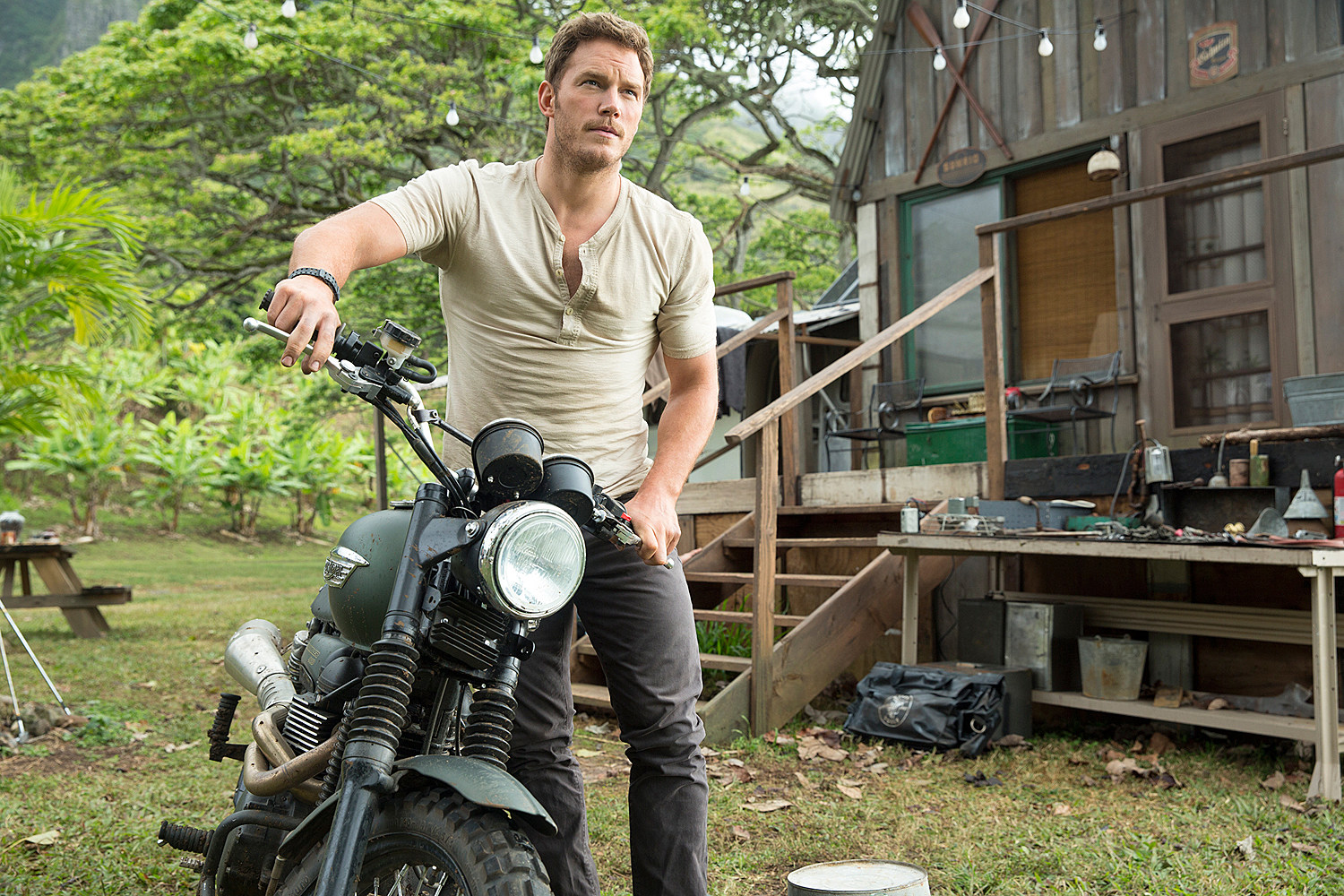
Chris Pratt chills with a motorcycle in a scene from "Jurassic World." Copyright Universal Pictures.
Of the several missteps “Jurassic World” takes toward mild entertainment, the brassiest and most regrettable is a direct challenge to “Jurassic Park” amid a pair of grand symbolic gesture. “Jurassic World” would be an OK movie if it hadn't thrown the proverbial gauntlet, but going after the big dinosaur is a mistake, and the resulting comparison creates expectations “Jurassic World” can't possibly meet. The two may be dinosaurs, but they’re leagues apart along the evolutionary scale.
Calling the titular theme park a world is a stretch, although it is a rather large island and the same one the action from the first film occurred more than 20 years ago; it even includes a pair of familiar faces in B.D. Wong's Dr. Henry Wu and a cameo by Mr. DNA. Everyone else is brand new, which helps explain why nobody learned the lessons wrought from the first time John Hammond tried to build this park. Hammond has passed on, leaving new owner Masrani (Irrfan Kahn) and park manager Claire (Bryce Dallas Howard) in charge of a facility with more than 20,000 visitors a day and a plethora of manufactured dinosaurs. The batch of dinosaurs includes a pack of velociraptors (seriously, didn’t anyone learn anything from the first film?) handled by professional trainer/requisite badass Owen (Chris Pratt) and his partner Barry (Omar Sy).
Surprisingly (or perhaps not), the original dinosaurs become a little boring for park visitors – as Howard puts it, “No one's impressed by a dinosaur anymore” – so Wong and his team create a new dinosaur, the Indominus rex, to drum up business. It's a stupid name for a dinosaur (a point the film comments on) but the creature is big, mean, smart, dangerously amalgamated and anxious to cause as much chaos as possible to the island, and she gets the opportunity to do so when she cleverly escapes captivity. The timing is pretty terrible: Howard's nephews (Ty Simpkins and Nick Robinson) are visiting and the nefarious Hoskins (Vincent D'Onofrio) lurks in the background waiting for an opportunity to convert the velociraptors into military weapons. Dinosaur-related shenanigans ensue as Howard and Pratt search for the nephews and the new rex devours humans and dinosaurs alike. 
 
                                                        And the raptor squad too.

Elements of “Jurassic Park” are plucked and recycled to complete “Jurassic World.” Some of of the reuse works pretty well – John Williams’ glorious theme song remains intact and people are consumed frequently – although other parts probably should have remained in the recycling bin. A few shots from the original are given homages (think the side mirror scene from “Jurassic Park”) without the cleverness or thoughtfulness, and Howard's subplot with her extended family blends John Hammond's grandchildren with Alan Grant's parental storyline with the kids. Things get a bit mangled in the mixing though – “Jurassic World” chastises Howard's Claire for focusing on her career instead of starting a family, an indignity the rugged but charming Grant (played by Sam Neill) never suffered through. Grant also received a fair amount of quality time with those kids to make his transformation believable; Howard never has the time with her nephews to forge the same natural, emotional bond.
It's a problematic subplot, but one possible to overlook if the on-screen spectacle is impressive enough. “Jurassic World” does go for size and strength, making the dinosaurs bigger and faster than before and adding more potential victims for them to munch on. But the size doesn't encompass grandeur; there's nary a moment when the viewer can stare awestruck by the creatures’ pure impossibility because the dinosaurs are missing a dash of reality. The film relies far too heavily on CGI to create an unnatural majesty the original earned by combining digital technology with animatronics and the occasional costumed performer. 

                                                               Just like this.

“Jurassic World” lacks contrast: it lacks contrast with the technology, and it lacks contrast with a tone that puts more emphasis on comedy than fear. Much fun is had picking out the people most likely to be eaten and rooting for appearances by certain dinosaurs, but the moments intended to scare frequently elicit laughs instead. That's the one little trick “Jurassic World” didn't pick up from “Jurassic Park” – very few moments of safety exist when things go sour in the original, and the biggest scare of all takes place once things start going right again.

Review: Three out of Five Stars

Click here to see the trailer.

Rating: PG-13
Run time: 124 minutes
Genre: Action
 
Ask Away

Target audience: Apparently everyone.

Take the whole family?: A lot of people get eaten in this bad boy; best to leave the kids at home so they don't cower in the small, unsafe theater bathroom like certain children did during “Jurassic Park.”

Theater or Netflix?: If you do plan to go to the theater, don't pay extra for the 3D; the world depicted in “Jurassic World” isn't grandiose enough to earn it.

Still on board the Chris Pratt train?:  Very much indeed. The man formerly best known as Andy Dwyer again showcases some serious action-movie chops and finds the balance between levity and verve the film misses. He's a highlight of the film, along with bits between Jake Johnson and Lauren Lapkus and Vincent D'Onofrio's incredibly edible face.

Scrumptious.
Watch this as well?: Go rent “Jurassic Park” or stream it if possible. I'll also recommend “Lost World,” which is also a step down from the original but is worth watching just for the long grass sequence; God does that moment work so, so well.

Friday, June 5, 2015

Just wasn't made for these times

Paul Dano in a scene from "Love & Mercy." Photo by Francois Duhamel, courtesy Roadside Attractions.
There are many moments in “Love & Mercy” when the film earns a place among the best biopics released this decade. They arrive when the filmmakers focus on the artist as a young man, a person with a brilliant mind who can’t control that very brilliance. Sometimes, the audience simply watches the process, but every then and now viewers receive a horrifying glimpse into the chaos swarming inside the artist's mind.
It's the other parts though, the ones focused less on the fall and more on the inevitable resurrection, that curb“Love & Mercy's” wonderment. Those are good moments with bits of terrific acting, but they're burdened wildly by hagiography and they cause the film to fall into the crowd-pleasing traps that afflict much of the genre. Sometimes, as is the case with “Love & Mercy,” watching a man fall apart is much more interesting than watching him put the pieces back together.

                                         This song does both excellently though.

The central figure in “Love & Mercy” is legendary musician Brian Wilson, who is portrayed by Paul Dano and John Cusack during two key parts of his life. Dano's occurs in the mid 1960s during his production of the seminal Beach Boys album Pet Sound, when the young man experiences auditory hallucinations as he perfects the strange music that make up that record. He's admired by younger brothers Dennis and Carl (Kenny Wormald and Brett Davern), chided for the eccentric sounds by cousin Mike Love (Jake Abel) and chastised mercilessly by his money-grubbing father and former manager Murry (Bill Camp).
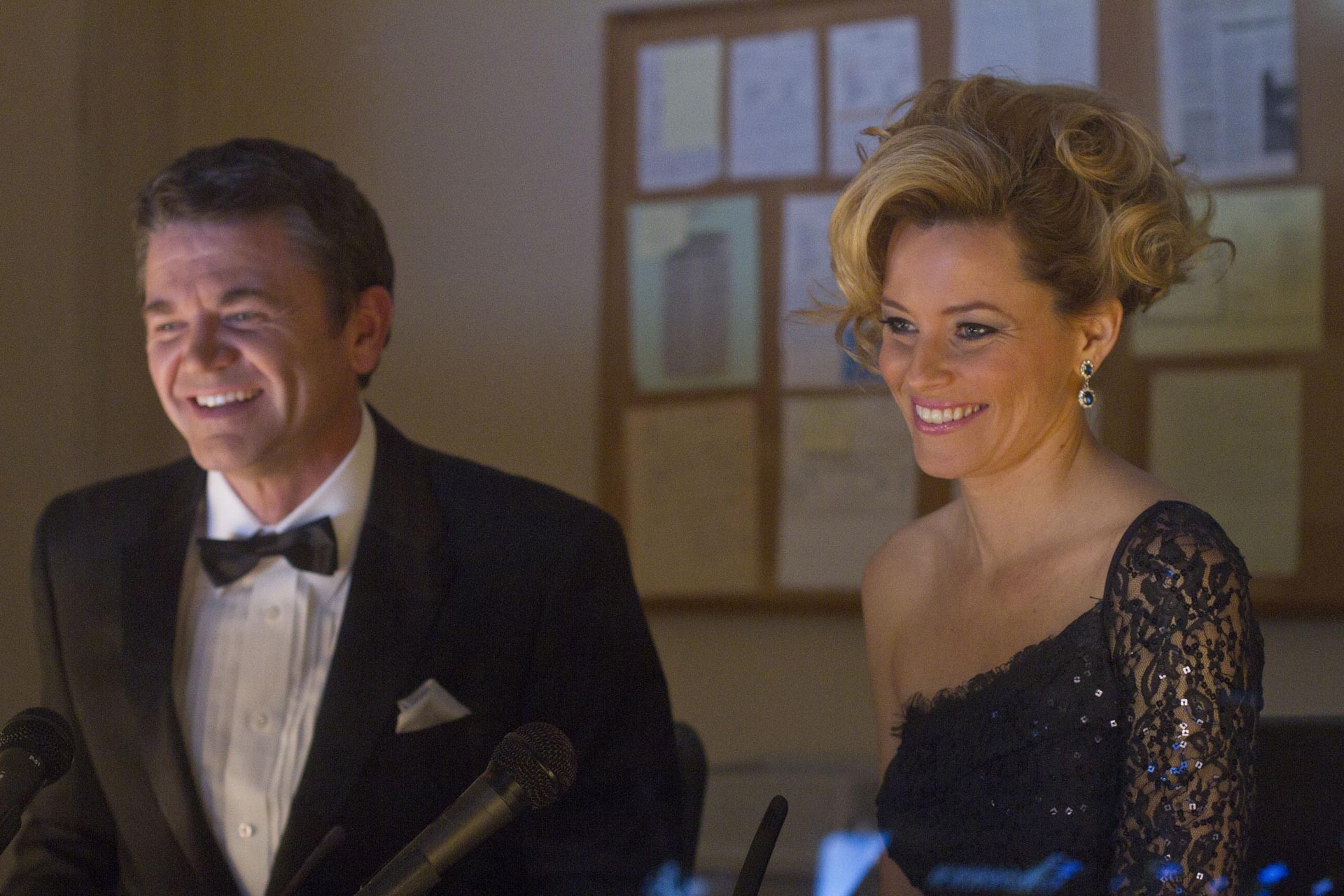
Cusack takes over when the film bounces forth and back into the late 1980s, where Wilson meets fetching auto saleswoman Melinda Ledbetter (Elizabeth Banks). This is a lost period for the artist defined by a toxic relationship with abusive therapist Gene Landy (Paul Giamatti), who keeps Wilson under constant surveillance and overloaded on prescription medications. Banks falls hard for the damaged musician and realizes she needs to do something to save Wilson from Giamatti's clutches.
“Love & Mercy's” filmmakers (director Bill Pohlad and writers Oren Moverman and Michael Lerner) avoid a straight narrative of Wilson's life, choosing instead to go with the aforementioned shifts between the two decades. That little narrative trick eliminates the need to show the years Wilson may or may not have spent in bed – the character comments on the mythology of that stretch in the film with uncertainty – and cuts down the rise to prominence story. That’s captured via a montage rounded out with sweet faux home videos. 

                                       Makes you feel the same way as this song does.

It's an unconventional choice, but a clever and practical one because the rushed back story leaves more time to watch Wilson in the studio. Those are just glorious moments and give the audience a peek into the making of an unforgettable album – a process accompanied by songs from Pet Sounds – that includes dogs, a tempered piano and a lot of improvising as musicians try to match the music playing within Wilson's mind.
His head is a scary place to be though, as shown via the album's underlying cacophony, the voices percolating in Wilson's head, and a few odd camera angles that give that glimpse into Wilson's creative process. As his creativity rises, the young man falls further and further down the rabbit hole until he's completely lost within himself and the cavalcade of drugs he's taken to make the trip a little easier. Dano does an incredible job as the young Wilson, portraying the young Wilson as an innocent man who can't break out of himself. It's sad enough watching a person go through what Wilson does; Dano makes sure it hurts.

                                                               Sort of like this.

I just wish “Love & Mercy” spent more time with the young Wilson instead of shifting over quite so much to the older one. While Dano’s section is highlighted by ingenuity and a melancholy that fits the Pet Sounds album, the Cusack half is a bit too conventional, a bit too much like what one would expect from films like “Ray” or “Walk the Line.” Some of it is on Cusack's performance – he’s better than he's done in years, but nowhere near Dano's level – although the main problem is a certain amount of narrative easiness that removes the nuance from Wilson's character. The film becomes a bit too devoted to the Cusack version, seemingly afraid of showing the complications that defined the younger man. Still, there's plenty of good to be found in the older half, with the highlights rooted in Banks' nuanced performance as Ledbetter and in Giamatti, who is terrifically unhinged as Landy.
Like the artist it highlights, “Love & Mercy” has a brilliance that’s impossible to duplicate, but it shines so brightly it can’t be sustained for 120 minutes.

                                                      This, however, is perfection.

Review: Four out of Five Stars

Click here to see the trailer.

Rating: PG-13
Run time: 120 minutes
Genre: Biographical

Ask Away

Target audience: Beach Boys lovers and anyone interested in a good biopic.

Take the whole family?: The rating is a fine fit, but I doubt many 13-year-olds would be down for this film.

Theater or Netflix?: Seems like a good Netflix choice considering the dearth of theatrical viewing options.

Are the Beach Boys underappreciated?:  Rolling Stone rated the band the 12th greatest of all time in 2010, so it does get the critical respect. But I don't think that translates to the average music listener due in large part to the heavy rotation of those early 1960s hits, which are fluffy fun but not much more. As the film points out, few bands dared to challenge the Beatles during the '60s; only one ever succeeded in doing so.

Watch this as well?: “American Splendor,” which also stars Paul Giamatti, is worth a visit – both are unique biographies of rather eccentric people. For a more somber companion, check out “Control,” Anton Corbijn's haunting and melancholic biopic about troubled Joy Division lead singer Ian Curtis.

Friday, May 29, 2015

The fault lies not in our stars, but on our planet

The Rock goes spelunking in "San Andreas."
I should have kept count of the number of cackles emitted from the audience at the ridiculous stupidity that is “San Andreas.” The dialogue is perfectly trite and littered with clichés (tops among them an obligatory “get the hell out of there!” screech courtesy Academy Award nominee Paul Giamatti); the characters are forgettable; the CGI is unconvincing and very much overused; the 3D conversion is a waste of resources; and the less said about the quality of the performances the better.
And yet, in a weird way, all of those problems blend together to create a pretty enjoyable viewing experience with the right audience. “San Andreas” is undoubtedly a bad film, but it's terribleness comes full circle to make it kind of a good-adjacent movie for one major reason; nobody is taking the on-screen destruction too seriously.
In “San Andreas,” action hero template Dwayne “The Rock” Johnson plays a Los Angeles-based rescue helicopter pilot in the midst of a divorce from his wife (Carla Gugino). Gugino and the couple's daughter, Blake (Alexandra Daddario), have unexpectedly moved in with new beau Daniel Riddick (Ioan Gruffudd), a wealthy architect with a private plane, fancy suits and a chauffeur to boot. Gruffudd, who at least seems somewhat interested in not sucking as a possible step parent, brings Daddario to his firm in San Francisco, where she meets aspiring architect/Hugh Grant impersonator Ben (Hugo Johnstone-Burt) and his moppet-ish little brother Ollie (Art Parkinson).

This kid's got the moppet market cornered for at least two more years.
Amid the relationship drama is research from professional sciencetician Lawrence (Giamatti), who predicts a massive earthquake along the titular fault line that would decimate just about everything along the 810-mile fault line (kudos to sanandreasfault.org for that tidbit), including Los Angeles and San Francisco. As Giamatti and reporter Serena (Archie Punjabi) try to warn California about the impending disaster, it's up to The Rock to save his ex-wife in Los Angeles and his daughter in San Francisco amid earthquake-related shenanigans and some acts of nozzlery involving certain and obvious characters of note.
The plot is exactly as dumb as it sounds and becomes immediately ludicrous once you put any thought into its machinations and repeated criminal acts by the heroic characters. And there's nothing overly clever about “San Andreas” that separates it from other disaster fodder like “The Day After Tomorrow,” “2012,” “Dante's Peak” and “Volcano” released in the last two decades or so either. Like the aforementioned forefathers, the film follows a pretty simple formula in which the disaster is set up with disregarded warnings, thousands of civilians are smooshed, smashed, drowned, impaled and otherwise maimed, and villains are established quickly to be dispatched in a rather satisfying fashion. If you've seen one film featuring a building, ship, city or civilization falling apart due to uncontrollable forces, you've pretty much seen them all.
Everything appears the same, but “San Andreas” isn’t without its little charms, certainly enough to stand out in a genre bloated by mediocrity and Roland Emmerichs. This film has an underlying current of playfulness reinforcing how much fun a disaster flick can be, as director Brad Peyton and screenwriter Carlton Cruse mess around with the audience from the get-go via a somewhat intense prelude to a character-establishing calamity, teasing the audience with a couple of pump fakes to set up the open shot. It's a neat little trick and sets the tone for a movie that just embraces the genre's utter silliness and forces audience members to embrace the ongoing guilty pleasure. “San Andreas” also lacks the self-importance of other disaster films; it never tries to be as didactic as “The Day After Tomorrow,” it avoids the cruelty of the abhorrent “2012,” and it definitely drops the self-seriousness that made “Volcano” unwatchable.  

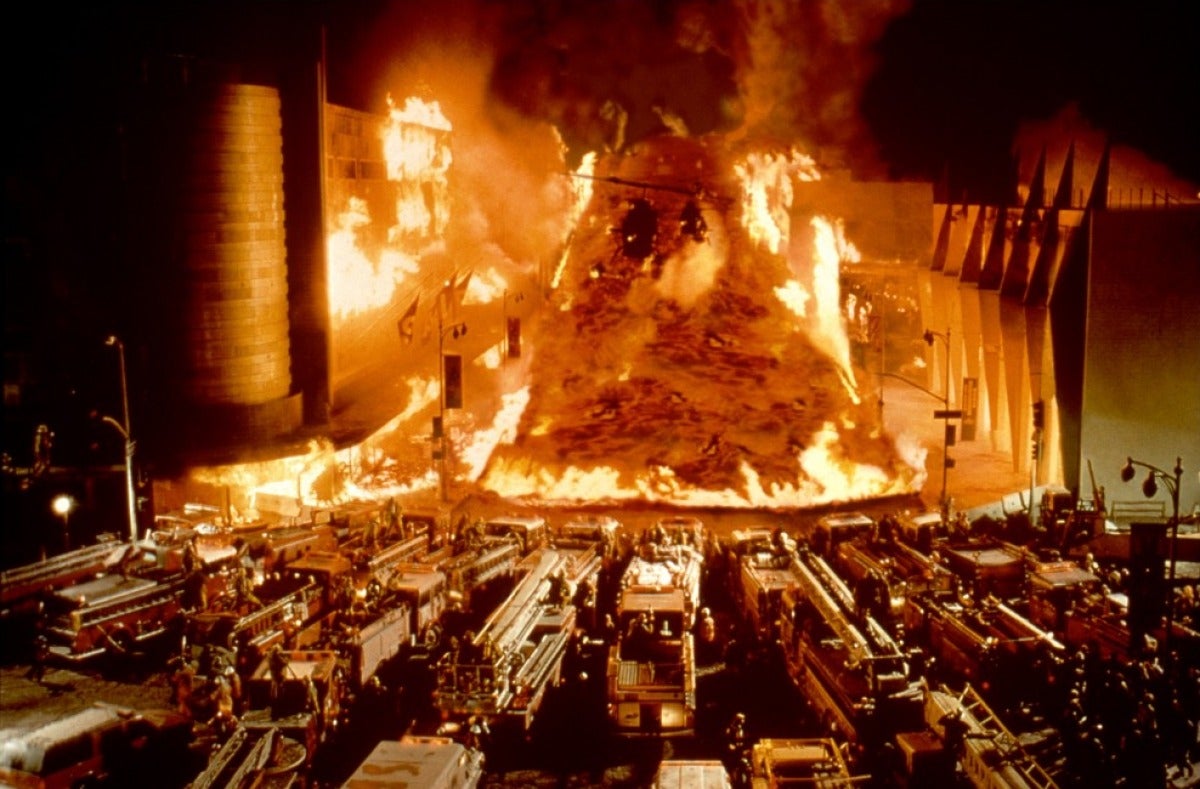
This is from 'Volcano.' Here's a link to a compendium of awful, awful moments from that film.
Even though the performances don’t ascend to anything resembling quality, they do buttress “San Andreas” inherent goofiness, with Gruffudd seemingly reveling in his role as the jerk who receives his inevitable comeuppance and Giamatti consuming the scenery as if he were a stoned elephant. The wee Brit Parkinson also gets a few moments to drop some witty-adjacent lines that keep the tone light and breezy.
If anyone carries “San Andreas,” it's Johnson, whose preternatural charm and bulk pretty much fleshes out a cardboard cutout of a character. It’s become a bit of a habit for the former wrestling star turned action star; give just enough to work from and he’ll turn in the proverbial winning performance guaranteed. 

                                     He also wins at "Saturday Night Live" hosting.

“San Andreas” suffers a bit from bad timing, having come out within months of more interesting action flicks — it doesn’t have the balls-out insanity captured by “Furious 7” and certainly isn’t capable of achieving the thorough brilliance of “Mad Max: Fury Road.” But “San Andreas” still succeeds as a popcorn flick and it's far more enjoyable than it ought to be; you won't be blown away, but you'll walk out of the theater with a slight, perplexed smile.

Review: Three and a half out of Five Stars

Click here to see the trailer.

Rating: PG-13
Run time: 114 minutes
Genre: Action 

Ask Away

Target audience: Disaster-film connoisseurs and Rock-philes.

Take the whole family?: There are enough body crushings to scare the heck out of a 6-year-old, but it's cartoonish enough to remain OK for anyone older than that.

Theater or Netflix?: I'd go with the home screening, but a matinee sans 3D is perfectly acceptable.

Is it a feminist triumph?:  “San Andreas” doesn't carry the wonderful gender politics of “Fury Road,” nor does it even pass the Bechdel test like “Furious 7,” but it does have Alexandra Daddario's character does take control of a small group amid the chaos. Sure, she does it so her father can rescue her, but the film does get half credit for letting her use her smarts to get saved later.

Watch this as well?: Go old school with flicks like “The Poseidon Adventure” (circa 1972) and “Earthquake” to see how disaster films used to be done, and maybe “Dante's Peak” for the camp factor. For people who want to see the Rock in action, please revisit entries five, six and seven in the “Furious” series.

Friday, May 22, 2015

A future illuminated by hope amid chaos

Britt Robertson in a scene from "Tomorrowland." © Disney Enterprises, Inc.
One of my favorite movies of all time is “Fitzcarraldo,” Werner Herzog’s 1982 film about a man who dreams to bring opera to the Amazon. It’s a brilliant film with an insane backstory (captured in the documentary “Burden of Dreams”), but what I love about it is how Klaus Kinski’s Brian Sweeney Fitzgerald never abandons his passion. Fitzgerald’s fervor was deep enough that even a misanthrope like Herzog couldn’t deny the man a happy ending.
I was hoping for the same result for the filmmakers behind “Tomorrowland,” which has all the heart and hope in the world but is burdened by an overwhelming number of flaws. The question I had to pose was whether the film’s issues are too egregious to overlook, or if, like in Fitzgerald’s case, the passion is too vibrant to keep down. In the end, I was won over “Tomorrowland's” gumption and boundless optimism for humanity's potential, although I just wish I didn't have to make the choice in the first place.
“Tomorrowland” is not based on the Disney theme park attraction (although the Small World ride is given a justification for its existence), but it is a futuristic utopia where brilliant minds conjured ways of making the future more prosperous. It’s essentially the view of Epcot Walt Disney outlined in a short video from the 1960s, but with even more future added to it.
And definitely way more than this.
Most people have no idea of Tomorrowland’s existence, but a preview of the place via a small pin tantalize precocious teenager Casey Newton (played by 20-something Britt Robertson), who seeks out a way to gain full entry into the place. It’s a dangerous journey, one that includes, a cantankerous George Clooney, a mysterious girl played by Raffey Cassidy, a lucky red baseball cap, and numerous androids who possess blaster guns and are very comfortable using them. Also along for the ride are Hugh Laurie, Tim McGraw, Keegan-Michael Key and Kathryn Hahn, who all help prop up the on-screen shenanigans in methods heroic, villainous, and comedic.
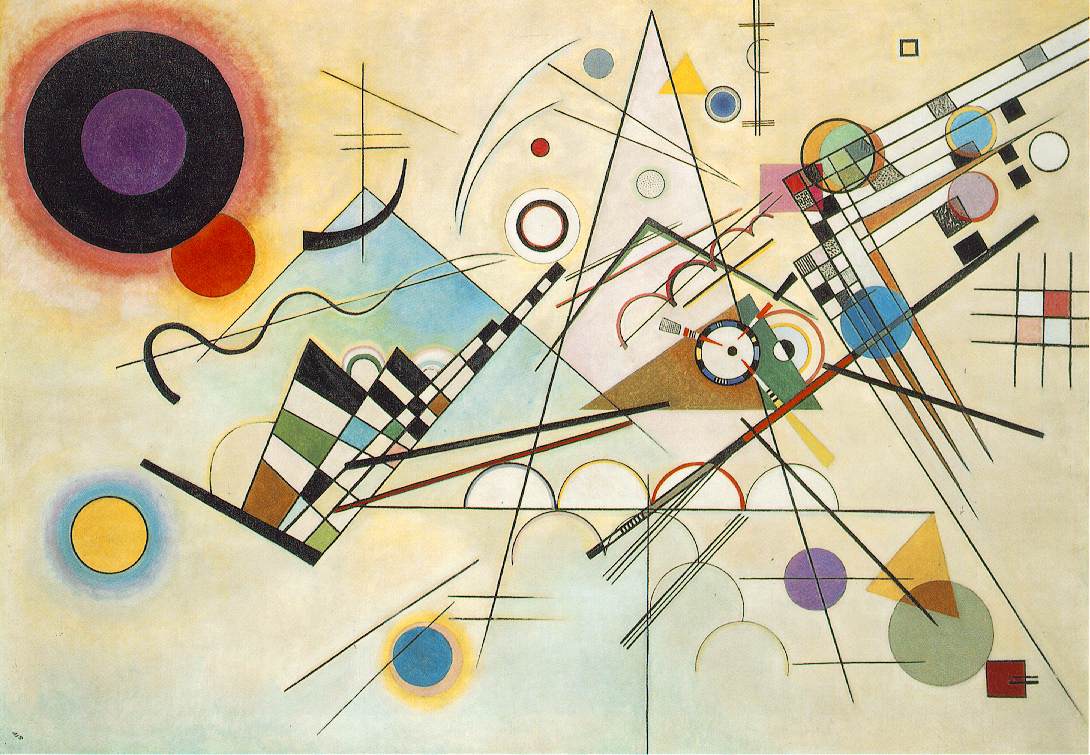
Most of that recap is available by watching the film’s previews, which definitely avoid going too much into the plot machinations. There's also a clear reason why the advertising team that put together “Tomorrowland's” trailer and accompanying material didn't provide a detailed outline of what to expect, and it's not about creating a mysterious ambiance. To put it simply, the film doesn’t have a cohesive narrative; rather, it exchanges a direct narrative for a scattered, loose storyline written as if it were a Wassily Kandinsky painting. 
Your medium-brow reference for today.
A tricky plot filled with twist and turns can work great when employed correctly, but “Tomorrowland’s” machinations are clever by half, and the story focuses so much on the introduction that the conclusion of the two-plus hour film is rushed. And all of the storytelling gadgets are undercut by a really, really, really heavy-handed message (capped off by a final shot fattened with treacle) and lazy writing highlighted by the use of the proverbial “special.” It feels as if the script is at war with itself, with Damon Lindelof's patented perplexity battling co-writer and director Brad Bird's eagerness and hope. Bird seems to win a few times (highlighted by the funniest scene in the film clearly inspired by one of his early employers) but Lindelof wins the contest, much to the film's detriment.
“Tomorrowland's” problems extend beyond the script and incorporate a disappointingly bland directorial effort by Bird, but the more critical I am about this film the more I feel like I'm missing the point. Viewing it solely on its cinematic merits ignores the vital philosophical discussion it presents to a rather young target audience, as“Tomorrowland,” serves as a pretty solid introduction to the debate between fatalism and free will. Essentially, are humans controlled by forces and efforts beyond their control or do they have the ability to change their station?
Bird and Lindelof favor the second option and use that assertion to assuage fears about a future that contains few bright spots for the two youngest generations and whatever progeny they may have. The world may be collapsing upon itself due to our own sins and stupidity, but there's always room for hope as long as humanity still exists. Really, the only thing that's worth fearing is the end of innovation, invention and ingenuity; one of the saddest moments of the film comes when Robertson mourns the destruction of a NASA launchpad by saying, “there's nothing to launch.” Few things are more frightening than realizing there are no more worlds to explore.
I really do appreciate “Tomorrowland” for possessing such hope and faith in humanity, and I admire it for its spirit and willingness to dream big like Fitzgerald. I just wish it was a better movie.

Review: Three out of Five Stars


Click here to see the trailer.

Rating: PG
Run time: 130 minutes
Genre: Adventure

Ask Away

Target audience: Fantasy/adventure junkies and families in need of a little positivity in their lives.

Take the whole family?: A surprisingly large number of human deaths make “Tomorrowland” too tough for kids younger than 6. It won't be a problem for anyone older than that though.

Theater or Netflix?: Netflix is OK, but save the money and go matinee if you do hit up the theater. Definitely avoid shelling out more bucks for a possible 3D option as well.

An issue with the advertising? Most of the film's posters depict George Clooney and the actor who plays Clooney as a child. There are thematic purposes for doing so, but it does remove two female characters who are at least equally important to the plot, if not more so. I’m not sure why the decision was made to kybosh the women in favor of Clooney and Clooney prime.

Watch this as well?: This would work as a nifty double feature with another live-action Disney flick with a gee-whiz attitude and an idealistic view of humanity's future, “The Rocketeer.” Also worth a peek is Brad Bird's feature directorial debut, “The Iron Giant.”

                       I'm also adding this trailer for "Fitzcarraldo" to hopefully pique your interest.

Friday, May 15, 2015

Sweet but just a bit tart

The Bellas return for "Pitch Perfect 2."
“Pitch Perfect 2,” the sequel to the surprise hit from 2012, is a slight flick akin to a moderately stale Fig Newton: Ooey, gooey, chewy on the inside and with just a bit of a crunch to the outside. It doesn’t sound like the most flattering description, but it's exactly what a “Pitch Perfect” sequel ought to be: an enjoyable perfectly satisfying, albeit problematic, film that leaves a pleasant taste in the mouth.
The film picks up with the Barden University Bellas three years after the events of the first film, it’s been a pretty good stretch for the Bellas; they’ve won three consecutive national acapella titles and kickoff the film performing for President Obama at the Kennedy Center. The performance, however, turns into a nightmare when Fat Amy (Rebel Wilson) accidentally reveals her front door to the president amid a rendition of Miley Cyrus' “Wrecking Ball.” The act leads the acapella league to ban the Bellas from competing at the national level and from recruiting new members to replace the group, whose members are set to graduate in the spring.
Bellas' leader Beca (Anna Kendrick) strikes an agreement to have the Bellas reinstated if they win the world competition, a contest dominated by the ruthlessly efficient and entertaining German collective Das Sound Machine. It's the Bellas' last shot at glory and preservation, and it comes with an abundance of drama entailing Kendrick's internship for a music producer (Keegan-Michael Key), seventh-year senior Chloe's (Brittany Snow) fear of losing the Bellas, the inclusion of a legacy member/aspiring songwriter Emily (Hailee Steinfeld), and the antics of Wilson and super senior Bumper (Adam DeVine). Oh, and Elizabeth Banks and John Michael Higgins are back as bickering announcers cum acapella overlords Gail and John.

This should refresh your memory.
The plot isn't all that complex or difficult to resolve, and the overarching push toward a global championship is suspiciously similar to the one used in “D2: The Mighty Ducks.” Then again, viewers aren't focused as much on “Pitch Perfect 2's” story as they are on the humor and acapella performances, and the film succeeds on both ends. Wilson gets her moments to shine as the apparent fan favorite, with Kendrick, Snow, fellow Bellas Hana Mae Lee (Lilly) and Ester Dean (Rose), Key and DeVine chipping in when needed. Even Snoop Dogg drops a couple of solid lines by recording a Christmas album I would totally purchase if it existed. The comedic highlight once again belongs to Banks and Higgins, who just kill it as the announcers who take the Don Rickles route and offend as many people as possible.
The performances too are enjoyable, featuring a slew of recent and old-school pop songs performed in scales both small (acapella throwdowns that are essentially singing version of a street-dance fight in “Breakin'”) and large (the world performance). Credit for the staging of said performances goes in part to Banks, who does a strong job behind the camera and shoots the big sequences with flair and precision in her feature-length directorial debut.
There are a few “and yets” that do put a damper on “Pitch Perfect 2.” The film's a bit lazy when it comes to expositional dialogue, with Higgins even saying, “it's as if the Bellas forgot who they are” at one point. The simplicity of the plot is forgivable; having characters state the obvious is a bigger issue.
So too is the various levels of offensiveness carried within the script. Screenwriter Kay Cannon toes the proverbial line with the offensive jokes and just keeps from crossing the threshold into problematic by redirecting the barbs back at Higgins' and Banks' characters. At greater issue though is the treatment of Lee's Lilly, who spent most of the first film squeaking and making beat boxing sounds. Her oddness becomes her defining character trait in round two, and while some of it works, much of it falls into stereotypical territory that makes her come off as a female Long Duk Dong.

Remember him?
Those problem areas with the script are balanced a bit by the female-centered comedy and some little moments Cannon inserts to deepen the relationships between in a realistic manner. And “Pitch Perfect 2” does have a sense of humor about itself and mocks a few tropes it indulges in, along with a few cracks centered on acapella's perplexing popularity.
To go back to the cookie analogy put forth in the opening paragraph, “Pitch Perfect 2” doesn't have the flavor complexities of a gourmet treat, nor does it comfort viewers like a homemade chocolate chip cookie. It's a Fig Newton of a movie, and who doesn't like a good Fig Newton?

I'm kind of Jonesing for one right now.

Review: Four out of Five Stars

Click here to see the trailer.

Rating: PG-13
Run time: 115 minutes
Genre: Comedy

Ask Away

Target audience: Acapella-philes and people into the original.

Take the whole family?: The film is a bit crass and not interesting enough for kids younger than 9, but otherwise there's nothing overly problematic.

Theater or Netflix?: Good enough for a night out with friends followed by a couple of bright mixed drinks.

Rebel Wilson, breakout star?:  She was in “Pitch Perfect,” which gave the filmmakers greater motivation to feature her in the sequel. Wilson is a fine comedic talent, but her character becomes a little grating at times and doesn't have a story interesting enough to carry so much screen time in an ensemble. She's a great supporting character stretched too far into a quasi-leading role.

Watch this as well?: “Pitch Perfect” is the obvious one. Aside from that, “Moulin Rouge!” is a pretty good companion piece given how both reappropriate pop songs, and maybe “Glee” depending on how you're feeling. One more to add is “Enchanted,” which is just delightful.