Showing posts with label Halloween. Show all posts

Thursday, October 18, 2018

Inconsistent Halloween saves its best for last

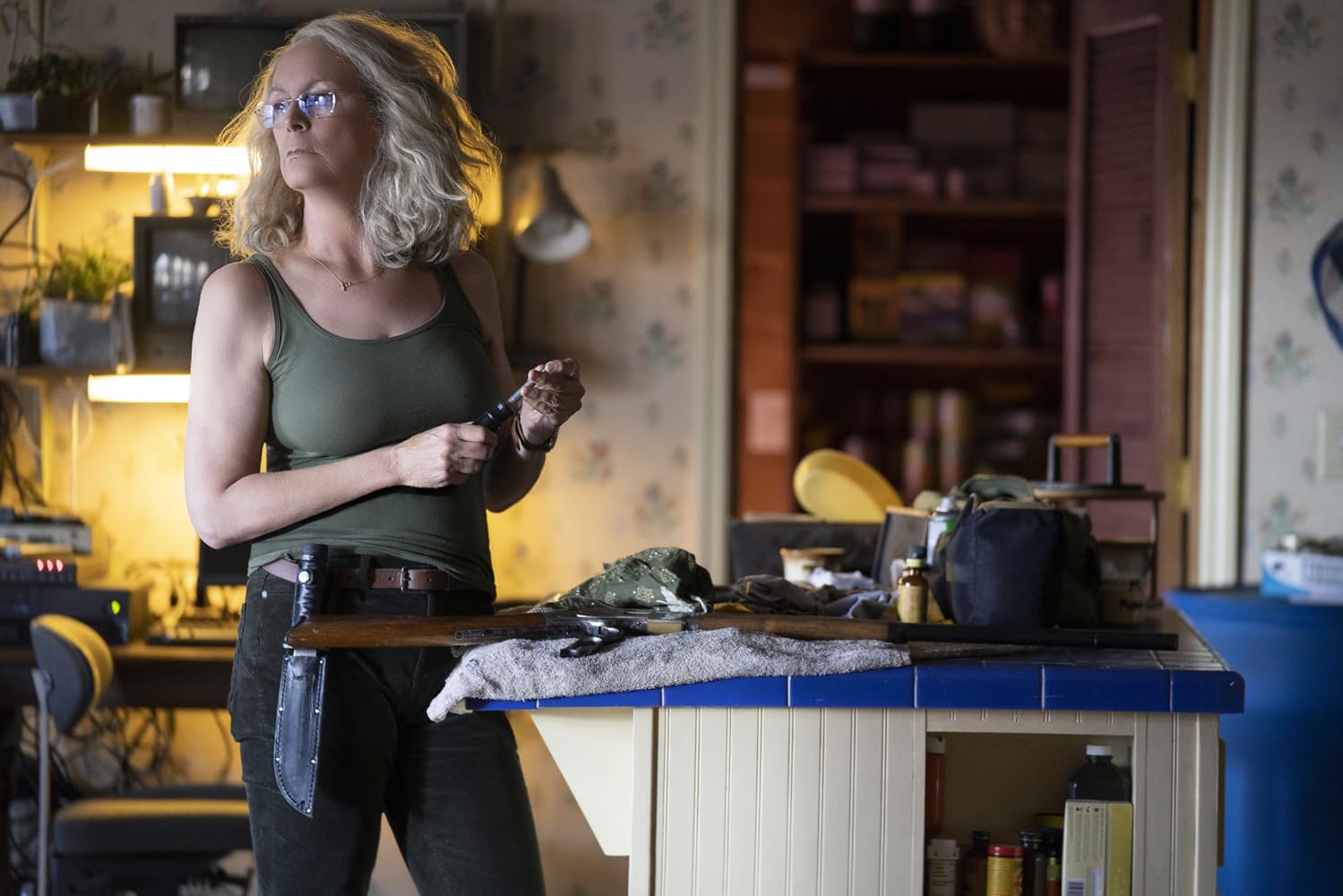
Jamie Lee Curtis in Halloween. Image courtesy Universal Pictures.
The redeeming factor for the wildly inconsistent Halloween sequel is the ferocity of its female lead. Laurie Strode was a fighter in the first film, trading blows and stabs with a monster. The new film makes it clear that Halloween night 40 years ago haunts her now as it did then, but the extra years have done nothing to temper Laurie Strode's tenacity. Without her resolve and strength, Halloween circa 2018 would be little more than high-budget fan fiction.

Eliding over the events from movies two, four, five, six, seven, and eight, Halloween opens with a pair of podcasters (Rhian Rees and Jefferson Hall) revisiting the horror in Haddonfield 40 years on. After failing to get a word from Michael Myers (played by both original actor Nick Castle and James Jude Courtney), they visit Laurie Strode (Jamie Lee Curtis) who is still scarred from that night. She lives alone in the woods, alienated from her daughter Karen (Judy Greer) and granddaughter Allyson (Andi Matichak) and preparing for another encounter with Myers. Myers, meanwhile, is being transferred to a new mental health facility, much to the protestation of his psychiatrist Dr. Sartain (Haluk Bilginer). For the second time in 40 years, something goes awry and Myers is loose again in Haddonfield, pursued by Strode, Sartain, and the weary Officer Hawkins (Will Patton). 
 
For much of Halloween, the question that drives much of the action is the why behind Michael Myers' wanton murder. Like the first movie, this Halloween offers little to no explanation (although much conjecture) for why the monster is a monster, which is for the best. Once the first set of sequels tried to connect Myers to a strained motivation it soured the character, and a monster without any apparent reason is far more horrifying than one with familial problems. But this movie goes too far into the other direction, painting Myers as more of a shark than a boogeyman. The scenario becomes predictable midway through the movie; Myers enters the house, murders the occupant (usually a woman) by surprise, then walks out to find his next victim. It's designed to be somewhat comedic, especially in the manner Myers so quickly dispatches of his victims, but it paints Myers as mindless instead of calculating. There's no intelligence or cleverness to his actions, and it removes much of Myers' mystique. Even if the audience never knew exactly why he picked Laurie and her friends, there was an intent somewhere that was pretty horrifying to think about. 
 
Halloween sheds the elegance and nuance of its predecessor and wraps itself instead in a bothersome coat of bluntness. Director David Gordon Green takes the basics of the original and ramps up the murders, showing as much gore and blood as he can. Green occasionally shows his horror chops on a few kills – highlighted by a rather effective sequence involving motion-detecting lights – but the murders become less and less intricate and the gore becomes greater and greater to compensate for the lack of imagination in the framing. The body count in Halloween is high enough to cause the shock factor wears off and the movie drags to get to the highly anticipated final showdown.

The path to the finale is pretty rough. Green and co-writers Danny McBride and Jeff Fradley ended up with a rather funky script that doesn't meld the horror, comedy, and meta-comedy particularly well. It's tough to tell exactly what Halloween is designed to be, especially in the sequences that exist solely because of horror clichés. An argument could be made for parody, but there isn't enough of it in the rest of the film to consider these as much more than storytelling laziness. And the character motivations are all over the map, with folks changing who they are just to carry the movie forward. Dr. Sartain in particular has a strange, unconvincing arc that does more to connect Laurie and Myers than establish him as a character. 
 
Ultimately that showdown between Laurie and Myers is all that matters for Halloween. Green treats the rest of the mayhem caused by Myers as a means to an end, steps for the film to reconnect these two after four decades apart. The battle between Myers and the Strode women is fraught with intensity and fright, a mother fighting against a monster to save her daughter and granddaughter. Curtis is great in this sequence, resurrecting the ferocity that defined Laurie Strode 40 years ago while adding decades of pent-up rage to her battle against Myers. Laurie is fighting as a mother, a victim, a warrior, and a survivor, putting everything she has against Myers and then some to end 40 years of bad dreams and misery. The showdown isn't perfect – Green can't help but through a couple of unnecessary references in that throw off the pacing – but it's still a helluva ride and about as good of an ending as this movie could have.

Review: Three and a half out of Five Stars

Click here to see the trailer.

Rating: R
Run time: 106 minutes
Genre: Horror

tl;dr

What Worked: Scares, Jamie Lee Curtis, final showdown

What Fell Short: Character motivations, too many in jokes

What To Watch As Well: Halloween

Friday, October 21, 2016

Origin of Evil can't escape its future

Annalise Basso, Lulu Wilson and Elizabeth Reaser in Ouija: Origin of Evil. Image courtesy Universal Pictures.
It’d be a blessing if Ouija: Origin of Evil existed in a universe not graced by the presence of its predecessor, Ouija. The latter film was among the worst films released in 2014, a risible horror flick forged with little talent or insight into the genre, its sole focus to sell more of the titular board game. It is as bad as bad can be, which makes it all the more surprising that Origin of Evil, a prequel explaining Ouija’s backstory, is mostly a pretty solid flick with decent scares and good performances from the central cast. Yet the prequel can't escape the vibes of its predecessor, which infects the final act so strongly it diminishes the entirety of the viewing experience in the process.
Origin of Evil is good enough before it goes to pot though, using a grounded story to serve as a base and offer an explanation for the chaos that ensues later. There's a level of sympathy inherent to a story in which a widow (Elizabeth Reaser) and her two daughters (Annalise Basso as the eldest child, Lulu Wilson as the younger one) struggle to adapt to a world without their emotional bedrock and main source of income. They're struggling to thrive, and it’s easy to understand why once Wilson's character seemingly begins to communicate with the lost beloveds like Reaser’s dead husband the mother would consider that a gift instead of a curse. Her inability to leave the past behind is shown as a heartbreaking flaw, especially when contrasted with the comparative peacefulness Henry Thomas' priest has discussing his dead wife. Reaser's obsession explains why she'd allow the strange behavior her youngest daughter displays to continue; acting rationally is often impossible for people blinded by grief and false hope.
Once the machinations for the creeping terror are set, Origin of Evil proceeds to ramp up the chills and create a discomfiting environment for the family and the audience. The film uses silence like a dagger, cutting off the soundtrack and much of the ambient noise as it prepares to launch another fright at the family. It also plays with the anticipation the audience has for the scenario; writer/director Mike Flanagan and cowriter Jeff Howard know the audience is waiting for something to happen, and they'll drag out that something for what feels like an eternity.
Just those factors alone show how many leagues greater Origin of Evil is than Ouija. Sadly, the newer film acts out one of its main themes by being unable to leave the dead buried. The film is obliged to follow through to set the big bads (the ones played by Reaser and Wilson) in Ouija, and while this one does provide the central family a level of kindness and decency not granted to it in the first film, it still has to tailor its story to link back to 2014 edition. This really comes through with an incredibly rushed and anticlimactic final act offering a weak connection with Nazis to explain the source of the house's evil. It feels as if Flanagan and Howard couldn't find a more organic method of tying in the end of this film with the events of the first one, thus cramming in what is ultimately an unsatisfying final act. The logical leap the film takes to reach its big conclusion is massive and often painful and takes the easiest way out of explaining things.
There is one additional issue this film faces not necessarily dependent upon how bad Ouija is. Like many horror films, Origin of Evil uses its child actress as a vessel for evil, using large amounts of makeup and special effects to make her appear to be a malevolent beast. It’s much more comical than scary though, especially when poor Wilson scampers about a hallway with her eyes all white and demon voices streaming from her small form. And, really, kids don’t need makeup or effects to appear horrifying; Wilson is unnerving enough with a simple glance or toothy smile, appearing like a little shark preparing to consume her prey. The film is wonderfully effective when it has Wilson acting as a spirit attempting to act as an innocent child; it falters when Wilson is made up to be the monster the first Ouija makes her out to be.

Review: Two and a half out of Five Stars

Click here to see the trailer.

Rating: PG-13
Run time: 99 minutes
Genre: Horror

Ask Away

Target audience: The people who liked the original and/or people digging for a horror flick for the season.

Take the whole family?: There is a little graphic violence that'll bother young kids. Best to stick within a couple of years of the rating.

Theater or Netflix?: There are worse things to see during the Halloween season, as long as you don't pay full price.

Why would they even make a second film?: Artistically there really was no reason for it; the film's 7 percent rating on Rotten Tomatoes isn't a great indicator of quality, and it's not a film star Olivia Cooke prefers to talk about. Money is definitely the key, and that first film made more than $50 million domestically off of a $5 million budget, per Box Office Mojo. Even a bad film like Ouija can do well with a budget that microscopic.

Watch this instead?: This film lifts enough elements from much stronger films – Poltergeist, The Exorcist, and even the main flaw of The Last Exorcism, – it makes it simple to recommend other flicks to watch. For horror fans, hit up Stake Land and enjoy one of the best vampire flicks to come out this decade.