 |
| Image courtesy Disney |
Two
thousand seventeen was a pretty solid year for movies. This is the
first year the number of films on the worst list were outpaced easily
by some pretty great choices on the best film lists, enough to
require knocking off some really lovely movies from this list. What's
left is a collection of reality altering indie movies, a tremendous
horror movie, and a great movie about the frailty of marriage.
The
films below are all ones reviewed from 2017. I kept the list to the
top six to focus on the films most worth a second look,
leaving out some wicked good selections. Just missing this year's
list are Star
Wars: The Last Jedi,
Baby
Driver,
American
Made,
and Ingrid
Goes West.
 |
| Image courtesy Cohen Media |
Winner
of the Best Foreign Language Film at the 2017 Academy Awards, The
Salesman
is a gut punch of a film about how a happy and fulfilling marriage
can fall apart from obsession and anger.
Writer/director
Asghar Farhadi uses a performance of Death
of a Salesman as
a backdrop for a story about a man who simply cannot let things go,
despite the protestations of his wife. Moving on is an impossibility
for a prideful person, one who is awful enough to use an attack on
his wife as a means of taking control of the marriage. What was once
a partnership devolves into something much darker, and The
Salesman
makes that transition hurt.
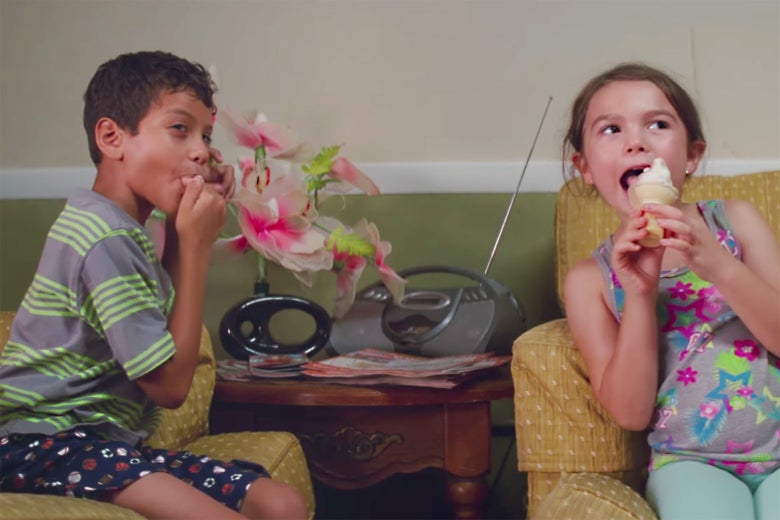 |
| Image courtesy A24 |
No.
2: The
Florida Project
The
Florida Project
is happily heartbreaking. It's a movie about the innocence of
childhood and the need/desire to escape the sadness of the
circumstances people are stuck under. The small family at the center
of the movie doesn't have much going for them besides each other, and
even that isn't enough to make for a sustainable lifestyle.
Buoyed
by a wonderful performance by Willem Dafoe, The
Florida Project succeeds
at the small things that make childhood memorable, like making
sandwiches with friends and pretending a firework show is just for
you. Even the cruelty of reality that strikes at the end can't
prevent the movie from engaging in one last flight of fancy, to
provide at least a glimmer of a happy ending before everything falls
apart.
 |
| Image courtesy Universal Pictures |
No. 3: Get Out
Writer/director
Jordan Peele is clearly a student of horror, knowing exactly what
tropes to invert and which ones to follow to make Get
Out
a terrifyingly bleak look at the black experience in America. Peele
swings a mighty strong hammer, explaining why a seemingly bucolic
upper-class neighborhood can be a place of discomfort and fear from
a certain viewpoint, as even the most welcoming of environments has
an underlying evil to it.
Get
Out
is brilliant for many reasons, but the film succeeds at the most
basic component of horror; making viewers feel uncomfortable and
frightened. It's a horror movie that succeeds at scaring the audience
for the frights it produces and for the thoughts it invokes.
 |
| Image courtesy Fox Searchlight |
No.
4: The
Shape of Water
Certainly
the strangest film on this list, The
Shape of Water is
also the purest and sweetest love story to come out in many, many
years. The film shows how powerful love can be, and how easily it can
be taken away by the evils of man
The Shape of Water doesn't
stray too far from writer/director Guillermo del Toro's history,
inserting supernatural elements while undercutting the rosiness of
bygone eras. This film layers on the romance more than he has in the
past, putting the emphasis on the story of two awkward beings finding
each other. That the central couple is a mute woman (a great
performance from Sally Hawkins) and a fish creature makes it all the
more interesting.
 |
| Image courtesy Warner Bros. |
No.
5: Dunkirk
Dunkirk
is the most efficient war movie to come out in the last two decades.
Telling three intertwining stories in less than two hours, director
Christopher Nolan gets at the desperation and despair found amid the
young men trapped on a beach waiting for either death or a miracle.
What
makes Dunkirk
so remarkable is the tension that builds from the first moment
through the end. Nolan keeps his foot on the gas, replicating the
real life experience at Dunkirk and never providing his soldiers, or
the viewers, a moment of true comfort. The reach of danger is never
too far away, and even a celebratory round of jelly and tea can come
to a crashing halt with a well-placed explosion.
 |
| Image courtesy Disney |
No.
6: Coco
Coco
is a pretty glorious animated movie. It's fluffy, brightly lit
exterior is gorgeous enough to draw kids into a story about the
inevitability of death and the uncertainty waiting in the afterlife.
A
hallmark of good children's entertainment is how cleanly and directly
it addresses complex and often said issues. Coco
simply excels at just that, not just through the honest conversation
about death, but the fear of becoming forgotten completely by time.
The film treats it as a sad eventuality, a fact of life that is,
ultimately, okay. Everything has to end somehow, and Coco
provides a little cheeriness to that fact.
 |
| Image courtesy Warner Bros. |
Worst
film: Fist
Fight
Even
if this wasn't a perfect year for movies, there were still very, very
few movies that could qualify as outrageously bad. Only seven films
ended up on my worst films list, which is a drop from years past.
With hindsight some of those selections aren't overly painful either;
King
Arthur: Legend of the Sword
has a couple of decent sequences, and The
Mummy
comes close on occasion to being kind of fun. The
Bye Bye Man
is a train wreck, but still more fun to watch than the drivel spewed
by Transformers:
The Last Knight.
Two
films battled neck and neck to be the year's worst. The
Snowman
came in a super close second – almost nothing goes right for that
movie – but it lacks the loathsome factor that makes Fist
Fight
the absolute worst movie of 2017. Fist
Fight
takes no advantage of what is on paper a pretty stacked cast – Charlie
Day, Tracy Morgan, Jillian Bell, Dean Norris, and Kumail Nanjiani
should go off somewhere and make their own comedy – and has a
loathsome plot to boot. Loathsome and irksome only wins at being
awful, which is the best victory Fist
Fight
will manage.

