Monday, July 15, 2019

Nostalgia carries The Lion King to mediocrity

Simba (voiced by JD McCrary) in The Lion King. Image courtesy Disney.
Whatever artistic purpose exists in converting classic Disney animated films into the husk of brilliance remains well beyond my understanding. Take The Lion King, Disney's newest reboot, a film that largely copies the original a la Psycho 1998 and yet has very little substance to add to its template. All of these Disney reboots exist for profit, but The Lion King is a rather egregious attempt to feed off nostalgia.

The movie has effectively the same plot as the 1994 original. Simba, voiced as a cub by JD McCrary and as an adult by Donald Glover, is stuck in the middle of a power play between his father Mufasa (James Earl Jones) and scheming uncle Scar (Chiwetel Ejiofor) for control of Pride Rock, which his father loses in rather dramatic fashion. Cast out of the kingdom, Simba is taken in by snarky meerkat Timon (Billy Eichner, a step up from Nathan Lane) and sweet warthog Pumba (Seth Rogen), who teach Simba to let go of the past and enjoy today. That's easier said than done though, especially after childhood friend Nala (Shahadi Wright Joseph as a cub and Beyonce as an adult) asks him to return to reclaim the throne and live up to his father's legacy. Joined by faithful servant Zazu (John Oliver), the wise Rafiki (John Kani) and his mother Sarabi (Alfre Woodard), Simba returns to battle Scar, hyena leader Shenzi (Florence Kasumba) and her army of hyenas (Keegan-Michael Key and Eric André among them) for control of the kingdom.

The biggest compliment to offer this new Lion King is also the root cause of one of its biggest flaws. This is a legitimately good looking film, from the lush scenery to the impressive CGI that does a phenomenal job making the animals look fairly authentic. Yet the CGI is a major weakness for The Lion King because the conversion from animation to realistic CGI removes a lot of the film's charisma. By aiming for verisimilitude with the lions, elephants, hyenas, and multitude of critters, the characters lose much of their personality because they can't emote. Take a character like Zazu, who is memorable in large part because his animated facial expressions enhance the wry dialog delivered by Rowan Atkinson. Poor Oliver is stuck voicing a literal bird, which puts the onus on his vocal abilities to carry the character and removes a layer of uniqueness from the character. Even the musical numbers are dinged by this; because the animals are supposed to be “real”, director Jon Favreau can't stage the elaborate musical numbers that highlighted the original. What's left is outright boring musical numbers that exist in a faux reality, which runs counter to a genre defined by its flights of fancy.

The Lion King is ill served by the transition to a real-life setting, which is one of the few real methods it attempts to distinguish itself from the 1994 version given how many shots this version borrows. Favreau does have a little wiggle room though, interpreting minor scenes to make subtle, often deleterious, changes to the source content. One example worth highlighting is transporting Can You Feel the Love Tonight in the middle of the afternoon, dulling a lot of the romanticism of the moment. To be fair, some of the tweaks work pretty well – an indulgent Disney reference in the third act is an improvement over the scenario from the original – but most of the tweaks do not benefit the film. Where Favreau and writer Jeff Nathanson, and by extension The Lion King, have control is in the approximately 30 minutes of extra run time. One of the main target areas is the development of the female characters, which is hit or miss. Having Senzi lead the Hyenas instead of serving as a Stooge is a step up, resulting in a pretty nice payoff during Scar's demise. The film is less effective with Nala, giving her a couple extra scenes that try to add courage to a character that was already pretty courageous. Favreau and Nathanson simply don't do enough with the extra time to justify having it, and the added time hurts the narrative flow while stagnating the musical numbers.

The one benefit of adapting The Lion King is the quality of the source material. The original is so good the ersatz version can't be all bad. Playing it safe saved the film from being anything less than mediocre, but it prevents it from achieving anything much greater than that. And without any interest in exploring the text, the film lacks an artistic reason to exist. The point is purely profit, and it makes for an uninteresting movie.

Review: Two out of Five Stars

Click here to see the trailer.
 
Rating: PG
Run time: 118 minutes
Genre: Drama

tl;dr

What Worked: Billy Eichner, James Earl Jones

What Fell Short: Extended Run Time, Live Action Setting, Musical Numbers

What To Watch Instead: The Lion King

Wednesday, July 3, 2019

Midsommar is a waking nightmare

Vilhelm Blomgren and Florence Pugh in Midsommar. Image courtesy A24.
Midsommar milks a lot of terror out of predictability. It's made very clear very early something bad is going to happen, and a passing familiarity with a certain horror genre prepares viewers for how poorly everything ends. Yet the film not only overcomes the obvious result, it uses the inevitability to its advantage to make things even more horrifying than before. Midsommar is a distorted countdown toward doom, with the horror stemming from the time-confused journey to the chaotically drug-soaked finale. 
 
Midsommar stars the ferocious Florence Pugh as Dani, a grad student constantly on the verge of both tears and breaking up with her boyfriend Christian (Jack Reynor). They stay together though heading into a midsummer festival in Sweden organized by Christian's friend Pelle (Vilhelm Blomgren) and his commune. Flanked by Christian's bros Josh (William Jackson Harper) and Mark (Will Poulter), Dani and Christian dive into the life of the peaceful, drug-fueled world of a small town where the sun never fully sets. The festival is not quite as it seems as a sinister undertones percolate up and the trip takes a dramatic turn for the worst.

Midsommar is a master class in film directing. Every shot has a purpose, every frame reveals a lot without telling too much. This film is about as close to technically perfect as a horror film can get, crafting an intense and discomfiting atmosphere that absolutely swallows people into its strangely sunny heart. Even the coldness that results from such technically precise filmmaking adds an untrustworthy layer of removal, an illusion of distance befitting a film about the distance between people and the ease of which it spreads. Kindness in this movie is a falsity, and writer/director Ari Aster's most vicious act is to allow the audience to even slightly pretend everything is safe.

Except for the special effects. Aster loves some blood and guts, showing as much violence as he can and leaving precious little to the imagination; if there's a body to throw down a mountain, he's going to show you exactly how hard it lands. This is a good idea for this film, with the initial shock of a sudden act of violence ultimately melting into the film's otherwise fever dream sense of reality. But the props he uses look terrible, clearly false and resulting in moments that are more funny than jarring. Midsommar depends so much on its atmosphere to carry the proceedings having one element look bad comes perilously close to revealing the facade behind it all. It's more effective on principle for this film to show the gore, but the lack of quality in the gore itself nearly cancels out the benefits.

The bodies are an unfortunate reminder of poor cinema craftsmanship, but the rest of Midsommar is a waking nightmare. It's a bloody trip, an experience to survive and wade through as the wait for the bad things to happen intensifies. And all of this happens in under the sun, with barely any darkness to be found. Fear is conveyed best in the dark, where the imagination replaces the senses and bad dreams overwhelm good nights of sleep. Aster shoots almost everything in the light, which is traditionally safe and warm and a refuge from the evils that lurk in the shadows. How then does one make the light even more terrifying than the dark? The effect is due in part to the copious drug use from the characters that eventually seeps into the filmmaking – it's difficult to have a firm grasp of exactly what's going on over the last 30 minutes.
 
Aster's most interesting trick is playing with the concept of safety in daylight. The film is so bright, so filled with white and purity it should come across as impossible for anything bad to take place. But removing darkness creates a distrust of the light – no community can be this friendly, no place can be this innocent. The thought is disorienting by intention, designed to confuse and to horrify as the validity of those doubts gains more and more truth. The evil in Midsommar hides in plain sight, only revealing itself far too late to do anything about it.

Review: Four and a half out of Five Stars

Click here to see the trailer.
 
Rating: R
Run time: 140 minutes
Genre: Horror

tl;dr

What Worked: Atmosphere, Florence Pugh, Directing

What Fell Short: Special Effects

What To Watch As Well: The Wicker Man

Sunday, June 30, 2019

Spider-Man: Far from Home a fun, breezy European holiday

Tom Holland in Spider-Man: Far from Home. Image courtesy Columbia Pictures.
Spider-Man: Far from Home's biggest success is simply not dropping the ball following one of the biggest movies of all time. It's breezy and funny, pretty well written with an inspired villain for the young webslinger to tangle against. Yet it still feels slightly hollow in comparison to the gravitas of the film preceding it in the Marvel franchise and the excellent Spider-Man movie that came out just six months prior. Good is a fine thing for any movie to be – many movies aspire to meet that expectation – but Far from Home would rather be good than aspire for greatness.

Months after the events of Avengers: End Game, Far from Home shows what has happened to the world following the Hulk's un-snapping (called the blip in this movie). Peter Parker (Tom Holland) is forced to start the school year over again with his best friend Ned (Jacob Batalon), his crush MJ (Zendaya), Ned's new girlfriend Betty (Angourie Rice), the hunky Brad Davis (Remy Hii), and the disgustingly wealthy Flash Thompson (Tony Revolori). As they travel to Europe on a class trip, Nick Fury (Samuel L. Jackson) recruits Peter to fight alongside the peculiar Mysterio (Jake Gyllenhaal) to stop the final Elemental monster from destroying the world. As Peter battles an unknown villain, he grapples with his feelings for MJ, the budding romance between Aunt May (Marisa Tomei) and Happy Hogan (Jon Favreau), and his doubts that he is qualified to replace Iron Man.

In terms of character development giving Spider-Man an epic case of self doubt makes sense. Despite battling Thanos and traveling through space, Spider-Man hasn't really proven himself against a large-scale villain. He's still just a kid from New York, more accustomed to fighting muggers and thieves and the parents of his crushes instead of world-destroying monsters. Add in the pressure of replacing Iron Man (and to a degree Captain America) and it produces a kid who really just wants to be on vacation and be honest with his crush. Spider-Man's battle is as much against the villains as it is against himself as he searches for his true self, and it's a narrative the film does well to mine to differentiate this Peter Parker from previous iterations.
 
Truth though is a hard thing to find in Far from Home. The film dedicates ample time to exploring the subject both in Peter's dive into his inner truth and the loss of a true reality for people to grab onto. Nothing in this movie is as it seems, and it becomes more and more difficult to parse out the real from the manufactured. As one character references as the film ends, the people will believe what they want them to believe because they control the narrative. Endless points about the modern state of media and the inability to believe the narrators can be tossed right in here, but for the film it's a pretty clever way of building suspense and giving Spider-Man a new sort of villain to fight. This also contrasts nicely to Spider-Man's inherent decency. His first instinct is to believe in sincerity; a villain that takes advantage of that is one capable of rocking Spider-Man's worldview.

The film's psychology is far more interesting than the action sequences. Far from Home doesn't get a lot of traction from the fight scenes with the Elementals, as the choreography is mundane and shot with little craft or care. The villain is a part of the issue on this – the villain isn't much of a fighter – which leaves few if any opportunities for Spider-Man to brawl. This should be the character's specialty, as the webs are designed to bring the fight to him and not as a projectile to launch like Thor's lightning or even Captain America's shield. The film went for big on its action sequences, but exchanging practicality for grandiosity does the character a disservice. The movie would be far more satisfying if Spider-Man could just punch a guy every now and then.

Admittedly the film's greatest failing is one that can't be helped – being released six months after Spider-Man: Into the Spider-Verse. Far from Home just can't compare to the brilliance of Into the Spider-Verse, and it feels a bit lacking as a film because audiences have already seen a better, more interesting portrayal of this character. The comparison isn't completely off base – Far from Home references and gently mocks the premise for Into the Spider-Verse, which isn't a favorable look for the former film. Far from Home is a little underwhelming, which fits a franchise about trying to live up to expectations. 
 
There's still a lot to like about Far from Home. Portraying MJ as a smart, morbid, awkward teen is a smart reinvention for the character fitting both the actress and the tone of the film. The breezy tone is a nice shift following End Game, a nice treat after the three-hour marathon of the last Avengers movie. Far from Home is the walk-off double in the bottom of the ninth; it's not quite a home run, but it's more than enough to win the game.

Review: Four out of Five Stars

Click here to see the trailer.
 
Rating: PG-13
Run time: 129 minutes
Genre: Action

tl;dr

What Worked: Humor, Jake Gyllenhaal, Zendaya

What Fell Short: Action Sequences, Length

What To Watch As Well: Spider-Man: Into the Spider-Verse, Spider-Man 2, Spider-Man: Homecoming

Thursday, June 20, 2019

Toy Story 4 is reliably fun and unexpectedly bizarre

Woody (Tom Hanks) and Bo (Annie Potts) in Toy Story 4. Image courtesy Disney.
You can see a bit of wear and tear on the Toy Story 4. The shine from the first three films has faded a little, the story finally feeling a little worn out after years for replay. The new toys can't fully reinvigorate a franchise that has been a rock for Pixar for nearly a quarter century. But even a rundown Toy Story is a joy to play with, still functioning at a remarkably high level. And in its old age, the franchise has embraced just how blooming weird its concept is.

Toy Story 4 brings back Woody (Tom Hanks), Buzz (Tim Allen), Jessie (Joan Cusack), Rex (Wallace Shawn), Hamm (John Ratzenberger), and the rest of Andy's old toys, showing them integrating into life with new owner Bonnie (Madeleine McGraw) and her toys Dolly (Bonnie Hunt), Trixie (Kristen Schaal), Buttercup (Jeff Garlin) and Mr. Pricklepants (Timothy Dalton). It doesn't take too long for Woody to go from favored toy to the back of the closet, replaced by new toy Forky (Tony Hale), who Bonnie create out of a spork and some garbage. An ensuing road trip results in Woody and Forky getting lost and stumbling into the seemingly nefarious Gabby Gabby (Christina Hendricks). Forky is captured, but Woody escapes and stumbles into his lost love Bo (Annie Potts) in the process. They are joined by a host of new toys like Giggle McDimples (Ally Maki), Ducky (Keegan-Michael Key), Bunny (Jordan Peele), and Canadian Evel Knievel knockoff Duke Caboom (Keanu Reeves) in their attempts to rescue Forky and reunite with Bonnie.

If the last bit seems familiar, it's because this is effectively the same general plot the franchise has relied on for more than two decades. A toy/multiple toys get lost, stumble into an adventure and escape from folks with malicious intentions, and return to their owner before the owner relocates. At this point the toys are boomerangs, trying ever so hard to return home despite the odds being heavily against them doing so. This formula worked great for three films, but in Toy Story 4 it feels a little played out, perhaps done just one too many times to have the same zip as the earlier films. If the film falls short, its caused by this fatigue that creeps into the events. The narrative is a little shaggier, the voice acting for Andy's crew a little less excited. The problem is worth calling as the main reason why Toy Story 4 can't quite hit the highs of films one through three.

The highs of this franchise are brilliance though, so falling short of brilliance still results in a mighty fine movie. In fact, Toy Story 4 often soars thanks to an abundantly weird tone that is a logical step for the franchise. Forky is the nexus for this oddness, a character that spends the first act desperately trying to dispose of himself out of fear of his newfound self awareness. The horror of his situation is surprisingly poignant, but the film focuses more on Forky as an existential joke and as a means of bringing out the best of those around him. As a character, his naivete bounces off Woody's weariness, giving Woody a new friend and combatant. Forky's innocence is a fountain of comedy, and a sign the film is willing to look deep into its history and reveal the tragedy of its premise. 
 
Forky's presence is a recognition of just how disposable its characters truly are. They are beloved by their owners for seconds or days or years, but ultimately they become forgotten, lost to the closet or an antique store to watch the world pass them by. What Toy Story 4 tackles with is the question of what one does when one isn't needed anymore, what the meaning of life is when your purpose is ripped away from you. For Woody, who has staved off his death for years, the answer isn't quite a reboot, but a little soul searching to evaluate what he has to offer to his owner, his friends, and the world at large. It's thoughtful and contemplative and ingenious, handled with grace and a hearty sense of humor. There's always room for a joke even when one is lost in an existential drift.

I hope Toy Story 4 is the final film of this franchise. This might not be the ideal way to end things – the final moment of Toy Story 3 are nearly perfect – but it's an excellent end to Woody's story. He's rewarded for his inherent decency and growth from selfish diva to a leader of toys, and there might not be much more to want from his story than this. If this is the end, it would serve as a pretty excellent final chapter to a very excellent series.

Review: Four and a half out of Five Stars

Click here to see the trailer.
 
Rating: G
Run time: 100 minutes
Genre: Animated

tl;dr

What Worked: Animation, Humor, Forky, Woody's Journey

What Fell Short: Redundant Plot

What To Watch as Well: Toy Story, Toy Story 2, Toy Story 3

Friday, June 7, 2019

Secret Life of Pets 2 short on inspiration

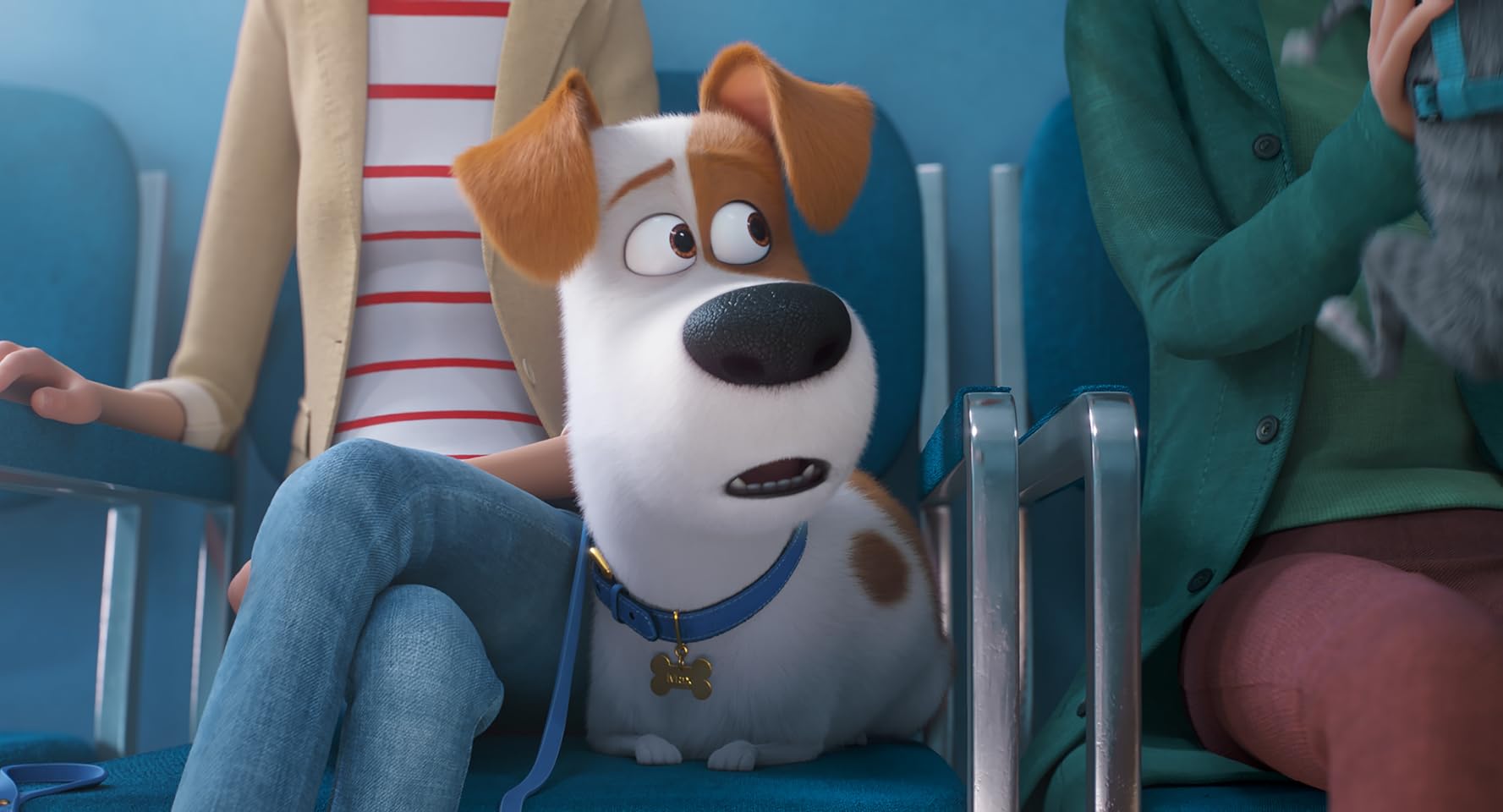
Max (Patton Oswalt) in The Secret Life of Pets 2. Image courtesy Universal Pictures.
The Secret Life of Pets 2 is an average entry in Illumination's animation stable. It's colorful and cheery, containing a skosh of inventiveness and a hint of weirdness or inspiration, just enough to maybe think the movie will actually be sort of interesting. Illumination movies never come close to fulfilling those flashes of interesting because of uninspired animation and static writing. Because mediocrity is easy, and it's far more profitable to be inoffensive than experimental.

Picking up some time following the events of the first film, Secret Life of Pets 2 is divided into three plots. Plot A has Max (now voiced by Patton Oswalt) and Duke (Eric Stonestreet) dedicating themselves to their owner's (Ellie Kemper) son Liam. They spend much of the film at a farm, with Max learning lessons about courage from the bold Rooster (Harrison Ford, clearly not caring). Plot B has Snowball (Kevin Hart) joining new dog Daisy (Tiffany Haddish) in an adventure to save a white tiger from the evil Sergei (Nick Kroll) and his wolves. They also run into the crotchety Pops (Dana Carvey) along the way. Plot C has Gidget (Jenny Slate) taking cat lessons from Chloe (Lake Bell) to get a toy back from some vicious kitties. The three plots eventually intersect in the third act, with the pets joining forces before getting rewarded for being very good dogs, cats, bunnies, and tigers.

Good lord is Secret Life of Pets 2 boring. Even with three plots, there isn't a lot actually happening on screen because the narratives are unambitious. The jokes rarely land, sort of stuck in this weird liminal state between catering to children and serving adults. Despite having quality comedic talent (Oswalt, Slate, Bell, Haddish, and even Hart), it's impressive how few jokes land. There are a few interesting ideas – a nice animation sequence with Snowball, the conclusion to Gidget's story – but not enough to ever be memorable. Things happen in Secret Life of Pets 2, but they're more incidentally quotidian than engaging.

The mistake of splitting Secret Life of Pets 2 into thirds is a lack of time for story development. Max and Duke at the farm with Rooster could be interesting, if the film allotted more time to add depth to the adventures and provide a concrete lesson that doesn't feel rushed. Snowball and Daisy saving the tiger is a fun idea, but it needs more time to build tension and establish the wolves as a full threat and give the tigers something more to do than hide. Gidget and Chloe is about as complete a story as this film has, but it could still use more time to explore the divine weirdness of its premise. This is pretty par for the course for Illumination, which toys with cool ideas but strays away to provide a mundane viewing experience.
 
If there's one thing Secret Life of Pets 2 has in its favor, its the relationship between Max and Liam. There's an inherent sweetness to watching a dog and his boy bond, with Max evolving into a guardian for his adoptive child. Even if this plot, like much of the rest of the film, is underdeveloped, the moment at the end where Liam hugs his dogs still hits the heart strings effectively. The brilliance is in its simplicity; the scene succeeds because it connects to a lot of childhood memories. If the movie knows one thing, it's that dogs are more often than not the best. (All scientific evidence shows my golden retrievers, Currie and Haley, were the best.)

That's one of the reasons I liked this movie more than the original. Haddish is a nice addition to the franchise, and adding her cuts down on Duke. Secret Life of Pets 2 cuts back heavily on the time padding and replaces it with actual plot, and an incomplete plot is far better than no plot at all. Adding Liam and avoiding a repeat of the jealousy plot of the original makes for a more touching film, albeit one that still feels incomplete. Secret Life of Pets 2 isn't particularly interesting, but it's inoffensive enough to keep kids occupied until the next Toy Story movie comes out. It's also really difficult to make an unappealing film about dogs.


Review: Two and a half out of Five Stars

Click here to see the trailer.
Rating: PG
Run time: 86 minutes
Genre: Animated
tl;dr

What Worked: Voice Talent, the Max-Liam Relationship

What Fell Short: Lack of enthusiasm, Underdeveloped Plots

What To Watch Instead: Madagascar 3: Europe's Most Wanted