Showing posts with label Jordan Peele. Show all posts

Thursday, June 20, 2019

Toy Story 4 is reliably fun and unexpectedly bizarre

Woody (Tom Hanks) and Bo (Annie Potts) in Toy Story 4. Image courtesy Disney.
You can see a bit of wear and tear on the Toy Story 4. The shine from the first three films has faded a little, the story finally feeling a little worn out after years for replay. The new toys can't fully reinvigorate a franchise that has been a rock for Pixar for nearly a quarter century. But even a rundown Toy Story is a joy to play with, still functioning at a remarkably high level. And in its old age, the franchise has embraced just how blooming weird its concept is.

Toy Story 4 brings back Woody (Tom Hanks), Buzz (Tim Allen), Jessie (Joan Cusack), Rex (Wallace Shawn), Hamm (John Ratzenberger), and the rest of Andy's old toys, showing them integrating into life with new owner Bonnie (Madeleine McGraw) and her toys Dolly (Bonnie Hunt), Trixie (Kristen Schaal), Buttercup (Jeff Garlin) and Mr. Pricklepants (Timothy Dalton). It doesn't take too long for Woody to go from favored toy to the back of the closet, replaced by new toy Forky (Tony Hale), who Bonnie create out of a spork and some garbage. An ensuing road trip results in Woody and Forky getting lost and stumbling into the seemingly nefarious Gabby Gabby (Christina Hendricks). Forky is captured, but Woody escapes and stumbles into his lost love Bo (Annie Potts) in the process. They are joined by a host of new toys like Giggle McDimples (Ally Maki), Ducky (Keegan-Michael Key), Bunny (Jordan Peele), and Canadian Evel Knievel knockoff Duke Caboom (Keanu Reeves) in their attempts to rescue Forky and reunite with Bonnie.

If the last bit seems familiar, it's because this is effectively the same general plot the franchise has relied on for more than two decades. A toy/multiple toys get lost, stumble into an adventure and escape from folks with malicious intentions, and return to their owner before the owner relocates. At this point the toys are boomerangs, trying ever so hard to return home despite the odds being heavily against them doing so. This formula worked great for three films, but in Toy Story 4 it feels a little played out, perhaps done just one too many times to have the same zip as the earlier films. If the film falls short, its caused by this fatigue that creeps into the events. The narrative is a little shaggier, the voice acting for Andy's crew a little less excited. The problem is worth calling as the main reason why Toy Story 4 can't quite hit the highs of films one through three.

The highs of this franchise are brilliance though, so falling short of brilliance still results in a mighty fine movie. In fact, Toy Story 4 often soars thanks to an abundantly weird tone that is a logical step for the franchise. Forky is the nexus for this oddness, a character that spends the first act desperately trying to dispose of himself out of fear of his newfound self awareness. The horror of his situation is surprisingly poignant, but the film focuses more on Forky as an existential joke and as a means of bringing out the best of those around him. As a character, his naivete bounces off Woody's weariness, giving Woody a new friend and combatant. Forky's innocence is a fountain of comedy, and a sign the film is willing to look deep into its history and reveal the tragedy of its premise. 
 
Forky's presence is a recognition of just how disposable its characters truly are. They are beloved by their owners for seconds or days or years, but ultimately they become forgotten, lost to the closet or an antique store to watch the world pass them by. What Toy Story 4 tackles with is the question of what one does when one isn't needed anymore, what the meaning of life is when your purpose is ripped away from you. For Woody, who has staved off his death for years, the answer isn't quite a reboot, but a little soul searching to evaluate what he has to offer to his owner, his friends, and the world at large. It's thoughtful and contemplative and ingenious, handled with grace and a hearty sense of humor. There's always room for a joke even when one is lost in an existential drift.

I hope Toy Story 4 is the final film of this franchise. This might not be the ideal way to end things – the final moment of Toy Story 3 are nearly perfect – but it's an excellent end to Woody's story. He's rewarded for his inherent decency and growth from selfish diva to a leader of toys, and there might not be much more to want from his story than this. If this is the end, it would serve as a pretty excellent final chapter to a very excellent series.

Review: Four and a half out of Five Stars

Click here to see the trailer.
 
Rating: G
Run time: 100 minutes
Genre: Animated

tl;dr

What Worked: Animation, Humor, Forky, Woody's Journey

What Fell Short: Redundant Plot

What To Watch as Well: Toy Story, Toy Story 2, Toy Story 3

Thursday, March 21, 2019

Us finds horror in implications and atmosphere

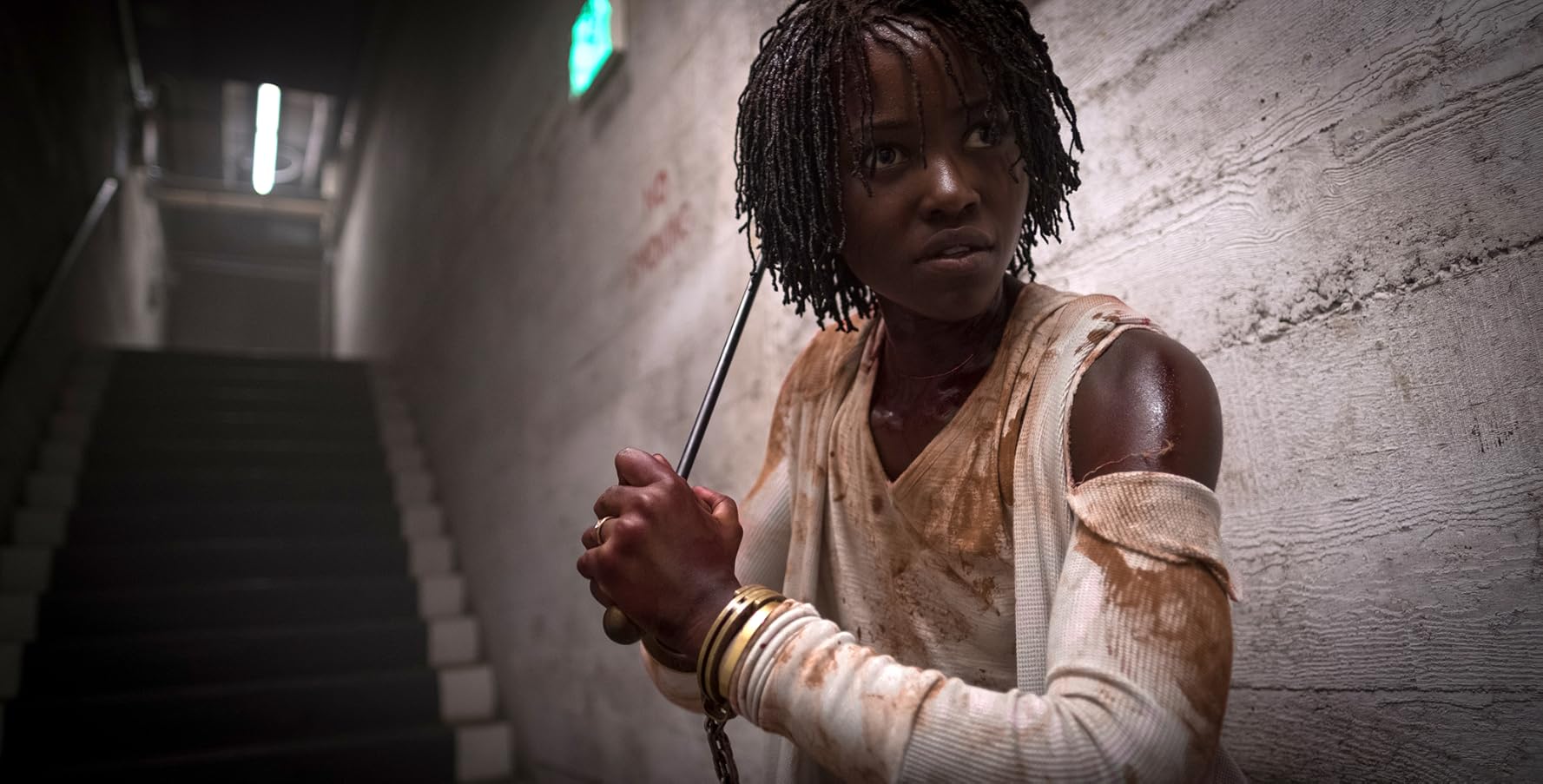
Lupita Nyong'o in Us. Image courtesy Universal Pictures.
There is something bothersome about Us, a slow dawning sense of terror that just lingers for a spell once the curtain closes and the lights go up. The film otherwise lacks a true moment of shock or terror – the jump scares are minimal, and the humor is ample enough to mitigate some of the traditionally scary moments – but goodness are the implications of Jordan Peele's film absolutely awful to dream about. Even as Us is hampered by ambitions it can't quite reach, it excels brilliantly at planting some dreadful thoughts and allowing them to grow.
 
Us stars, and is often carried by, the enigmatic Lupita Nyong'o. She plays Adelaide Wilson, a normal mom on vacation in Santa Cruz with her husband Gabe (Winston Duke), daughter Zora (Shahadi Wright Joseph), and son Jason (Evan Alex). It's a typical beach vacation – sun, sand, copious amounts of booze with friends Kitty (a great Elisabeth Moss) and Josh (Tim Heidecker) – except for a dark cloud that hangs over Adelaide. She has a bad childhood memory of running into another version of herself, and she can't escape the feeling she hasn't escaped her other self. Her fears come to fruition when their home is invaded by the Wilson's doppelgangers, who have murderous intentions for Adelaide and her family.

As shown in Us and Get Out, Peele has an excellent grasp of the fundamentals of horror. He's an expert at evoking discomfort even amid what are otherwise friendly and bright locations – a busy boardwalk filled with games and rides is just as terrifying as the spookiest of houses in Peele's hands. Something sinister lurks behind every corner, which works conceptually with Us, a movie whose universe contains a shallow mirror just below a vibrant surface. The Wilson family can't trust the upper-middle class shell they've created for themselves because right below the surface are the forgotten wishing for a taste of what they have.

And, well, there's a lot that can be read into that idea. Us could very well serve as a political statement, centering on the subjugation of a class of people who aren't even worth considering. The film could be a comment about the illusions of wealth, or about the strength of family. It can be about the emptiness of life in a technological age, about the ferociousness of motherhood, about fatalism, about the complexities of the soul. Peele's films are read as much as they are watched – he's just as skilled at planting clues as he is setting atmosphere – yet the message for Us is a little muddled. Peele has a lot to say about a lot of subjects with Us, and he can't deliver on everything he wants to say. The enormous ambition he has with this film is admirable and worth an attempt to emulate, but his drive toward divine profundity comes at the expense of a thematic direction and a modicum of sanity.

Us suffers a little from a tonal funk. The film relies a lot on its sense of humor – it's often as funny as it is scary – but the jokes undercut some of the vital gravitas of the horror. Moments designed for silent awe are infiltrated with uproarious laughter from the audience because they aren't quite sure which direction the film is leading them toward. The divide between humor and fear is often quite thin – a point Peele is very well aware of – but the film can't shed its jokiness enough for some of the horror to truly hit.

Well, at least in the moment. The brilliance of Us lies in the after scare, the residual fear that boomerangs back with more force than it was thrown. The final twist creates a rabbit hole of horrible thoughts and possibilities about the very nature of humanity and the lack of clarity between good and evil. It's a disturbing note to end a film on, the kind that results in a few chills and a restless night miles away from the theater. The point of Us is to leave its audience perturbed by these ideas. It wants to exploit the dark thoughts that reside in the depths of the mind and bring them to the surface, haunting the viewer like the best horror films should.

Review: Four and a half of Five Stars

Click here to see the trailer.

Rating: R
Run time: 116 minutes
Genre: Horror

tl;dr

What Worked: Lupita Nyong'o, Elisabeth Moss, Atmosphere, Implications

What Fell Short: Imbalanced tone, uncontrolled ambition

What To Watch As Well: Get Out, C.H.U.D.

Friday, February 24, 2017

Get Out delivers multitude of horrors

Daniel Kaluuya in Get Out. Image courtesy Universal Pictures.
It's pretty easy to see the objectives writer/director Jordan Peele wants to accomplish in his excellent feature debut, Get Out. He shows it in the first scene, where a random African-American man walks down a seemingly peaceful street at night, muttering to himself about being lost as a car ominously drives in the background. Peele, most renowned for his work with Keegan-Michael Key on Key and Peele, plays up the odd humor of the scenario before letting the horror swoop in, all the while playing with the audience's perception on horror conventions. A well-lit suburb at night is about as safe as a place can get, as long as you're white.
The horror Peele mines for Get Out is rooted in the black experience in an extremely white environment, which is the case when photographer Chris (Daniel Kaluuya) spends the weekend with his white girlfriend Rose's (Allison Williams) family (parents Bradley Whitford and Catherine Keener and a younger brother played by Caleb Landry Jones) somewhere in the woods. The whole experience is peculiar (as a friend of Chris played by LilRel Howry points out emphatically), but Peele makes it difficult for his protagonist to tell whether or not the situation is based on sinister motivations or the awkwardness from his hosts as indicated through their frequent dips into casual racism. The gap between the two is razor thin from an outside view, with clumsy good intentions and legitimate evil difficult to parse out. Using the slightly off concept is a standard horror trick built to disorient the protagonist and the audience, but Peele employs it as a way of seeing the world through his character's eyes, a clever trick to get one of his main points across.
Peele has many points to make with Get Out, and he uses uses horror as a vehicle for his social commentary about the complexities of racism. One of the most troubling points he makes comes from the fates of servants Walter and Georgina (Marcus Henderson and Betty Gabriel, respectively), the only two black characters Chris comes into regular contact with after leaving the city with Rose. Their behavior is remarkably discomfiting, exacerbating the overarching weirdness Chris absorbs, but the horror truly arrives when the reason for their odd behavior is revealed. It takes a second to think about it, but once that twist comes and the ramifications of it begin to permeate into the mind, the lack of respect held toward those characters becomes borderline heartbreaking. That’s an underlying theme for this film, in which the scares and fears are reinforced by tragedy.
Get Out is scary to think about, but it also offers its fair share of top notch horror. The film goes heavy on the psychological scares, showcasing the queer ambiance along with a few innovative ideas thrown in to ratchet up the anxiety. An impromptu therapy session between Chris and Keener's psychiatrist Missy results in some subtly bothersome imagery and the most menacing cup of tea ever depicted in film. It takes an innovative filmmaker to transform tea into a tool for evil, and it takes a damn good one to make it work. There is a battle though between serving the horror and throwing in a few laughs to lighten the proceedings and play more directly into Peele's background. It is a tough line to define given how easy it is for horror to devolve into comedy unintentionally, but he more often than not pulls off the tonal shifts with aplomb. He succeeds by having done some homework prior to filming, using some horror tropes (like the menacing groundskeeper) as a way of deriving laughs from the audience while still using them as a way of contributing to the atmosphere. It is funny to see the groundskeeper stare as Chris arrives with Rose, but the look he gives and his general reaction remain eerie regardless of how it’s played. The comedy feeds the horror, which later feeds the comedy that in turn feeds the horror, an ouroboros of emotional fluctuations.
There is a lot to unpack with Get Out and admittedly even more a person could sift through with additional viewings. It’s worth it for the intellectual challenge it offers, yet it does so without skimping on the horrors. Get Out is the ideal horror film, showing what a talented filmmaker can do with a proper understanding of the genre’s depths.

Review: Four and a half out of Five Stars

Click here to see the trailer.

Rating: R
Run time: 103 minutes
Genre: Horror

Ask Away

Target audience: Definitely great for horror junkies.

Take the whole family?: It gets pretty gory right around the end, albeit not quite enough to necessarily warrant an R rating. Around age 13 is more than fine.  

Theater or Netflix?: A theater trip would be appropriate for people who like horror.

What else does this film do well?: One of the things Jordan Peele excels at is subtly breaking down horror conventions. There are a few moments where the audience is trained to expect something bad to happen at that moment, only for it to serve as a vital plot point. It is pretty interesting to watch the audience react to its non-reaction, and it becomes a moment worth appreciating once the importance of the scene comes into play.

Watch this as well?: Get Out owes a bit of debt to the Invasion of the Body Snatchers films, along with the original Stepford Wives. For a movie with a similar sense of atmosphere, check out the great House of the Devil.

Thursday, April 28, 2016

That Darn Cat!

Keegan-Michael Key, Jordan Peele and a kitten in "Keanu." Image courtesy Warner Bros.
What surprises most about “Keanu” from the outset is the violence. A parody of films such as “John Wick,” “New Jack City,” and a plethora of crime/revenge films from the last 25 years, the movie opens with a bloodbath and maintains its violence streak. The shock comes from the involvement of stars Jordan Peele and Keegan-Michael Key, two very funny people whose sense of humor is rooted more in absurdity, silliness, and racial analysis than showing guys get shot in the head in the middle of a drug den. Even the last bit of a joke at the end of the opening sequence sets the tone though for what's to come, a movie that will indulge in a little silliness but stays a little too close to what inspired it. “Keanu” centers on a milquetoast suburban father (Key) and his cousin (Peele), who infiltrate a local gang after the latter's cat, Keanu, is kidnapped. Doing so requires them to pretend to be Omar-esque killers, the Allentown Boys, to meet with local drug lord/cat thief Cheddar (Method Man) and his main bruiser, Hi-C (Tiffany Haddish). Despite being very far out of their element, the two manage to pull it off for awhile, even as the people they're pretending to be (also played by Key and Peele) come searching for that cat. Everything comes to a head when an additional party also fights for little Keanu as blood and bullets rain down upon everyone and Will Forte is nearly eaten by a snake.
It’s worth mentioning the eponymous cat in “Keanu” is the most adorable MacGuffin in cinematic history. That kitten is so cute it explains why a cadre of drug dealers, murderers, and people with felonious intents would go out of their way to keep/steal him. It also happens to be the most clever gag the film has to offer, a running joke that a kitten could cause mayhem in a manner befitting Helen of Troy. It's a really weird joke that fits with the sense of humor Peele and Key offered in their Comedy Central program “Key and Peele,” but it works on another level too. There's an old screenwriting trope in which writers have characters save the cat (or some other little act of kindness) as a shortcut to establish heroic tendencies, the logic being a person decent enough to protect a helpless animal can't be too bad of a person. Except, in this case, in which everyone but Peele's geeky stoner Rell Williams – whose morals loosen as the film progresses – is a villain who acts in stereotypical villainous ways. With Keanu, their actions gain a hint of sweetness to them, as their intention shifts from killing wantonly to murdering to protect the cutest kitten imaginable. They become heroic by default, effectively proving the notion that saving the cat grants some heroic qualities to the worst of people; after all, nobody who saves a cat can be an evil man.
If all of “Keanu” were as smart and clever as this central joke, and if the film had probed a little deeper with its analysis of black identity that picks up in the second half before fading , it would be one of the funniest and smartest films in recent memory. For some reason though the film skirts away from the truly scary stuff, happy to revel in wanton violence but afraid to commit to the intelligence it flashes otherwise. It takes the easy route in dealing with the crisis of manhood Key's nebbishy Clarence Goobril faces concerning his wife (played by Nia Long), following the path forged by films like the atrocious “Malibu's Most Wanted” than finding anything interesting to say. The resolution to Peele's romantic subplot with Haddish's Hi-C has a similarly convenient vibe to it, an issue worsened by an overly truncated relationship between the two. Even the humor gets a little too simple from time to time, including one sight repeated gang that is inspired heavily from the film “Neighbors.” For two guys known for comic ingenuity, that comes as a severe letdown.
But there are a few moments when “Keanu” follows through with its bizarre potential and hits some pretty great comedic highs, like a terrific drug trip Key's Clarence undergoes involving an old George Michael music video and a conversation with Keanu's namesake. It’s a strange non sequitur befitting the stars’ sense of humor, as well as an indicator of what the film could be if it was a little less accessible. Then again, it’s impossible to hate a film featuring a cat as sweet as little Keanu.

Review: Three and a half out of Five Stars

Click here to see the trailer.
Rating: R
Run time: 98 minutes
Genre: Comedy

Ask Away

Target audience: People who enjoyed “Key and Peele.”

Take the whole family?: Considering how many dudes get shot up, along with a few scenes at a strip club, it's best to keep the kids at home.

Theater or Netflix?: You can wait to stream it.

Seriously, how cute is that cat?: It is seriously unfair how adorable little Keanu is. Michael Keegan-Key and Jordan Peele released a video in which they evaluate cats for the role, and while the nature of it is silly, the point remains that casting the correct animal is vital to selling the ridiculous premise. Compare that to a film like “A Talking Cat,” whose cat is so uninspiring the movie uses a different cat on its cover.

Watch this as well?: Visit Youtube to catch some clips from “Key and Peele.” Some of the highlights include the “East/West College Bowl” shorts, “Continental Breakfast,” “Substitute Teacher,” and, my favorite because of how bonkers the entire premise is, “Aerobics Meltdown.”