Showing posts with label Lupita Nyong'o. Show all posts

Thursday, March 21, 2019

Us finds horror in implications and atmosphere

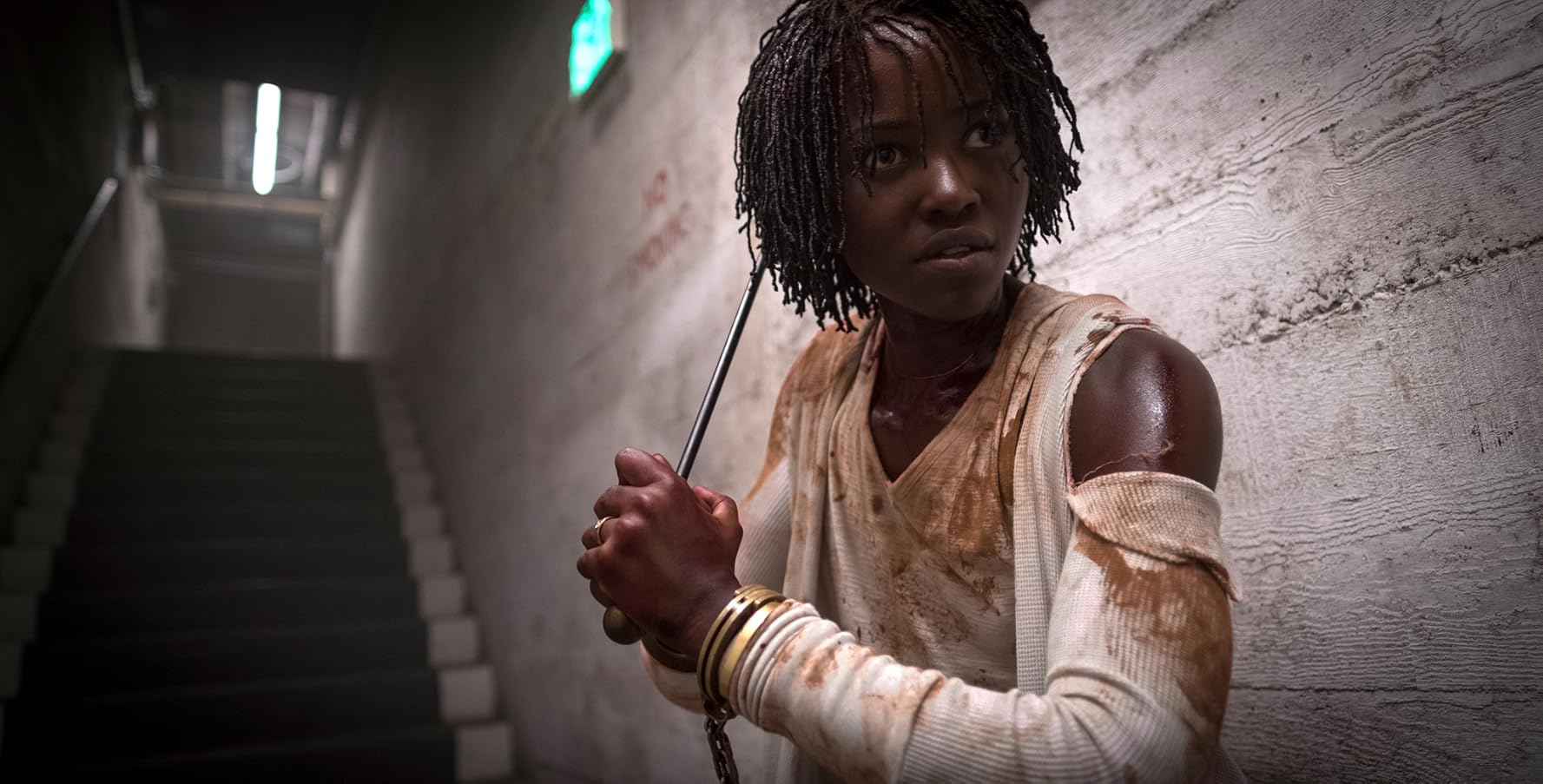
Lupita Nyong'o in Us. Image courtesy Universal Pictures.
There is something bothersome about Us, a slow dawning sense of terror that just lingers for a spell once the curtain closes and the lights go up. The film otherwise lacks a true moment of shock or terror – the jump scares are minimal, and the humor is ample enough to mitigate some of the traditionally scary moments – but goodness are the implications of Jordan Peele's film absolutely awful to dream about. Even as Us is hampered by ambitions it can't quite reach, it excels brilliantly at planting some dreadful thoughts and allowing them to grow.
 
Us stars, and is often carried by, the enigmatic Lupita Nyong'o. She plays Adelaide Wilson, a normal mom on vacation in Santa Cruz with her husband Gabe (Winston Duke), daughter Zora (Shahadi Wright Joseph), and son Jason (Evan Alex). It's a typical beach vacation – sun, sand, copious amounts of booze with friends Kitty (a great Elisabeth Moss) and Josh (Tim Heidecker) – except for a dark cloud that hangs over Adelaide. She has a bad childhood memory of running into another version of herself, and she can't escape the feeling she hasn't escaped her other self. Her fears come to fruition when their home is invaded by the Wilson's doppelgangers, who have murderous intentions for Adelaide and her family.

As shown in Us and Get Out, Peele has an excellent grasp of the fundamentals of horror. He's an expert at evoking discomfort even amid what are otherwise friendly and bright locations – a busy boardwalk filled with games and rides is just as terrifying as the spookiest of houses in Peele's hands. Something sinister lurks behind every corner, which works conceptually with Us, a movie whose universe contains a shallow mirror just below a vibrant surface. The Wilson family can't trust the upper-middle class shell they've created for themselves because right below the surface are the forgotten wishing for a taste of what they have.

And, well, there's a lot that can be read into that idea. Us could very well serve as a political statement, centering on the subjugation of a class of people who aren't even worth considering. The film could be a comment about the illusions of wealth, or about the strength of family. It can be about the emptiness of life in a technological age, about the ferociousness of motherhood, about fatalism, about the complexities of the soul. Peele's films are read as much as they are watched – he's just as skilled at planting clues as he is setting atmosphere – yet the message for Us is a little muddled. Peele has a lot to say about a lot of subjects with Us, and he can't deliver on everything he wants to say. The enormous ambition he has with this film is admirable and worth an attempt to emulate, but his drive toward divine profundity comes at the expense of a thematic direction and a modicum of sanity.

Us suffers a little from a tonal funk. The film relies a lot on its sense of humor – it's often as funny as it is scary – but the jokes undercut some of the vital gravitas of the horror. Moments designed for silent awe are infiltrated with uproarious laughter from the audience because they aren't quite sure which direction the film is leading them toward. The divide between humor and fear is often quite thin – a point Peele is very well aware of – but the film can't shed its jokiness enough for some of the horror to truly hit.

Well, at least in the moment. The brilliance of Us lies in the after scare, the residual fear that boomerangs back with more force than it was thrown. The final twist creates a rabbit hole of horrible thoughts and possibilities about the very nature of humanity and the lack of clarity between good and evil. It's a disturbing note to end a film on, the kind that results in a few chills and a restless night miles away from the theater. The point of Us is to leave its audience perturbed by these ideas. It wants to exploit the dark thoughts that reside in the depths of the mind and bring them to the surface, haunting the viewer like the best horror films should.

Review: Four and a half of Five Stars

Click here to see the trailer.

Rating: R
Run time: 116 minutes
Genre: Horror

tl;dr

What Worked: Lupita Nyong'o, Elisabeth Moss, Atmosphere, Implications

What Fell Short: Imbalanced tone, uncontrolled ambition

What To Watch As Well: Get Out, C.H.U.D.

Friday, April 15, 2016

The very pretty 'Jungle Book' a little light on content

Neel Seethi as Mowgli and Ben Kingsley's Bagheera in "The Jungle Book." Image courtesy Disney.
The frustrating thing with “The Jungle Book” is how much it teases the audience into being an excellent film instead of the good but underwhelming flick it ends up being. It is more often than not a visually stunning, engaging romp featuring a rather good child actor and some excellent voice work from its cast. And yet the problems arrive with a bang, a result of some dreadful decisions coupled with plotting issues that bog down the final act.
Yet another adaptation of Kipling's eponymous story collection, “The Jungle Book” centers on the adventures of feral child Mowgli (Neel Seethi), a so-called man-cub who lives a simple life with his family of wolves – including den mother Raksha (Lupita Nyong'o) and pack leader Akela (Giancarlo Esposito) – and is watched over by wise panther Bagheera (Ben Kingsley). At least, that is, until the day when vicious tiger Shere Khan (Idris Elba) proclaims his intent to murder the boy, forcing Mowgli to flee along with Bagheera to a human village. Their plans go awry due to tiger-related shenanigans, and poor Mowgli is left alone to fend for himself in unknown territory, surrounded by hypnotic python Kaa (Scarlett Johansson) and little creatures that steal his food. Fortunately he meets lazy bear Baloo (Bill Murray), who teaches the boy to embrace his human side and adopt a more carefree life. Baloo's teachings put Mowgli in a bit of a moral quandary, and it only gets more complicated once he runs into the sizable King Louie (Christopher Walken) and has to face down Shere Khan one last time.
“The Jungle Book” opens with a bang as young Mowgli scampers toward the viewer, escaping some momentarily unseen entity chasing him through the dangerous jungle. It's a terrific start to the film, hinting at Mowgli's ingenuity and cleverness while showing how he's both embraced and shunted a bit from his adopted family. The film at its best has a lot of these little details, including a running point in which Mowgli picks up a scar or two during every little adventure. It's a nice touch of verisimilitude for a movie that is fantastic by nature and by effect.
The film remains quite charming to a point, which comes out of the blue when Baloo starts singing “Bare Necessities” from the animated film. It’s a distracting moment that unleashes a floodgate of callbacks, lowlighted by a Walken performance of the very racist “I Wanna Be Like You.” That first moment with Baloo singing to himself unleashes a flood of flaws that dampen the viewing experience. The songs hinder the narrative flow, creating a rather rushed third act that also drains much of the film’s dramatic agency, a problem capped by a weak, puzzling and ultimately lazy finale. There’s also the insertion of a secondary revenge motivation involving Mowgli’s father, which highlights “The Jungle Book’s” major problem; writer Justin Marks’ disorganized script.
And yet the whole of “The Jungle Book” is just good enough to outweigh the weaker parts and is helped along greatly by Seethi, who performs more like a child then an actor, especially given that he acts alongside CGI creatures in a fake jungle. And the voice actors inhabiting those ersatz creatures are first rate. Elba is perfectly cruel and blasé as Khan, while Johansson plays a major part in providing what is the film’s best sequence; she has a knack for controlling her voice in a manner both alluring, sweet and subtly terrifying. Even Murray seems to be having a little fun as Baloo, who enters the film is a way Bill Murray enters people’s lives in real life.
Considering how much goes right with it, it’s still difficult not to consider the film at least something of a letdown though. Its flashes of brilliance – even the problematic third act has one really terrific visual moment – are enough to dream of what could have been for director Jon Favreau. Perhaps he and Marks were forced to shoehorn in the music numbers (although it wouldn’t explain why one song returns as an orchestral during a chase sequence) and add in the silly “Star Wars” inspired subplot, making for a more inspired film than what’s left. All that’s left to analyze though is what Favreau and company ultimately delivered; a very good but flawed film that comes very close to being exceptional.

Review: Four out of Five Stars

Click here to see the trailer.

Rating: PG
Run time: 105 minutes
Genre: Adventure
Ask Away

Target audience: Families with kids old enough to handle a little intensity. Speaking of which...

Take the whole family?: There's way too much going on kinetically and a couple of scary scenes that will turn off kids younger than 5.

Theater or Netflix?: Theater should be OK, but don't pay for the 3D if you have more than a child or two with you.

How racist is this?: Not as bad as it could be given the involvement of Disney and Rudyard Kipling. The main issue is the resurrection of “I Wanna Be Like You,” which in is a song about racial inferiority and efforts to become more “civilized.” It's one of many reasons Disney would have been better served excising the songs from this version.

Watch this as well?: Disney's first crack at Rudyard Kipling's short story collection has its charms, along with a heavy undertone of racism that makes it a little difficult to watch these days. Also flash back to one of those old “Tarzan” films Johnny Weissmuller; considering the Tarzan character is based on Mowgli, it brings things full circle.