Showing posts with label Disney. Show all posts

Friday, March 29, 2019

Dumbo's fun peculiarities overshadowed by poor storytelling

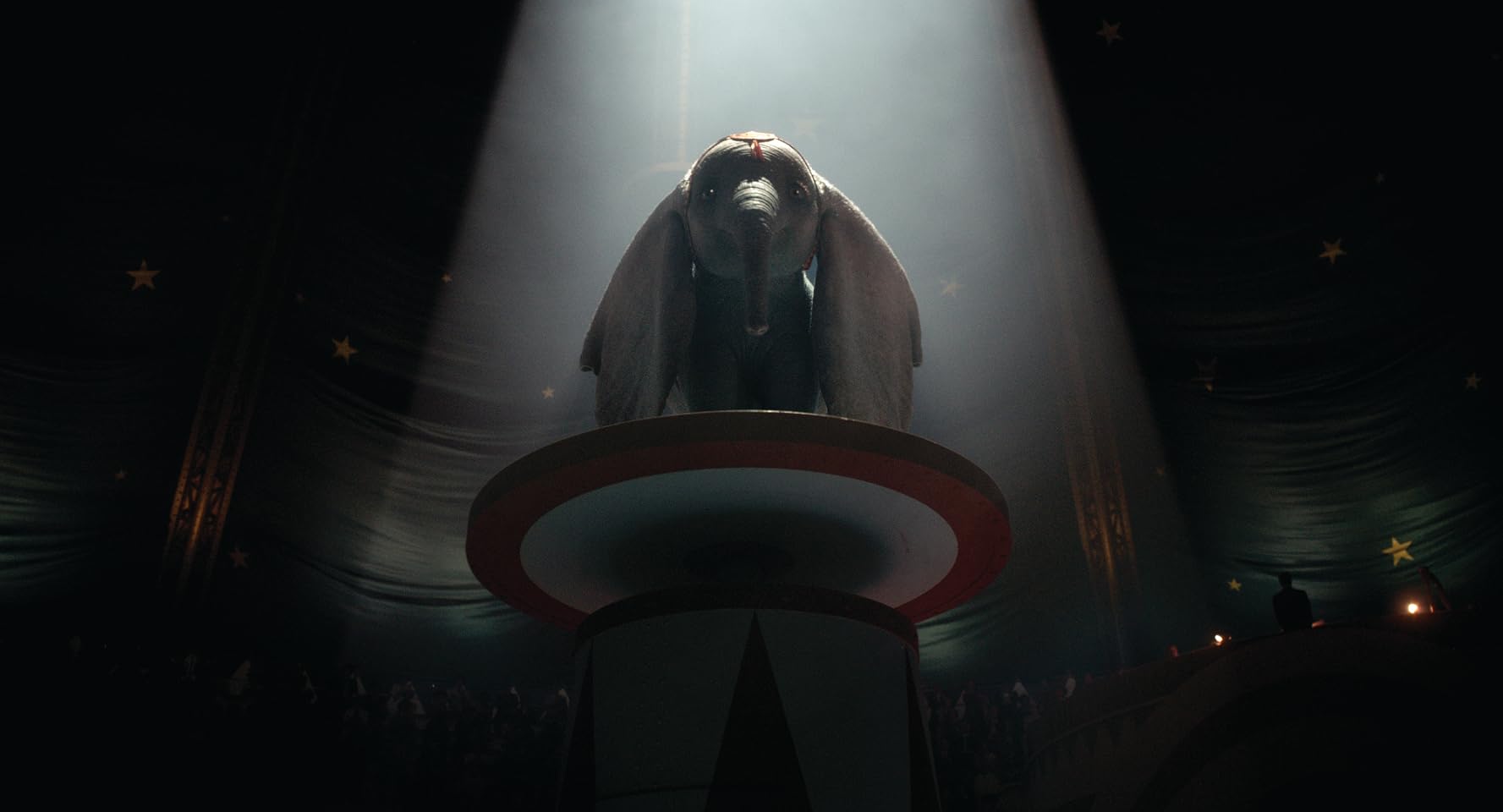
Dumbo in his film, Dumbo. Image courtesy Disney.
It's been awhile since Tim Burton has made an interesting movie. His recent slate of films have been either incomplete efforts – inklings of his old aspirations that never quite land – or yeoman work for Disney. Dumbo, Burton's interpretation of classic (and wicked racist) Disney film, fits more in the former category than the latter. It has a few moments of zaniness befitting Beetlejuice or Pee-wee's Big Adventure, but the result is often frustrating and ultimately slight.

Dumbo stars Colin Farrell as Holt Farrier, a cowboy returning home to circus life following his service in World War I. His transition back to being a performer is rocky at best; his wife died of influenza, leaving him alone with daughter Milly (Nico Parker) and son Joe (Finley Hobbins). Ringmaster Max Medici (Danny DeVito) has demoted him to elephant handler, and his chances of getting his old job back are stymied by the arm he lost in the war. But things start to turn with the addition of Jumbo the elephant, who soon gives birth to the eponymous large-eared creature. Once Dumbo starts to fly, he draws the attention of V.A. Vandevere (Michael Keaton), who runs the wondrous Dreamland in the big city. Vandevere wants to pair Dumbo with the high-flying Colette (Eva Green) to create the most magnetic act in town, but the Farriers soon learn Dreamland is little more than a facade.
 
The funny thing about Dumbo is the movie isn't about its titular character, but about the struggles of the Farrier family. It's a pragmatic script choice, as it's difficult to center the movie around a CGI elephant that doesn't speak, but it causes the film to lose a lot of its luster. The Farrier family troubles are far less interesting than the issues Dumbo and Jumbo face, or, rather, the film does a poor job selling the emotional complexities between Holt, Milly, and Joe. It's surprising considering how many hurdles screenwriter Ehren Kruger threw at the Farriers – a barely employed father returning from war without an arm to two children who recently lost their mother is kind of a cheat. Somehow, the film doesn't take advantage of the cheat it gave itself; the relationships are never given the time needed to grow from that problematic baseline. Things are awkward until they're not, and few bumps or troubles are depicted.

Even though the story is about the Farriers, the movie's heart belongs to Dumbo and Jumbo. Their connection is what should own the story, at least given the amount of heft Burton and Kruger put into the silent tale of mourning elephants. Yet the story balance is completely off; by dividing the narrative between the Farriers and the elephants, the film never gives enough time to either family unit to grow. . Making the movie live action effectively necessitates the addition of human characters to drive the story, but the human family is the worst part of this movie.

There's a lot to be frustrated with about Dumbo. The story is wonky and littered with holes – the flying elephant is the most realistic aspect of the movie. The dialog is uninspired, leaving the actors with little buffer to fail. The performances, aside from Keaton and Green, are spotty to weak. The filmmakers effectively doubled the run time of the original to add more story and didn't have much of a story to tell.

Except for the existence of Dreamland and Vandevere. This is about as close as viewers get to the old Burton, an oddly fascinating place that doesn't try too hard to be quirky. Dreamland contains a lot of potential as a setting, given the electric wonders and how poorly the lights hide the park's dark soul. It's a place where dreams come true, but the price is unfathomable, not too far removed from Pinocchio's Pleasure Island. Dreamland though is underutilized as a location; there's far more to the place than the film allows viewers to see because the first act is spent in the middle of nowhere. Perhaps Burton would have been better served setting the entire film in Dreamland, allowing the place's inherent creepiness to sell the inevitable feel-good ending. Dreamland is about as close as it gets to old-school Burton, making it so cruel how close Dumbo is to being the fantastically strange film its meant to be.

Review: Two out of Five Stars

Click here to see the trailer.

Rating: PG
Run time: 112 minutes
Genre: Fantasy

tl;dr

What Worked: Michael Keaton, Eva Green, Dumbo and Jumbo

What Fell Short: CGI, Inconsistent Acting, Script Issues

What To Watch Instead: Dumbo

Thursday, August 2, 2018

Christopher Robin short on plot, long on feels

Piglet, Pooh, Rabbit, Roo, Kanga, Tigger, and Eeyore in Christopher Robin. Image courtesy Disney
Christopher Robin never gets around to justifying its existence. From the outset, there was not a notable or interesting reason to revisit the titular boy after his adventures with Winnie-the-Pooh and friends concluded. He is defined by the innocence of his childhood and the curiosity that comes with it, as shown through his admittedly odd collection of anthropomorphic friends, and an adult version removes the childhood wonderment. As a result, the movie is pretty unexceptional, a term that is part insult and part compliment for a franchise in which the greatest adventures lie in the quotidian Ultimately, the disappointments of the movie's story are more than compensated for by the tale of friendship and the congenial tone that results in many smiles upon one's face.

Ewan McGregor stars as the eponymous character, now somewhere in his 30s and working as a bean counter at a luxury luggage company. He's dedicated to his job, much to the chagrin of his loyal wife Evelyn (Hayley Atwell) daughter Madeline (Bronte Carmichael). His plans for a weekend of rest and relaxation with his family are interrupted by a last-minute request by his boss Giles (Mark Gatiss) to shave 20 percent from the company's budget at the threat of losing his job. At the same time, Winnie-the-Pooh (voiced by Jim Cummings) has lost his friends Tigger (also Cummings), Eeyore (Brad Garrett), Kanga (Sophie Okonedo), Roo (Sara Sheen), Piglet (Nick Mohammed), Owl (Toby Jones) and Rabbit (Peter Capaldi) somewhere in the Hundred Acre Wood. A cinematic act of fate brings Pooh and Christopher Robin together again, each the only one who can help the other find what they are looking for.

Christopher Robin quite often evokes the best of the Winnie the Pooh franchise. Aside from Tigger's hyperactivity, the film's tone is calm and genial, focused on small moments and the profundity found within them. A simple party is a treasure, an event to be luxuriated in because of the company you're with and the memories that stay thereafter. There are few moments in life as pleasant as spending time with some very good friends, even if the occasion is a long goodbye. The themes of friendship in Christopher Robin ring very true. There's little to no sappiness or faux endearment in this movie; the fondness the characters have for one another are genuine and sweet. The room gets a little dusty when Pooh holds Piglet's hand, reassuring the scared creature that he is always needed. And even after 90-plus years of existence, Christopher Robin's friends remain as charming as ever. Piglet, Pooh, Eeyore (the film's MVP), Kanga, Roo, Owl, and Rabbit are a great collection of characters, quirky enough to have unique personalities but with an underlying love for one another despite their differences. Tigger can be a bit much, but the film holds his appearances back to reduce the scenery chewing inherent to his character. Christopher Robin makes it simple to see why it would be so difficult for the eponymous character to have to say goodbye, and how happy he would be to say hello again when they re-enter his life. 
 
The tremendously shallow story is Christopher Robin undoing. A grown up Christopher Robin forgoing his love of doing nothing is a trite narrative, compounded by the work-obsessed father forgoing his child plot. Hook did this more than 20 years ago now, as have pretty much every movie in which a character tries to recapture their childhood. The cliché would work if the movie had something interesting to say about the situation, but the film follows the tropes without expanding on them, using them as a crutch instead of a launching pad to something interesting. The pacing doesn't help this as well; the film spends so much time establishing Christopher Robin as a numbers-obsessed workaholic the inevitable dive back into pleasant times is rushed and unfulfilling.

That Christopher Robin focuses on Christopher Robin is to be expected. That the female characters are relegated as plot devices instead of people is disappointing. Despite her best efforts, Atwell's entire purpose in this movie is to chastise Christopher Robin for losing his laughter and lust for life, and there is little an actress can do with such a limited role. Carmichael's Madeline should at least serve as a mirror for Christopher Robin, but the film can only hint at the parallel without going into it because it allocates most of its time to Christopher Robin’s self discovery. Madeline is the great lost opportunity for this movie, the character who very well should be in the spotlight as much as Christopher Robin, if not more so.

There really isn't a great reason to see what happens to Christopher Robin as an adult. Christopher Robin doesn't provide the narrative justification for jumping ahead 30-odd years in his life, and the adventures Pooh and his friends have in this film does nothing to advance them as characters. Yet the film’s charm and goodwill override the lack of necessity. Sometimes, it's just nice to see some old, dear friends again.

Review: Three and a half out of Five Stars

Click here to see the trailer.
Rating: PG
Run time: 104 minutes
Genre: Family

tl;dr

What Worked: Brad Garrett as Eeyore, Jim Cummings as Pooh, the genial tone

What Fell Short: Narrative laziness, tropes

What To Watch As Well: Pete's Dragon, The Many Adventures of Winnie the Pooh

Thursday, November 23, 2017

Coco an emotional, spiritual journey

Miguel enters the Land of the Dead in Coco. Image courtesy Disney.
Coco is the darkest movie in Pixar history. Pixar has a knack for diving into some dark and sad territory, but this is the first time the company has centered its story on death. This story is literally about spirits and aging and the ever present thought of mortality. Pixar, being Pixar, translates a story about death into a visually-stunning, family-oriented, crowd-pleasing musical rife with joy and a few lessons for everyone. (Except the bad guy, whose moral retribution is among the most dreadful in Disney's long history of making the villains pay for their transgressions.)
At stake in Coco is both life and eternal life. The life of the precocious but impetuous Miguel (voiced by Anthony Gonzalez) is the most trenchant threat the movie has to offer, given the fear of dying at a young age is about as close to a universal horror as it gets for Coco’s young target audience. More existentially horrifying is the death that comes after death, as the spirit Héctor (Gael García Bernal) describes to Miguel after watching the already dead dissolve away into nothing. All life effectively ends once the world has forgotten about you, the memory imprinted into others is the flickering candle that keeps the souls fresh in the Land of the Dead. Death is inevitable, but a second death caused by the world forgetting you, and knowing that is exactly how one is fading toward oblivion, is terrifying and inevitable. Coco attempts to cover the darkness of its subject matter with what is a gorgeous depiction of the Land of the Dead. What could be shown as a dark and morbid place is depicted instead as a lively city light brightly and festooned with garish lights and lots of light hues, showing how the denizens of the Land of the Dead haven’t lost their humanity.
And yet, this is still a movie about an impossible to know subject explained to children with little cognizance of what death actually means. Coco resides in a very dark place for a Pixar film, putting its child protagonist at risk of a premature entry into the Land of the Dead from the start of act two. The film gives its young character an easy out by requesting forgiveness from long-dead matriarch Mamá Imelda (Alanna Ubach), under the condition Miguel abandons his love for music and adopts his family's shoemaker life. Miguel actively resists his dead family's help and instead searches for  guitar legend Ernesto de la Cruz (Benjamin Bratt) for absolution, preferring the possibility of death over the death of his passion. It's a headstrong and dangerous choice, albeit one the movie doesn't fault him for either. It's a Pixar tradition to have complicated moral lessons, never quite showing one side of an argument to be more right than the other. There are shades of correctness, areas in which compromise between the warring parties should take precedence because of their shared bond. A lesson is learned by all, but everyone learns their own lesson to reach the important middle ground. The problem, at least for Coco, is the plot machinations to get to those points is a little sloppy, even granted the relative lower bar set for animated movies (and the expository nature of musicals). The lessons are a little too easy to figure out for the characters, the journey toward self discovery a little too convenient. One of the major plot points is telegraphed in a manner that remains inexplicable, relying on a character making an incredibly dumb admission of guilt in a fictional format. The narrative can’t be this pointed to work as effectively as it could; being too blunt about the process lessens the effect of the lesson shared to the character, and to the audience as well.
It’s a frustrating problem, but forgivable for how wonderful the rest of the movie is. Coco is really, really easy to get lost to, the visuals complementing the music, which adds brightness to the morbid story. This movie is a reminder of what Pixar is capable of when it isn't chasing Cars money, providing joyous and heartfelt viewing experiences for children and adults. It's hard not to bob one's head along to the addicting songs and laugh at the gallows humor and enjoy Miguel’s family run by his Abuelita (Renee Victor). And it's especially hard not to sob uncontrollably in the third act when Miguel plays a heart-wrenching song to his great grandmother, the eponymous Coco. The build up to that moment is brilliant, the moment plays out gorgeously, and the movie earns every tear that will cascade from your eyes.

Review: Four and a half out of Five Stars

Click here to see the trailer.

Rating: PG
Run time: 109 minutes
Genre: Animation

Ask Away

Target audience: Families and Pixar junkies.

Take the whole family?: Coco is appropriately morbid given the subject matter, but it's bright enough to not scare off kids much younger than 7.

Theater or Netflix?: Totally worth watching it in theaters with the kids, especially after a long day of Black Friday shopping.

How's the soundtrack?: Pretty great, actually. Inspired by the Mexican milieu and its themes of memory, the music oscillates between fun and cheerful to mournful and heartbreaking. They're catchy, but in a quality way that doesn't make replaying the music for two days straight feel regrettable.

Watch this as well?: Most of the Pixar library is some variation of good to excellent. This one fits alongside Inside Out and Up in the break your heart category.

Friday, June 16, 2017

Cars 3 missing ambition, heart

Lightning McQueen (Owen Wilson) and Cruz Ramirez (Cristela Alonzo) in Cars 3. Image courtesy Disney.
Every time I write a review of a Pixar movie I hit up YouTube to watch clips from the older movies the company has made. It is a form of procrastination, but the clips do result in some inspiration from the wonders the company has produced over the years, or at the least cause me to sob uncontrollably (the opening to Up always gets me). Unfortunately, it's beginning to serve more of a trip down memory lane for when Pixar made great movies. Aside from the wonderful Inside Out, Pixar hasn't made a movie that qualifies as pretty good in about five years. Based on Cars 3, it's becoming more and more common to see exceptional movies like Inside Out be outliers, not standards.
To state it early on, Cars 3 is not a bad movie. The animation remains top notch, the racing scenes are effectively cool and engaging, and just enough of the jokes land to result in a few chuckles from kids in the audience. That, though, isn't Pixar. The company makes legendary animated movies that hit the soul like a hammer or captivate viewers with their sense of humor and great characters. At least, that's how it was for a rather long time. Then Cars came out and started to muddy Pixar's reputation. A wave of sequels to other movies started to drizzle out, some to fantastic (Toy Story 3), a couple to middling (Finding Dory) and at least one to dreadful (Cars 2) results. What's left now is the blend of the two, a third Cars movie a step below Finding Dory and mediocre enough to ask if Pixar has anything left in the tank.
What ultimately sinks Cars 3 is cynicism. This movie is designed to be a cash grab, offering little underneath the glossy patina to digest, or at least remember. Most movies are created to earn some level of profit – whether it be box office sales or merchandise – yet it remains disheartening how much of the focus for this movie is on the toys it'll sell in lieu of telling a solid, satisfactory story. It's particularly weird for this movie considering how much Lightning McQueen (voiced again by Owen Wilson) complains about becoming an empty mascot with little redeeming value beyond a brand name, protesting against the fate of his character in real life to no effect. The continued existence of the Larry the Cable Guy voiced Mater is proof enough that profit outshines creative ambition.
The push away from being a corporate shill is one of many, many messages a person could take out of Cars 3. That the writers undercut that a bit by also praising certain products featuring Lightning McQueen fits the loose moral center that guides this movie. The whole movie has this loose vibe, with plots that don’t go far enough to justify audience engagement or interest. It doesn't really matter that Lightning is intimidated by the fast new racer (Armie Hammer), or annoyed by the young trainer (Cristela Alonzo) who failed at her one shot at being a racer, or seeks life advice from the wise old truck (Chris Cooper) that taught his mentor, or discomfited by the materialistic company owner (Nathan Fillion). None of these plots are fleshed out enough to be interesting in and of themselves, and throwing them all together succeeds only at pushing the run time beyond any level of justification. The only theme that is tracked from beginning to end is McQueen's fear of getting old, which spurs him to try new training methods before giving up and reverting back to what he did before to spite the Moneyball-esque analysis that has apparently taken the love out of the sport.
What it adds up to is Trouble with the Curve mixed with Rocky IV mixed again with whatever racing movie or even feel good sports movie filled with clichés easily anticipated twists you've ever seen. Cars 3 is remarkable for its narrative laziness, and it's just boring watching Cars 3 because the expectations are planted early on and the big twists foretold with little subtlety. Even the themes are outlined blatantly by some awkwardly obvious song choices and bits of clunky expositional dialog. And, honestly, what's the point of watching a movie like this if it doesn't offer anything that hasn't already been done before? It'll keep the kids moderately entertained for nearly two hours, but that's the expectation for movies from lesser studios like Illumination, not one as great as Pixar.

Review: Three out of Five Stars

Click here to see the trailer.

Rating: G
Run time: 109 minutes
Genre: Animated

Ask Away

Target audience: Kids for sure, and along with parents trying to keep their kids occupied for nearly two hours.

Take the whole family?: Nothing too scary or intimidating about this one. Aside from a far too long run time, this is fine for all ages.

Theater or Netflix?: Matinee if you must.

How's the short film?: Really quite charming, if a little strange. Called Lou, the short about a sentient collect of lost and found items that sort of torments a child to be decent is sweet in its own way and often pretty funny. At the least it is far more interesting than the featured attraction.

Watch this as well?: Pick just about any Pixar movie unrelated to the Cars franchise and you'll get some entertainment out of it (along with lots upon lots of tears). For adults, this movie has a lot of parallels to the very strange but fun Will Ferrell racing flick Talladega Nights: The Ballad of Ricky Bobby.

Friday, March 17, 2017

Beauty and the Beast offers stale retelling of tale as old as time

Beast (Dan Stevens) and Belle (Emma Watson) in Beauty and the Beast. Image courtesy Disney.
There are a number of problems plaguing the live-action version of Beauty and the Beast in theaters today, but the totality of the film’s issues is summarized in one simple statement: This movie never justifies a reason to exist independent of the original. There are a few differences in this one when compared with the 1991 animated classic, some character changes and a fattened up run time to make it appropriate for these sorts of adaptations. None of it, though, offers a significant artistic reason for Disney to reboot Beauty and the Beast. It  banks on nostalgia to ride through some placid waves of mediocrity, trading excellence for subpar exchanges.
The troubles start from the get-go with a retelling of the tale of how a young prince (Dan Stevens) and his loyal staff (consisting of Ewan McGregor, Ian McKellen, Emma Thompson, Audra McDonald, Gugu Mbatha-Raw, Nathan Mack and Stanley Tucci) receive the curse that turns them into the titular Beast and a collection of personified furniture and knickknacks. It's a longer rendition than the animated one, acted out by the characters in a way that does not align with the voiceover narrative going on at the moment. That points to the heart of the problem with 2017's Beauty and the Beast; you the story doesn’t change, it just has more to it at a lesser quality. More is somehow less and yet still the same.
So what do audiences get with the extra 45 minutes of screen time with Beast, Belle (Emma Watson), Garcon (Luke Evans), LeFou (Josh Gad) and the kooky servants of the decrepit castle? They receive more backstory explaining why Beast is as he is (the reason is a dead mother, because Disney can't not have a dead parent). They find out why Belle's father (Kevin Kline) is a single father (the reason is yet another dead mother). They get a few more songs thrown in, none of which hold a candle to the exceptional numbers ported over from the original. They have more time to discover plot holes and think about how weird it is to eat from a spoon that was a person. They generally get useless content that provides no greater understanding of Beauty and the Beast. That is, except, for one change concerning the characterizations of Beast and Garcon. This version widens the personality gap between the two, turning Beast into a curmudgeon instead of a cold-hearted brute and cranking up Garcon's villainy to cartoonish levels. Beast is now a misunderstood loner, while Garcon is the jock who takes the bullying several steps beyond what is reasonable. I can understand the motivation to avoid the moderate similarities of the two characters found in the first Beauty and the Beast that gives some logic to Garcon’s actions, but the way the result pushes it so far to the other end the narrative arcs get bumped away in the process. All of that focus on those two leaves little else for poor Belle to do but sit and watch as the men fight. There are 45 more minutes to work with, and the filmmaker couldn't spare additional time to add depth to Belle’s story.
The most distracting thing about this Beauty and the Beast is the visual divide between Watson's Belle and the CGI rendering of Stevens' Beast. The characters never look quite right standing next to each other, the poor quality of Steven's CGI character clashing greatly against Watson. A few action scenes in particular make Beast look like a meh video game character as he leaps awkwardly from one spire to the next like a drunk King Kong. It kills any sense of verisimilitude between the two characters, putting one in a real world while banishing the other to a computerized realm.
Aside from all that, there are precious few differences between the 1991 Beauty and the Beast and its 2017 followup; it has almost everything the original does, but done slightly to largely worse. This new version isn't capable of standing on its own, nor does it seem to want to be anything beyond a real version of the animated classic. Riding on coattails is an OK strategy for financial success – and it will probably do more than fine at the box office – but a terrible one for earning a cinematic legacy.

Review: Two out of Five Stars

Click here to see the trailer.

Rating: PG
Run time: 129 minutes
Genre: Fantasy

Ask Away

Target audience: People who have really, really fond memories of the original.

Take the whole family?: A few scenes get a little heavy, but on the whole the material is safe enough for kids.

Theater or Netflix?: Just wait for it to come to you and avoid the price gouging.

What up with LeFou?: There's apparently been a decent amount of hubbub over Josh Gad's LeFou, who is apparently gay per Gad. Despite some shouting from certain countries, the movie minimizes his character’s sexual orientation and makes it largely a non-issue. The only scene that offers a direct indication of LeFou’s sexuality lasts for about five seconds and is nowhere near salacious. There is almost nothing to any of this, because Disney prefers to stay well within the boundaries of social progression.

Watch this instead?: Go dig out the DVD of the original and watch it a few more times.