Showing posts with label Michael Keaton. Show all posts

Friday, March 29, 2019

Dumbo's fun peculiarities overshadowed by poor storytelling

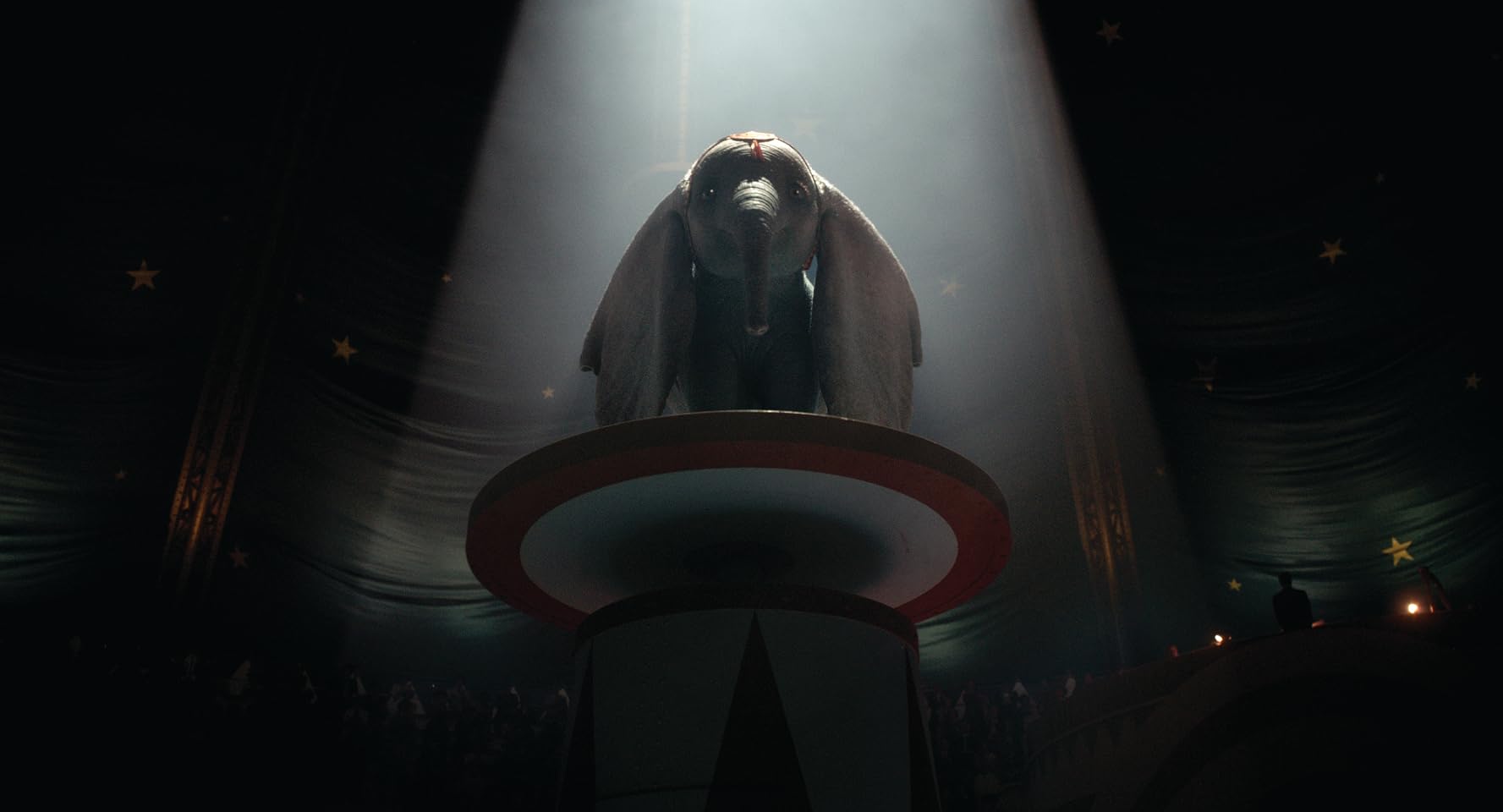
Dumbo in his film, Dumbo. Image courtesy Disney.
It's been awhile since Tim Burton has made an interesting movie. His recent slate of films have been either incomplete efforts – inklings of his old aspirations that never quite land – or yeoman work for Disney. Dumbo, Burton's interpretation of classic (and wicked racist) Disney film, fits more in the former category than the latter. It has a few moments of zaniness befitting Beetlejuice or Pee-wee's Big Adventure, but the result is often frustrating and ultimately slight.

Dumbo stars Colin Farrell as Holt Farrier, a cowboy returning home to circus life following his service in World War I. His transition back to being a performer is rocky at best; his wife died of influenza, leaving him alone with daughter Milly (Nico Parker) and son Joe (Finley Hobbins). Ringmaster Max Medici (Danny DeVito) has demoted him to elephant handler, and his chances of getting his old job back are stymied by the arm he lost in the war. But things start to turn with the addition of Jumbo the elephant, who soon gives birth to the eponymous large-eared creature. Once Dumbo starts to fly, he draws the attention of V.A. Vandevere (Michael Keaton), who runs the wondrous Dreamland in the big city. Vandevere wants to pair Dumbo with the high-flying Colette (Eva Green) to create the most magnetic act in town, but the Farriers soon learn Dreamland is little more than a facade.
 
The funny thing about Dumbo is the movie isn't about its titular character, but about the struggles of the Farrier family. It's a pragmatic script choice, as it's difficult to center the movie around a CGI elephant that doesn't speak, but it causes the film to lose a lot of its luster. The Farrier family troubles are far less interesting than the issues Dumbo and Jumbo face, or, rather, the film does a poor job selling the emotional complexities between Holt, Milly, and Joe. It's surprising considering how many hurdles screenwriter Ehren Kruger threw at the Farriers – a barely employed father returning from war without an arm to two children who recently lost their mother is kind of a cheat. Somehow, the film doesn't take advantage of the cheat it gave itself; the relationships are never given the time needed to grow from that problematic baseline. Things are awkward until they're not, and few bumps or troubles are depicted.

Even though the story is about the Farriers, the movie's heart belongs to Dumbo and Jumbo. Their connection is what should own the story, at least given the amount of heft Burton and Kruger put into the silent tale of mourning elephants. Yet the story balance is completely off; by dividing the narrative between the Farriers and the elephants, the film never gives enough time to either family unit to grow. . Making the movie live action effectively necessitates the addition of human characters to drive the story, but the human family is the worst part of this movie.

There's a lot to be frustrated with about Dumbo. The story is wonky and littered with holes – the flying elephant is the most realistic aspect of the movie. The dialog is uninspired, leaving the actors with little buffer to fail. The performances, aside from Keaton and Green, are spotty to weak. The filmmakers effectively doubled the run time of the original to add more story and didn't have much of a story to tell.

Except for the existence of Dreamland and Vandevere. This is about as close as viewers get to the old Burton, an oddly fascinating place that doesn't try too hard to be quirky. Dreamland contains a lot of potential as a setting, given the electric wonders and how poorly the lights hide the park's dark soul. It's a place where dreams come true, but the price is unfathomable, not too far removed from Pinocchio's Pleasure Island. Dreamland though is underutilized as a location; there's far more to the place than the film allows viewers to see because the first act is spent in the middle of nowhere. Perhaps Burton would have been better served setting the entire film in Dreamland, allowing the place's inherent creepiness to sell the inevitable feel-good ending. Dreamland is about as close as it gets to old-school Burton, making it so cruel how close Dumbo is to being the fantastically strange film its meant to be.

Review: Two out of Five Stars

Click here to see the trailer.

Rating: PG
Run time: 112 minutes
Genre: Fantasy

tl;dr

What Worked: Michael Keaton, Eva Green, Dumbo and Jumbo

What Fell Short: CGI, Inconsistent Acting, Script Issues

What To Watch Instead: Dumbo

Friday, July 7, 2017

Homecoming gives Spider-Man a fresh start

Spider-Man (Tom Holland) keeps things together in Spider-Man: Homecoming. Image courtesy Sony.
One of the things that makes Spider-Man: Homecoming fun and worthwhile is the direction Marvel took eponymous character. Or, rather, the direction they didn’t take in what is, technically, a reboot for a flailing franchise. Instead of going back to the beginning and rehashing the origin story, this movie is about the growing pains the character suffers after discovering his powers but not quite learning how to control them either. Homecoming is proof that watching a hero fail repeatedly can be more interesting than watching them succeed.
Shifting focus away from a retreaded origin story makes a lot of sense. Practically speaking the Spider-Man origin story is well-covered territory in comics, cartoons and movie theaters (this marks the fifth Spidey flick in the last 15 years). Marvel – taking over the creative work from Sony – banked on the character being known enough to make a reboot redundant, and the result is a movie focused less on how Peter Parker (now played by Tom Holland) became Spider-Man and more on the aforementioned trials and errors he endures to become a hero. Unlike in previous iterations in which the follies are glossed over, this mid-teen Spider-Man spends most of the movie crashing into walls and rooftops and succeeding because of his wits but in spite of his inherent clumsiness. Even his big battle with Adrian Toomes/the Vulture (Michael Keaton) is won by Spidey's ability to find moderate competence. This isn't necessarily new ground for a superhero movie, but it is a refreshing break from the strict formula Marvel and D. C. have followed in recent years.
Homecoming is refreshing, light summer flick of a movie. A fair portion of the story takes place in and around Parker's high school and involve the foibles of his best friend (Jacob Batalon), crush (Laura Harrier), rival (Tony Revolori) and constant observer Michelle (Zendaya). The setting is smart for a movie about Spider-Man, as his high school misadventures are often overshadowed by dangerous opponents and the fact that previous actors to receive radioactive spider bites are far too old for high school (Holland at least looks the part). Homecoming follows the same path as the better Marvel movies by blending the superhero genre with something else, in this case the classic John Hughes movie. What that provides is a balance for the life of a superhero against the inherent drama of being a teenager, with the obligations of homework, detention, and constant supervision by his protective Aunt May (Marisa Tomei) getting in the way of the superhero responsibilities.
In a universe populated by gods and aliens and green monsters rocking purple pants, everything in Homecoming is refreshingly human. The closest thing to a super powered being this movie has is Tony Stark (Robert Downey Jr.), whose powers are based on his relentless drive and inability to just stop tinkering with the things around him. He's also sort of a villain in this movie because of his incessant meddling, or at least the impetus for the start of the Vulture's career as a villain. One of the common traits for these Marvel movies is the consequences of heroism, or at least what happens when Tony Stark messes up and the effect his failures have on the world around him. Stark's business pursuits nearly cost Toomes his livelihood, directing a person who is at heart a working class fellow to turn to crime to support his family. His grand plan does not entail destroying the world or taking over the universe; he just wants his family to live in a nice house and to keep his friends employed, at least until the life of crime inevitably corrupts his sense of morality. One scene in particular reveals how conflicted Toomes is as a person, understanding the good his enemy has done but still willing to kill if it means keeping his family safe. That combination, along with a great performance by Keaton, makes him the perfect starter villain for an inexperienced Spider-Man.
Homecoming’s main downer are a few false notes it hits in the third act. They’re rooted in the one cliché it couldn't avoid; the hero's moments of self doubt that require deep existential pondering. It would have been more interesting if the movie was willing to step around that trap, but as is Homecoming remains refreshingly enjoyable and an excellent restart for Spider-Man.

Review: Four out of Five Stars


Click here to see the trailer.

Rating: PG-13
Run time: 133 minutes
Genre: Action

Ask Away

Target audience: Viewers who continue to follow everything happening in the Marvel Cinematic Universe.

Take the whole family?: This is a tamer PG-13 movie, so bringing the kids along to watch it won't be too rough on them.

Theater or Netflix?: It's big enough effects wise to justify a theater experience.

Is there an end credit scene?: There sure is, and it is my favorite MCU one thus far. It's worth sticking around for because it pays off a recurring joke and hits the tone of the movie itself. Nothing groundbreaking is revealed, although it serves as a pretty great capper to a very good movie.

Watch this as well?: This movie falls just a few steps short of besting Spider-Man 2, one of the great superhero movies. The first Spider-Man movie with Tobey Maguire and Kirsten Dunst is worth a watch, as are a few of the cartoons that have come out. I'm partial to the Spider-Man animated series from mid 1990s; that, plus X-Men, made for a pretty solid Saturday morning

Friday, November 6, 2015

Shining a light into moral darkness

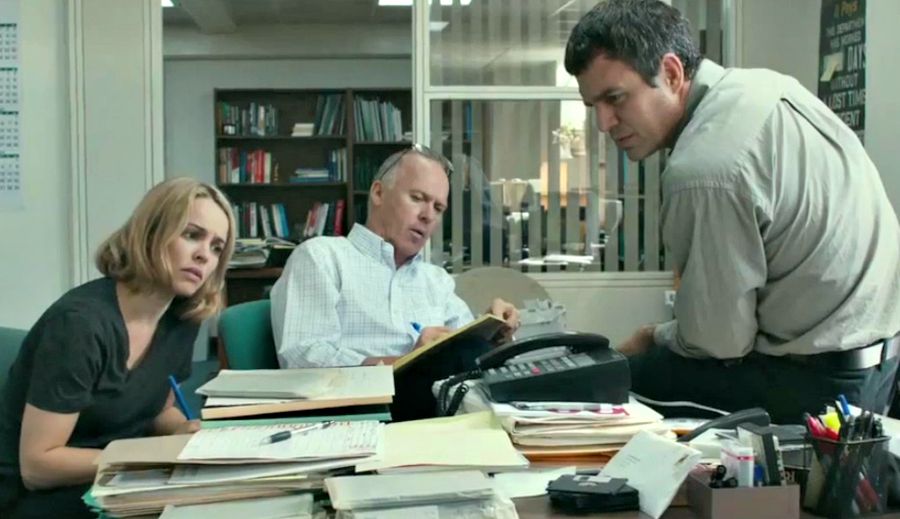
Rachel McAdams, Michael Keaton and Mark Ruffalo in a scene from "Spotlight." Image courtesy Open Road Films.
The remarkable and thrilling “Spotlight” could have taken the easy way out in its retelling of a deep, complicated investigation into a series of child abuse cases perpetrated by Catholic priests and hidden by church officials. Instead of taking the easy route and keeping the blame on the church, the film instead shines a metaphorical light at a society that quietly condones the behavior; as the film explains it, the lawyers, cops, community and even the newspaper investigating the allegations are to blame. From the film’s perspective, it takes a village to fail a child.
The newspaper in question is the venerable Boston Globe, the most well-known newspaper in New England. After a quick trip to a police station in 1976 – a scene used to set up the ensuing reporting – “Spotlight's” action picks up in the Boston Globe office circa 2001 amid a time of great tumult for the paper. New editor Marty Baron (Liev Schrieber) is already talking budget cuts to reduce the expenses of a paper losing its readership steadily, and those cuts could include the titular Spotlight team, an secret investigatory unit overseen by Ben Bradlee Jr. (John Slattery) and consisting of editor Robby Robinson (Michael Keaton) and reporters Mike Rezendes (Mark Ruffalo), Sacha Pfeiffer (Rachel McAdams) and Matt Carroll (Brian D'Arcy James).
The Spotlight unit usually selects its own stories to dig into – those stories are then kept secret even within the Globe's newsroom – but Schrieber pushes an article about alleged sexual abuse of children by Catholic priests. The proposition is met with some resistance from the staff, many of whom grew up Catholic and are cognizant of the church's influence in the area; as one character points out, a majority of the Globe's subscribers are Catholic. Still, the Spotlight team inquires about the allegations, talking with victims, a psychologist, and lawyers involved with settlements involving the church (Jamey Sheridan and Billy Crudup). They also work with an eccentric attorney (Stanley Tucci's Mitchell Garabedian) who represents a number of clients abused by priests and claims he has proof the scandal reaches to the head of the city's diocese, Cardinal Bernard Law (Len Cariou). The reporting starts off with a handful of priests, but the journalists find themselves going down the proverbial rabbit whole as the research deepens and the number of priests involved increases exponentially.
The story is horrifying in its nature, and “Spotlight” never pulls its punches when discussing what exactly happened to these victims. The details as described in the film are heart wrenching, as is the outline of how the priests preyed upon the children. As one character says while listing the step-by-step details of how his priest groomed him, “How do you say no to God?” The statement alone is terrifying, as is the empty promises made by church officials in that very first scene at the police station in 1976 after a parent is dissuaded from pressing charges against a priest: “This will never, ever happen again.”
And yet it does, again and again and again and again for decades and to hundreds of children throughout the greater Boston area. “Spotlight” offers all of its sympathy to the victims of those actions; everyone else, however, has blood on their hands. The church is castigated repeatedly for allowing the abuse to happen and shifting priests from one parish to another to hide the allegations; the state is guilty of looking the other way whenever allegations arose; attorneys representing the church and the victims share guilt for making money from the settlements; and the community deserve scorn for pretending the problem wasn't there. Even the Globe is called out in “Spotlight” for ignoring evidence sent to it years before the investigation actually started.  
Director Tom McCarthy and co-writer Josh Singer do marvelous work setting up the atmosphere in which deference to the church is mandatory so they can show how much effort is required to report on this story. They focus on the process of breaking through the wall that covers basic research and people skills to political haggling, bartering and outright bullying when needed. The process makes for fascinating cinema because of how difficult it can be to get people to do the right thing.
Not that the reporters are men and women filled with an overabundance of courage and bravery; “Spotlight” portrays them as clever, resourceful professionals committed to doing their job and nothing more. They are human, prone to fears of their family’s safety and outright anger as the revelations become more and more horrifying. This is an issue that is worthy of righteous anger, but “Spotlight,” to its credit, never succumbs to that temptation; its mission, like the one the reporters take, is to tell the story and let the facts speak for themselves.

Review: Four and a half out of Five Stars

Click here to see the trailer.

Rating: R
Run time: 128 minutes
Genre: Drama

Ask Away

Target audience: Newspaper nerds and anyone down for a well-executed investigatory flick.

Take the whole family?: Although the film isn't graphic about the content, the information it does provide will bother younger kids. Early teens and older should be fine though.

Theater or Netflix?: Good enough to justify a theater trip.

Academy Award odds?: It's among the favorites for the top prize – although a ton can and probably will change after the nominations come out – and director Tom McCarthy could get a nomination for directing and for Best Original Screenplay alongside co-writer Josh Singer. There's a good shot Mark Ruffalo and Michael Keaton become finalists for Best Supporting Actor, and Rachel McAdams might sneak in for Best Supporting Actress. All are uniformly well deserved nominations.

Watch this as well?: “All the President's Men” is the most obvious companion piece. However, definitely add in “Zodiac” – among the best movies to come out this millennium – and the smaller-scoped “The Paper” (also featuring Keaton) to your journalistic viewing list as well.