Showing posts with label Jamey Sheridan. Show all posts

Friday, September 9, 2016

Drama sucked out of Sully

Aaron Eckhart and Tom Hanks in Sully. Image courtesy Warner Bros.
Sully shows how easy it can be to botch the story of a man saving 155 lives after crashing an airplane into the Hudson River. It manages to do so despite having an incredible real-life story to work from, a very capable director in Clint Eastwood, and professional nice guy Tom Hanks playing the eponymous pilot, Chesley “Sully” Sullenberger. Yet the film still boggles up a great story, exchanging the interesting tidbits of self doubt and crisis for a celebration of one man and creating a rather one-note and flat piece of cinema.
It's hard to pin down what Eastwood and screenwriter Todd Komarnicki are trying to convey with Sully. The film has a habit of bouncing wantonly between points and changing narrative directions and tone for reasons known to the two men responsible for this film and no one else. It's quite odd, really, how the film opens with Sullenberger expressing self doubts about his actions and experiencing severe PTSD, only to drop them when the need apparently arises to honor the man. The final sequence is an outpouring of adoration for the man in the film's fictionalized universe and in reality via a short promo where Sullenberger literally stands behind an American flag boldly. In between the praises for Sullenberger is one of the worst final scenes in recent memory, a final moment that offers no catharsis or introspection or proper closure to a hypothetically emotional narrative. That leaves the man himself left out of the equation to bow to the collective cheers and applause from audiences. Perhaps the poor quality of the film itself is for the man's benefit; people cheering at the end credits are probably focused more on his incredible act of aviation brilliance than the abstract concept of a film that replicated it.
To be fair, the man has earned all of the accolades and praise he receives for that one feat of impossibility, as well as the right to have Hanks play him on screen. At this point in his long and terrific career, Hanks seems to have a fetish for portraying men of high moral values (or at least the perception of said values) who serve as shining beacons through the morass of the human soul. This isn't Hanks' finest performance – he is getting a little too close to self parody – but he offers the kind of performance one should expect from him, albeit not at the Hanksian level he reached last year in Bridge of Spies. That the people around him – a co-pilot played by Aaron Eckhart, the Great Laura Linney (tragically trapped on the other end of several phone calls), various union representatives – are designed more as cheerleaders than actual people doubles down on the need for an exceptional lead performance. Their main purpose is to offer comfort to Sullenberger from the external figures the film portrays as trying to “get” Sullenberger. Eastwood and Komarnicki almost make the characters of the NTSB panel investigating the crash (led by Mike O'Malley, Anna Gunn and Jamey Sheridan) mustache-twirling villains hell-bent on outing Sullenberger as a poor pilot. Making a government board a villain is a rather lazy plot point; having them almost immediately join the sides of angels at the end adds an extra level of screenwriting sloth.
Sully could be all about Sully if Eastwood and Komarnicki had centered it on the character and perhaps mentioned the crash without showing it on screen, and it appeared for a while they might indeed skip over the incident. The idea of not showing the crash into the Hudson is intriguing, allowing for a heavier focus on the central figure and letting the nightmares the man has about what happened serve as a reminder for the worst case scenario. Instead, Sully builds up to the crash (actually showing it twice from different, asinine perspectives), establishing the happy ending while reducing the fear evoked during the crash. Good filmmakers can wring drama out of events in which the audience knows the ending (The Walk does this brilliantly); taking so long to get there only decreases the tension. That Eastwood and Komarnicki do it once again exacerbates the initial problem and Sully’s most notable flaw; it’s tough to succeed as a drama when the dramatic moments lack intensity.

Review: One and a half out of Five Stars

Click here to see the trailer.

Rating: PG-13
Run time: 96 minutes
Genre: Drama
 
Ask Away

Target audience: People who enjoy watching Tom Hanks embody human decency.

Take the whole family?: The crash sequences will get a little intense for kids, so keep within a year or so of the PG-13 rating.

Theater or Netflix?: Home rental is better, but don't pay for the IMAX experience if you do go out.

Oscar Odds?: It'd be a problem if this film earned a Best Picture nomination or anything related to the screenplay and directing. Depending on how the rest of the year shakes out, Tom Hanks might be the best best (and possibly a deserving candidate) for an individual nomination, and it could get a few technical nods to boot.

Watch this instead?: The gold standard for this type of film remains the unimpeachable United 93. Despite the collective knowledge of the fate of the eponymous flight, director Paul Greengrass teases the possibility of a happy ending, keeping the audience tethered to the action.

Friday, November 6, 2015

Shining a light into moral darkness

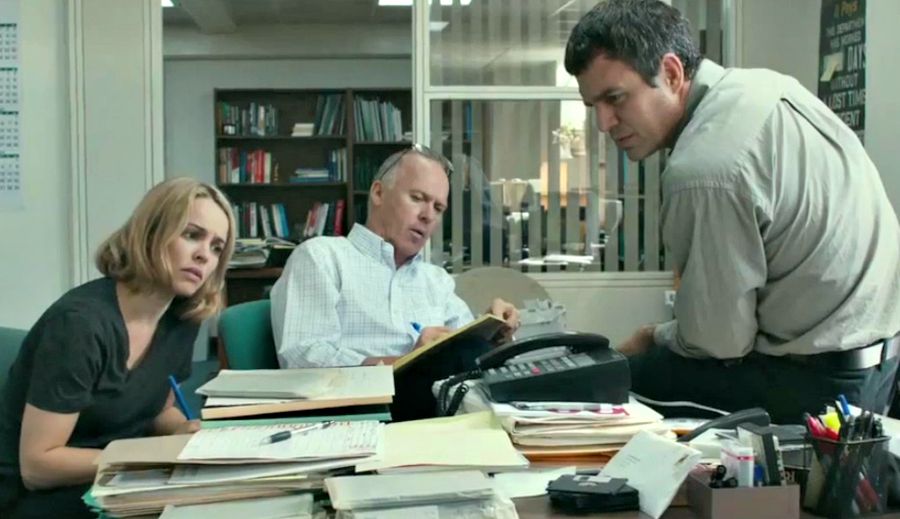
Rachel McAdams, Michael Keaton and Mark Ruffalo in a scene from "Spotlight." Image courtesy Open Road Films.
The remarkable and thrilling “Spotlight” could have taken the easy way out in its retelling of a deep, complicated investigation into a series of child abuse cases perpetrated by Catholic priests and hidden by church officials. Instead of taking the easy route and keeping the blame on the church, the film instead shines a metaphorical light at a society that quietly condones the behavior; as the film explains it, the lawyers, cops, community and even the newspaper investigating the allegations are to blame. From the film’s perspective, it takes a village to fail a child.
The newspaper in question is the venerable Boston Globe, the most well-known newspaper in New England. After a quick trip to a police station in 1976 – a scene used to set up the ensuing reporting – “Spotlight's” action picks up in the Boston Globe office circa 2001 amid a time of great tumult for the paper. New editor Marty Baron (Liev Schrieber) is already talking budget cuts to reduce the expenses of a paper losing its readership steadily, and those cuts could include the titular Spotlight team, an secret investigatory unit overseen by Ben Bradlee Jr. (John Slattery) and consisting of editor Robby Robinson (Michael Keaton) and reporters Mike Rezendes (Mark Ruffalo), Sacha Pfeiffer (Rachel McAdams) and Matt Carroll (Brian D'Arcy James).
The Spotlight unit usually selects its own stories to dig into – those stories are then kept secret even within the Globe's newsroom – but Schrieber pushes an article about alleged sexual abuse of children by Catholic priests. The proposition is met with some resistance from the staff, many of whom grew up Catholic and are cognizant of the church's influence in the area; as one character points out, a majority of the Globe's subscribers are Catholic. Still, the Spotlight team inquires about the allegations, talking with victims, a psychologist, and lawyers involved with settlements involving the church (Jamey Sheridan and Billy Crudup). They also work with an eccentric attorney (Stanley Tucci's Mitchell Garabedian) who represents a number of clients abused by priests and claims he has proof the scandal reaches to the head of the city's diocese, Cardinal Bernard Law (Len Cariou). The reporting starts off with a handful of priests, but the journalists find themselves going down the proverbial rabbit whole as the research deepens and the number of priests involved increases exponentially.
The story is horrifying in its nature, and “Spotlight” never pulls its punches when discussing what exactly happened to these victims. The details as described in the film are heart wrenching, as is the outline of how the priests preyed upon the children. As one character says while listing the step-by-step details of how his priest groomed him, “How do you say no to God?” The statement alone is terrifying, as is the empty promises made by church officials in that very first scene at the police station in 1976 after a parent is dissuaded from pressing charges against a priest: “This will never, ever happen again.”
And yet it does, again and again and again and again for decades and to hundreds of children throughout the greater Boston area. “Spotlight” offers all of its sympathy to the victims of those actions; everyone else, however, has blood on their hands. The church is castigated repeatedly for allowing the abuse to happen and shifting priests from one parish to another to hide the allegations; the state is guilty of looking the other way whenever allegations arose; attorneys representing the church and the victims share guilt for making money from the settlements; and the community deserve scorn for pretending the problem wasn't there. Even the Globe is called out in “Spotlight” for ignoring evidence sent to it years before the investigation actually started.  
Director Tom McCarthy and co-writer Josh Singer do marvelous work setting up the atmosphere in which deference to the church is mandatory so they can show how much effort is required to report on this story. They focus on the process of breaking through the wall that covers basic research and people skills to political haggling, bartering and outright bullying when needed. The process makes for fascinating cinema because of how difficult it can be to get people to do the right thing.
Not that the reporters are men and women filled with an overabundance of courage and bravery; “Spotlight” portrays them as clever, resourceful professionals committed to doing their job and nothing more. They are human, prone to fears of their family’s safety and outright anger as the revelations become more and more horrifying. This is an issue that is worthy of righteous anger, but “Spotlight,” to its credit, never succumbs to that temptation; its mission, like the one the reporters take, is to tell the story and let the facts speak for themselves.

Review: Four and a half out of Five Stars

Click here to see the trailer.

Rating: R
Run time: 128 minutes
Genre: Drama

Ask Away

Target audience: Newspaper nerds and anyone down for a well-executed investigatory flick.

Take the whole family?: Although the film isn't graphic about the content, the information it does provide will bother younger kids. Early teens and older should be fine though.

Theater or Netflix?: Good enough to justify a theater trip.

Academy Award odds?: It's among the favorites for the top prize – although a ton can and probably will change after the nominations come out – and director Tom McCarthy could get a nomination for directing and for Best Original Screenplay alongside co-writer Josh Singer. There's a good shot Mark Ruffalo and Michael Keaton become finalists for Best Supporting Actor, and Rachel McAdams might sneak in for Best Supporting Actress. All are uniformly well deserved nominations.

Watch this as well?: “All the President's Men” is the most obvious companion piece. However, definitely add in “Zodiac” – among the best movies to come out this millennium – and the smaller-scoped “The Paper” (also featuring Keaton) to your journalistic viewing list as well.