 |
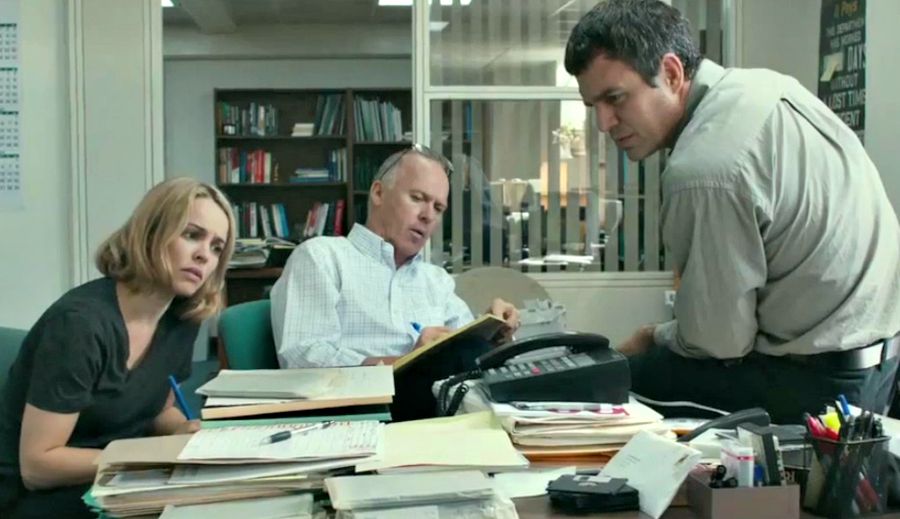
| Rachel McAdams, Michael Keaton and Mark Ruffalo in a scene from "Spotlight." Image courtesy Open Road Films. |
The remarkable and thrilling “Spotlight” could have taken the easy way out in its retelling of a deep, complicated investigation into a series of child abuse cases perpetrated by Catholic priests and hidden by church officials. Instead of taking the easy route and keeping the blame on the church, the film instead shines a metaphorical light at a society that quietly condones the behavior; as the film explains it, the lawyers, cops, community and even the newspaper investigating the allegations are to blame. From the film’s perspective, it takes a village to fail a child.
The newspaper in question is the venerable Boston Globe, the most well-known newspaper in New England. After a quick trip to a police station in 1976 – a scene used to set up the ensuing reporting – “Spotlight's” action picks up in the Boston Globe office circa 2001 amid a time of great tumult for the paper. New editor Marty Baron (Liev Schrieber) is already talking budget cuts to reduce the expenses of a paper losing its readership steadily, and those cuts could include the titular Spotlight team, an secret investigatory unit overseen by Ben Bradlee Jr. (John Slattery) and consisting of editor Robby Robinson (Michael Keaton) and reporters Mike Rezendes (Mark Ruffalo), Sacha Pfeiffer (Rachel McAdams) and Matt Carroll (Brian D'Arcy James).
The Spotlight unit usually selects its own stories to dig into – those stories are then kept secret even within the Globe's newsroom – but Schrieber pushes an article about alleged sexual abuse of children by Catholic priests. The proposition is met with some resistance from the staff, many of whom grew up Catholic and are cognizant of the church's influence in the area; as one character points out, a majority of the Globe's subscribers are Catholic. Still, the Spotlight team inquires about the allegations, talking with victims, a psychologist, and lawyers involved with settlements involving the church (Jamey Sheridan and Billy Crudup). They also work with an eccentric attorney (Stanley Tucci's Mitchell Garabedian) who represents a number of clients abused by priests and claims he has proof the scandal reaches to the head of the city's diocese, Cardinal Bernard Law (Len Cariou). The reporting starts off with a handful of priests, but the journalists find themselves going down the proverbial rabbit whole as the research deepens and the number of priests involved increases exponentially.
The story is horrifying in its nature, and “Spotlight” never pulls its punches when discussing what exactly happened to these victims. The details as described in the film are heart wrenching, as is the outline of how the priests preyed upon the children. As one character says while listing the step-by-step details of how his priest groomed him, “How do you say no to God?” The statement alone is terrifying, as is the empty promises made by church officials in that very first scene at the police station in 1976 after a parent is dissuaded from pressing charges against a priest: “This will never, ever happen again.”
And yet it does, again and again and again and again for decades and to hundreds of children throughout the greater Boston area. “Spotlight” offers all of its sympathy to the victims of those actions; everyone else, however, has blood on their hands. The church is castigated repeatedly for allowing the abuse to happen and shifting priests from one parish to another to hide the allegations; the state is guilty of looking the other way whenever allegations arose; attorneys representing the church and the victims share guilt for making money from the settlements; and the community deserve scorn for pretending the problem wasn't there. Even the Globe is called out in “Spotlight” for ignoring evidence sent to it years before the investigation actually started.
Director Tom McCarthy and co-writer Josh Singer do marvelous work setting up the atmosphere in which deference to the church is mandatory so they can show how much effort is required to report on this story. They focus on the process of breaking through the wall that covers basic research and people skills to political haggling, bartering and outright bullying when needed. The process makes for fascinating cinema because of how difficult it can be to get people to do the right thing.
Not that the reporters are men and women filled with an overabundance of courage and bravery; “Spotlight” portrays them as clever, resourceful professionals committed to doing their job and nothing more. They are human, prone to fears of their family’s safety and outright anger as the revelations become more and more horrifying. This is an issue that is worthy of righteous anger, but “Spotlight,” to its credit, never succumbs to that temptation; its mission, like the one the reporters take, is to tell the story and let the facts speak for themselves.
Review: Four and a half out of Five Stars
Click here to see the trailer.
Rating: R
Run time: 128 minutes
Genre: Drama
Ask Away
Target audience: Newspaper nerds and anyone down for a well-executed investigatory flick.
Target audience: Newspaper nerds and anyone down for a well-executed investigatory flick.
Take the whole family?: Although the film isn't graphic about the content, the information it does provide will bother younger kids. Early teens and older should be fine though.
Theater or Netflix?: Good enough to justify a theater trip.
Academy Award odds?: It's among the favorites for the top prize – although a ton can and probably will change after the nominations come out – and director Tom McCarthy could get a nomination for directing and for Best Original Screenplay alongside co-writer Josh Singer. There's a good shot Mark Ruffalo and Michael Keaton become finalists for Best Supporting Actor, and Rachel McAdams might sneak in for Best Supporting Actress. All are uniformly well deserved nominations.
Watch this as well?: “All the President's Men” is the most obvious companion piece. However, definitely add in “Zodiac” – among the best movies to come out this millennium – and the smaller-scoped “The Paper” (also featuring Keaton) to your journalistic viewing list as well.

