Showing posts with label Billy Crudup. Show all posts

Friday, May 19, 2017

Fear in short supply in Alien: Covenant

Katherine Waterston in Alien: Covenant. Image courtesy 20th Century Fox.
The biggest disappointment with Alien: Covenant – Ridley Scott's recent addition to the Alien franchise he kicked off nearly 40 years ago – is how little emotional reaction is earned from it. For a series that has, at its best, features staples in horror and action, Covenant gives little incentive for the viewer to grip onto anything for comfort. The things that go bump in the night in this franchise are no longer scary, or at least Scott and writers John Logan and Dante Harper can’t capture the elements that made these creatures so terrifying in the first place.
That concept of horror has been a constant for a franchise that has shifted dramatically in tone over the last four decades. Scott directed one of the best horror films of the '70s with his initial entry, while James Cameron used what Scott refined to craft an even better action flick with the sequel. Even Prometheus, the much maligned sequel and precursor to Covenant, is ambitious with its philosophical leanings and stabs at building a mythology for the featured beasts. But Covenant stretches the franchise's flexibility to its breaking point by trying to mix and match the tones of the previous films. Combining the philosophy that defines Prometheus with the horror elements of Alien and a little of the action aspects of Aliens doesn't mesh together as well as the filmmakers intended. The enormity of the ponderings about the meaning of existence aren't given enough time to develop nor gain the traction of the predecessor. What this film offers instead is limited to the mild musings of returning cynthetic David (Michael Fassbender), who shares his sentiments with a newer version of himself (also played by Fassbender) in an obviously onanistic function.
What really disappoints about Covenant are the attempts at invoking horror, the bedrock for the franchise and the aspect Scott himself mastered with the first installment. There is an inherent level of horror to the concept of Covenant, in which humans (played by Katherine Waterston, Danny McBride, Demián Bichir, Billy Crudup, Carmen Ejogo, and a collection of disposable parts) come across malevolent creatures far outside of their comprehension. It’s the fear of exploration, albeit one that is less terrifying as the idea of hateful gods depicted in Prometheus. Visiting a new land with hateful alien beings is disturbing; having one's creator actively turn against them is downright horrifying.
The existential fear never ascends to where it should, nor does the more primitive scares found in being trapped by a creature that goes bump in the night. This is horror 101, the fear of the monster under the bed and the reason why this franchise exists in the first place, yet Scott appears to have lost that ability to invoke those frights in 2017. The problems are fairly fundamental, easy to spot when compared with the original. The ship in this film, the titular Covenant, is a large, new starship built to traverse the stars to find a new planet, leaving ample room for the humans to run and hide if need be. Contrast that with the Nostromo from Alien, a smaller vessel that's been knocked around space for who knows how long. There are fewer places to hide on the Nostromo, more places for the monster to trap its victim and engage in acts of carnage. More problematic is how rushed the featured engagement is. Things go wrong quickly and are resolved even faster, the plan to rid the ship of the alien coming about too quickly and far too easily to offer actual scares for the viewer. The crew in Covenant is never given the opportunity to have the extermination plan go awry as they are in previous films, which cuts down on the film's ability to invoke some sympathy into their plight.
Most worrisome of all is the aesthetics for the aliens in Covenant. Scott and crew mess around a little with the design, essentially showing the creatures in several forms before finally settling on the classic creature, sort of like an expanded version of Alien: Resurrection. Several of them are doofy looking, lacking the creepy visual innuendo of the classic model and limited moreso by some less than stellar CGI. The digital divide between human and alien is clear and disappointing, missing those scenes in which the creature comes ever so close to tearing through the victim's flesh at any given moment. The monsters instead look cheap and act cheaper, leaving the viewer let down by the lack of innovation by the filmmakers.

Review: Two and a half out of Five Stars

Click here to see the trailer.

Rating: R
Run time: 122 minutes
Genre: Sci-Fi

Ask Away

Target audience: Anyone who have enjoyed the Alien series, including Prometheus.

Take the whole family?: The rating is a little strong – the violence isn't that much greater than some PG-13 movies and the sex is minimal – but still keep the really young kids at home.

Theater or Netflix?: Make it part of a Netflix evening.

How silly does this film get?: More than expected. The movie carries those bits of meta silliness from Prometheus that are kind of groan inducing. It is most notable in a scene featuring Michael Fassbender, Billy Crudup, a familiar looking pod, and assurances nothing bad will happen. The result is about what one would expect, and it makes Crudup's character look like a complete idiot.

Watch this instead?: Alien and Aliens are both great, and I'm still a defender of the messy and flawed but ambitious Prometheus. It is worth hitting up James Cameron's perturbing The Abyss.

Friday, December 9, 2016

Dreamy legacy at the heart of Jackie

Natalie Portman in a scene from Jackie. Image courtesy Fox Searchlight.
The smartest part of the heartfelt, melancholy Jackie rests in its unorthodox storytelling. Beginning with an interview between Jackie Kennedy (played brilliantly by Natalie Portman) and a disheveled reporter (Billy Crudup), the film mixes and matches events occurring somewhere between a couple of years before to a few weeks after the assassination of John F. Kennedy in 1963. It's an effective nesting doll effect, a story being told within a story told within a story, that mirrors the perception of the White House at that time as a beacon shining at a brighter future. That the unseemly facts get lost in the perception befits a film in which the broader scope is of greater import than the ugly details that only distract from the hopeful veneer.
In Jackie, the illusion of a concept is more trustworthy than the reality. The film's underlying brutality and the days surrounding it are portrayed in a less straightforward manner than the fantasy Portman's Jackie forces Crudup's nameless reporter to accept. That fantasy is based heavily on the idea of Camelot (rooted in the mythology and the musical), a utopia consisting of hopes and desires for a better tomorrow. Previous portrayals of the Kennedy family have used the Kennedy's love of the musical Camelot in an ironic fashion, using the innocent dreaminess of the concept of the show to contrast brightly with the true, more salacious nature of the relationship. That Camelot the show is more about the destruction of a kingdom and its ideals rather than the growth of one is often looked over when comparing it to the Kennedy White House, and the film shows how Jackie uses the illusion of the concept of Camelot to sell the Kennedy legacy. It's a lie built upon a lie that has an inkling of truth just underneath it all: Legends outlive and outgrow the details.
Jackie understands that better than anyone else around her, and a fair amount of the fighting she does in this film is directed at reinforcing and maintaining the image of her husband as a man and president. The version Portman plays is a hell of a fighter too, despite her voice never rising above a strong whisper. She's canny and clever, using her quiet demeanor as a key weapon in her battles against officials with more experience and more power than she would, whether it’s Bobby Kennedy (Peter Sarsgaard) or Lyndon B. Johnson (John Carroll Lynch). She knows how the game is played and in particular the right buttons to press to end up on top of an argument. This comes across most in the interview between Kennedy and the reporter, with Portman’s character shown as the dominant force in the conversation. Jackie as manipulator is meant to contrast against the poised, pretty and precise First Lady the film shows in a re-creation of her famed televised White House tour. That Jackie, guided by her friend Nancy (Greta Gerwig), is tied inextricably to the Kennedy legacy, a devoted woman and lover of the arts who could serve as the perfect queen to John Kennedy's king. It's the most false and the most honest version Jackie uses, the blatant falseness of the act a means toward preserving the aforementioned legacy. The clothes and immaculate styling she underwent to create that image are what made her the cultural icon she became.
There is a third representation offered by director Pablo Larrain and screenwriter Noah Oppenheim for one night. It comes in a sequence after the assassination with Jackie alone in the White House wandering about with lots of alcohol and little idea of what else she should do. She's lost and alone, unsure of what she should be doing now or the days and months thereafter. Her facade means nothing in an empty house, but she's still frantically trying to find something that will work her through the grief. It's a heartbreaking sequence queued up by Richard Burton's rendition of Camelot, the song from the show with the most idealized version of the eponymous kingdom.
What Jackie does with all these components – the legacy, the depths of Jackie Kennedy, the historical significance of the moment – is cook them together so separating the truth from the illusion is quite difficult. And that's the way the film wants it and the reason it opts to end not with the death of a president or a woman alone crying, but of a perfect moment supporting the idea of a beautiful ersatz Camelot where, perhaps, joy is found within the illusion.

Review: Four and a half out of Five Stars

Rating: R
Run time: 99 minutes
Genre: Biography

Ask Away

Target audience: Viewers interested in anything related to the Kennedy clan.

Take the whole family?: The rating is a little harsh given the content. Still, kids will be bored by the content on screen, and there is one scene that is graphic.

Theater or Netflix?: It justifies a cinema trip, but feel free to wait for it if you can't find it locally.

How are the Kennedy accents?: The only one you really get to hear is Peter Sarsgaard's, and it is a pretty weak attempt. The issue for Sarsgaard is the lack of consistency to his Brahmin inflection, which is patchy at best. Folks who've lived around Boston know vocabulary, mood, tone and level of sobriety can influence when the accent pops out, although none of those appear to be a factor for Sarsgaard's Bobby Kennedy.

Watch this as well?: Thematically speaking there are a few parallels between this film and The Man Who Shot Liberty Valance. Both films deal with the formations of legends and how becoming one isn't necessarily for the best. That's also hit upon in the documentary Smash His Camera, which profiles famed Jackie Kennedy paparazzo Ron Galella.

Friday, November 6, 2015

Shining a light into moral darkness

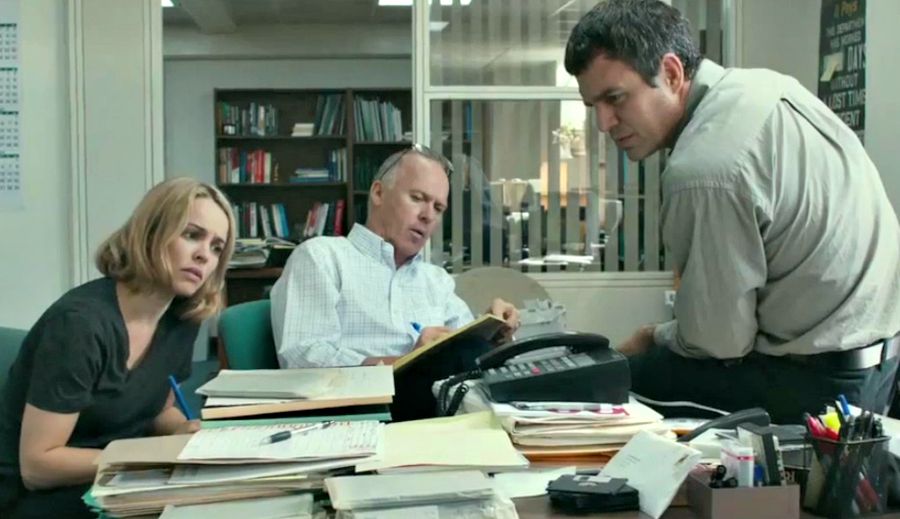
Rachel McAdams, Michael Keaton and Mark Ruffalo in a scene from "Spotlight." Image courtesy Open Road Films.
The remarkable and thrilling “Spotlight” could have taken the easy way out in its retelling of a deep, complicated investigation into a series of child abuse cases perpetrated by Catholic priests and hidden by church officials. Instead of taking the easy route and keeping the blame on the church, the film instead shines a metaphorical light at a society that quietly condones the behavior; as the film explains it, the lawyers, cops, community and even the newspaper investigating the allegations are to blame. From the film’s perspective, it takes a village to fail a child.
The newspaper in question is the venerable Boston Globe, the most well-known newspaper in New England. After a quick trip to a police station in 1976 – a scene used to set up the ensuing reporting – “Spotlight's” action picks up in the Boston Globe office circa 2001 amid a time of great tumult for the paper. New editor Marty Baron (Liev Schrieber) is already talking budget cuts to reduce the expenses of a paper losing its readership steadily, and those cuts could include the titular Spotlight team, an secret investigatory unit overseen by Ben Bradlee Jr. (John Slattery) and consisting of editor Robby Robinson (Michael Keaton) and reporters Mike Rezendes (Mark Ruffalo), Sacha Pfeiffer (Rachel McAdams) and Matt Carroll (Brian D'Arcy James).
The Spotlight unit usually selects its own stories to dig into – those stories are then kept secret even within the Globe's newsroom – but Schrieber pushes an article about alleged sexual abuse of children by Catholic priests. The proposition is met with some resistance from the staff, many of whom grew up Catholic and are cognizant of the church's influence in the area; as one character points out, a majority of the Globe's subscribers are Catholic. Still, the Spotlight team inquires about the allegations, talking with victims, a psychologist, and lawyers involved with settlements involving the church (Jamey Sheridan and Billy Crudup). They also work with an eccentric attorney (Stanley Tucci's Mitchell Garabedian) who represents a number of clients abused by priests and claims he has proof the scandal reaches to the head of the city's diocese, Cardinal Bernard Law (Len Cariou). The reporting starts off with a handful of priests, but the journalists find themselves going down the proverbial rabbit whole as the research deepens and the number of priests involved increases exponentially.
The story is horrifying in its nature, and “Spotlight” never pulls its punches when discussing what exactly happened to these victims. The details as described in the film are heart wrenching, as is the outline of how the priests preyed upon the children. As one character says while listing the step-by-step details of how his priest groomed him, “How do you say no to God?” The statement alone is terrifying, as is the empty promises made by church officials in that very first scene at the police station in 1976 after a parent is dissuaded from pressing charges against a priest: “This will never, ever happen again.”
And yet it does, again and again and again and again for decades and to hundreds of children throughout the greater Boston area. “Spotlight” offers all of its sympathy to the victims of those actions; everyone else, however, has blood on their hands. The church is castigated repeatedly for allowing the abuse to happen and shifting priests from one parish to another to hide the allegations; the state is guilty of looking the other way whenever allegations arose; attorneys representing the church and the victims share guilt for making money from the settlements; and the community deserve scorn for pretending the problem wasn't there. Even the Globe is called out in “Spotlight” for ignoring evidence sent to it years before the investigation actually started.  
Director Tom McCarthy and co-writer Josh Singer do marvelous work setting up the atmosphere in which deference to the church is mandatory so they can show how much effort is required to report on this story. They focus on the process of breaking through the wall that covers basic research and people skills to political haggling, bartering and outright bullying when needed. The process makes for fascinating cinema because of how difficult it can be to get people to do the right thing.
Not that the reporters are men and women filled with an overabundance of courage and bravery; “Spotlight” portrays them as clever, resourceful professionals committed to doing their job and nothing more. They are human, prone to fears of their family’s safety and outright anger as the revelations become more and more horrifying. This is an issue that is worthy of righteous anger, but “Spotlight,” to its credit, never succumbs to that temptation; its mission, like the one the reporters take, is to tell the story and let the facts speak for themselves.

Review: Four and a half out of Five Stars

Click here to see the trailer.

Rating: R
Run time: 128 minutes
Genre: Drama

Ask Away

Target audience: Newspaper nerds and anyone down for a well-executed investigatory flick.

Take the whole family?: Although the film isn't graphic about the content, the information it does provide will bother younger kids. Early teens and older should be fine though.

Theater or Netflix?: Good enough to justify a theater trip.

Academy Award odds?: It's among the favorites for the top prize – although a ton can and probably will change after the nominations come out – and director Tom McCarthy could get a nomination for directing and for Best Original Screenplay alongside co-writer Josh Singer. There's a good shot Mark Ruffalo and Michael Keaton become finalists for Best Supporting Actor, and Rachel McAdams might sneak in for Best Supporting Actress. All are uniformly well deserved nominations.

Watch this as well?: “All the President's Men” is the most obvious companion piece. However, definitely add in “Zodiac” – among the best movies to come out this millennium – and the smaller-scoped “The Paper” (also featuring Keaton) to your journalistic viewing list as well.