Showing posts with label Scandal. Show all posts

Friday, May 27, 2016

'Weiner' a portrait of a politician made for these times

Anthony Weiner on the campaign trail. Image courtesy IFC Films.
There's a stretch during the excellent documentary Weiner in which everything in the world is going right for eponymous former congressman Anthony Weiner. It’s highlighted with the politician sitting in a subway, getting nods of approval from New Yorkers reading articles proclaiming his pole position in the race to be New York City's next mayor. The train ride comes months after his first fall from office, and it's clear he's enjoying the serenity and validation from his potential constituents. In his own way, Anthony Weiner has very much earned this one moment in the sun. At least until the bottom drops out, because Anthony Weiner is constructed to self-destruct. He's a fascinating man, the rare loser who needs to win to add more height for his inevitable, self-inflicted falls from grace.
Weiner starts off as a comeback tale, devoting its first act to Anthony Weiner’s attempts at a political resurrection in 2013, two years after resigning from Congress in shame from a sexting scandal. Anthony Weiner’s a dreamer, following what for all intents and purposes is a quixotic quest to win New York’s mayoral race, despite his recent woes. And yet there he is, drawing the rabid support of crowds and getting audiences to boo candidates who crack jokes about his indiscretions. He's feisty, cocky and electrifying, especially when compared with the less than thrilling Bill de Blasio. Scenes in which Anthony Weiner dances during parades or talks back to rather condescending foes offers a glimpse as to why voters fell in love with him in the first place. Even at his worst, it’s clear he cares deeply for his constituents, his passion guided by good intentions.
Weiner posits its central figure as a man of his time, for better or for worse. His speeches in Congress, and the ones on the campaign trail, are short and fiery enough to draw viewers, as is his scrappiness and the stereotypical New Yorker persona that makes him oddly charming. The film outlines clearly why his star shone so bright in the first place. The man even married into American political royalty when he wed Huma Abedin; Hillary Clinton has essentially described her as a second daughter. That Anthony Weiner is able to earn an attempt at a second chance, and even spend a few glorious moments in the lead.
Anthony Weiner is a modern candidate in the worst ways too. His first fall started with an accidental Twitter posting he did not intend to go public, which spiraled into a much larger scandal. People are often capable of some forgiveness for one mistake, especially if the person shows at least a modicum of remorse as Anthony Weiner does on the campaign trail. But when the person makes the same mistake again, exposed via a tabloid website by a 23-year-old woman named Sydney Leathers, forgiveness takes a back seat to moral indignation and a flurry of tweets and mediocre comedic material courtesy Bill Maher.
Weiner elides over the candidate’s handling of the first scandal aside from a few denials and his resignation. Perhaps it wasn’t as interesting as what happened the second time, when Anthony Weiner couldn’t keep track of the occurrences and completely lost any contact with composure during a meltdown with MSNBC's Lawrence O'Donnell. The interview itself is a train wreck; that Anthony Weiner rewatches the train skid off the rails the morning after is painful and weirdly right. The description fits the tone of the film’s final two acts, whether it’s watching the candidate get into a yelling fest with a bigoted voter or, worst of all, the clear strain the situation is taking on his marriage with Huma Abedin. Directors Josh Kriegman, a former aide to Anthony Weiner, and Elyse Steinberg make it clear she’s hurting too, especially when she has to fend off attacks from media members speculating why she’d remain married to him, then criticizing her for their speculation.
Everything is almost too perfect to create a situation like the one belonging to Anthony Weiner. A man who can’t control his impulses (sexual or anger) cheating on his wife through texts, Twitter and Facebook, with a name that is at the root of the scandal in the first place makes him the perfect candidate for this level of failure. The danger though is when those scandals block out the wishes of the people, who are depicted in Weiner flailing for attention and asking the press to care about their needs, what they want from candidates. All they want is to hear his proposals, yet their voices are drowned by camera clicks and inane questions about a man’s idiocy. That’s the saddest thing about Weiner; the man could have done a lot of good, but he couldn’t get out of his own way to do it.

Review: Four and a half out of Five Stars

Click here to see the trailer.

Rating: R
Run time: 96 minute
Genre: Documentary
 
Ask Away

Target audience: Political junkies and people interested in documentaries.

Take the whole family?: It wouldn't be that interesting to kids anyway, but this does not deserve an “R” rating.

Theater or Netflix?: It’s worth seeing at the cinema if you can.

Is Sydney Leathers a villain?: For a story in which the central figure commits career defenestration, there remains a bit of loathing toward Leathers, who’s given the code name pineapple. It boils over during her attempt to meet Weiner on election night is shown as a callous act from a person desperate for fame. The film does emphasize the fault lies with Anthony Weiner, but she doesn’t exactly come across as all that heroic. Funny enough, Leathers doesn't see herself cast in that role; rather, she (wrongly) believes Huma Abedin comes off worse, at least according to an underwhelming New York Magazine article.

Watch this as well?: Errol Morris' “The Fog of War” also offers an in depth look into a complicated man, in this case it's former Secretary of Defense Robert McNamara. Also worth flagging down are a pair of documentaries by Barbara Kopple focused on people in the midst of chaos: “Harlan County U. S. A.” and “American Dream."

Friday, November 6, 2015

Shining a light into moral darkness

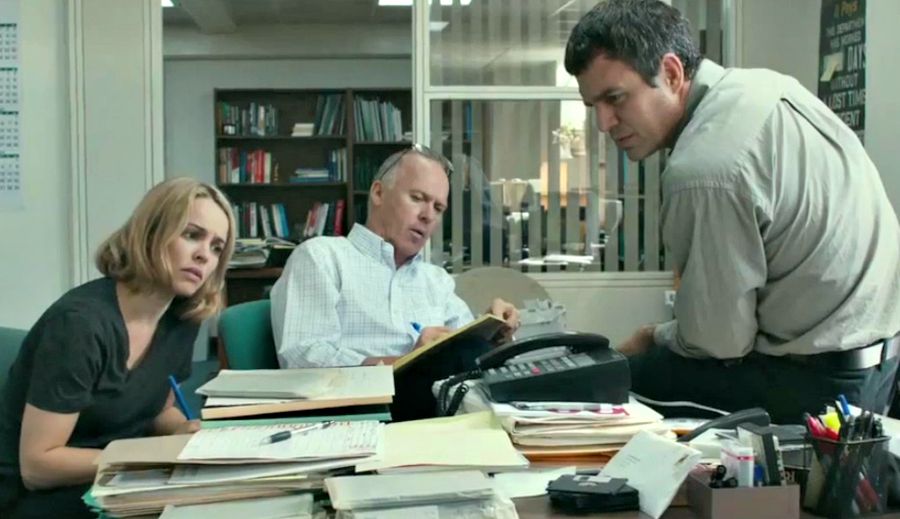
Rachel McAdams, Michael Keaton and Mark Ruffalo in a scene from "Spotlight." Image courtesy Open Road Films.
The remarkable and thrilling “Spotlight” could have taken the easy way out in its retelling of a deep, complicated investigation into a series of child abuse cases perpetrated by Catholic priests and hidden by church officials. Instead of taking the easy route and keeping the blame on the church, the film instead shines a metaphorical light at a society that quietly condones the behavior; as the film explains it, the lawyers, cops, community and even the newspaper investigating the allegations are to blame. From the film’s perspective, it takes a village to fail a child.
The newspaper in question is the venerable Boston Globe, the most well-known newspaper in New England. After a quick trip to a police station in 1976 – a scene used to set up the ensuing reporting – “Spotlight's” action picks up in the Boston Globe office circa 2001 amid a time of great tumult for the paper. New editor Marty Baron (Liev Schrieber) is already talking budget cuts to reduce the expenses of a paper losing its readership steadily, and those cuts could include the titular Spotlight team, an secret investigatory unit overseen by Ben Bradlee Jr. (John Slattery) and consisting of editor Robby Robinson (Michael Keaton) and reporters Mike Rezendes (Mark Ruffalo), Sacha Pfeiffer (Rachel McAdams) and Matt Carroll (Brian D'Arcy James).
The Spotlight unit usually selects its own stories to dig into – those stories are then kept secret even within the Globe's newsroom – but Schrieber pushes an article about alleged sexual abuse of children by Catholic priests. The proposition is met with some resistance from the staff, many of whom grew up Catholic and are cognizant of the church's influence in the area; as one character points out, a majority of the Globe's subscribers are Catholic. Still, the Spotlight team inquires about the allegations, talking with victims, a psychologist, and lawyers involved with settlements involving the church (Jamey Sheridan and Billy Crudup). They also work with an eccentric attorney (Stanley Tucci's Mitchell Garabedian) who represents a number of clients abused by priests and claims he has proof the scandal reaches to the head of the city's diocese, Cardinal Bernard Law (Len Cariou). The reporting starts off with a handful of priests, but the journalists find themselves going down the proverbial rabbit whole as the research deepens and the number of priests involved increases exponentially.
The story is horrifying in its nature, and “Spotlight” never pulls its punches when discussing what exactly happened to these victims. The details as described in the film are heart wrenching, as is the outline of how the priests preyed upon the children. As one character says while listing the step-by-step details of how his priest groomed him, “How do you say no to God?” The statement alone is terrifying, as is the empty promises made by church officials in that very first scene at the police station in 1976 after a parent is dissuaded from pressing charges against a priest: “This will never, ever happen again.”
And yet it does, again and again and again and again for decades and to hundreds of children throughout the greater Boston area. “Spotlight” offers all of its sympathy to the victims of those actions; everyone else, however, has blood on their hands. The church is castigated repeatedly for allowing the abuse to happen and shifting priests from one parish to another to hide the allegations; the state is guilty of looking the other way whenever allegations arose; attorneys representing the church and the victims share guilt for making money from the settlements; and the community deserve scorn for pretending the problem wasn't there. Even the Globe is called out in “Spotlight” for ignoring evidence sent to it years before the investigation actually started.  
Director Tom McCarthy and co-writer Josh Singer do marvelous work setting up the atmosphere in which deference to the church is mandatory so they can show how much effort is required to report on this story. They focus on the process of breaking through the wall that covers basic research and people skills to political haggling, bartering and outright bullying when needed. The process makes for fascinating cinema because of how difficult it can be to get people to do the right thing.
Not that the reporters are men and women filled with an overabundance of courage and bravery; “Spotlight” portrays them as clever, resourceful professionals committed to doing their job and nothing more. They are human, prone to fears of their family’s safety and outright anger as the revelations become more and more horrifying. This is an issue that is worthy of righteous anger, but “Spotlight,” to its credit, never succumbs to that temptation; its mission, like the one the reporters take, is to tell the story and let the facts speak for themselves.

Review: Four and a half out of Five Stars

Click here to see the trailer.

Rating: R
Run time: 128 minutes
Genre: Drama

Ask Away

Target audience: Newspaper nerds and anyone down for a well-executed investigatory flick.

Take the whole family?: Although the film isn't graphic about the content, the information it does provide will bother younger kids. Early teens and older should be fine though.

Theater or Netflix?: Good enough to justify a theater trip.

Academy Award odds?: It's among the favorites for the top prize – although a ton can and probably will change after the nominations come out – and director Tom McCarthy could get a nomination for directing and for Best Original Screenplay alongside co-writer Josh Singer. There's a good shot Mark Ruffalo and Michael Keaton become finalists for Best Supporting Actor, and Rachel McAdams might sneak in for Best Supporting Actress. All are uniformly well deserved nominations.

Watch this as well?: “All the President's Men” is the most obvious companion piece. However, definitely add in “Zodiac” – among the best movies to come out this millennium – and the smaller-scoped “The Paper” (also featuring Keaton) to your journalistic viewing list as well.