Showing posts with label Mark Ruffalo. Show all posts

Thursday, April 26, 2018

Infinity War a big, bold Avengers installment

Thanos (Josh Brolin) in a scene from Avengers: Infinity War. Image courtesy Disney.
Avengers: Infinity War makes it clear from the start exactly what the eponymous superhero group faces. The movie kicks off showing the brilliant power its villain Thanos (Josh Brolin) possesses, while hinting at just how zealous he is about it. Stakes matter in a movie as big and bold as Infinity War; viewers need to respect what the nearly two-dozen heroes have to battle against to make the necessary bloat worthwhile. The heroes in this movie aren't simply fighting the concept of amazing destruction, but a being legitimately powerful enough to make that happen. What they face is important, and the movie never lets up on how much they have to accomplish to win.

Infinity War is both the movie one would expect from Marvel's years of buildup and something largely unexpected. It's as big as it should be, littered with heroes ranging from franchise staples to new additions in the last decade or so of movies. Viewers get barbs lobbed between Iron Man (Robert Downey Jr.), Dr. Strange (Benedict Cumberbatch) and Star-Lord (Chris Pratt). Thor (Chris Hemsworth) chills with Rocket Raccoon (Bradley Cooper) and Groot (Vin Diesel). Scarlet Witch (Elizabeth Olsen), Vision (Paul Bettany), Gamora (Zoe Saldana), Black Panther (Chadwick Boseman), Captain America (Chris Evans), Mantis (Pom Klementieff) Falcon (Anthony Mackie), Black Widow (Scarlett Johansson), War Machine (Don Cheadle), Hulk (Mark Ruffalo), Bucky (Sebastian Stan), and Drax (Dave Bautista) take on aliens and other malevolent beings. Spider-man (Tom Holland) is around being all doe-eyed and awkward. Almost everyone of note from a decade of movies is here, and Infinity War spends a lot of time ensuring they all get a few moments to shine. The result is an immense run time, although directors Anthony and Joe Russo keep the drag to a minimum, making for a pretty smooth 150-minute movie. 
 
Pretty much every aesthetic selling point is handled well in this movie. The action sequences are well coordinated and range from small melees to epic battles against alien beings. The Marvel Cinematic Universe’s trademark jokes work more often than not, in large part because the addition of so many otherwise unconnected characters adds a new dynamic to the banter. On the most basic level, Infinity War is the movie people who have followed this franchise would want; the good stuff is there, and it's done rather well. And yet there's still a lot of unexpected bits to Infinity War. With the high stakes established so early, the tone of the movie is not as bright as the banter makes it appear. The jokes aren't as jovial or friendly as they usually are in Marvel films; in this case, the humor is rooted in fear and stress, a reaction to the situation the heroes face. The tone is less hopeful than before, more desperate and worrisome.

A lot of that has to do with how writers Christopher Markus and Stephen McFeely plan their narrative. The film’s focus at first glance is stopping Thanos, the actual protagonist is Thanos himself. It's his quest to collect the Infinity Stones that drives the movie, his journey toward what he believes to be a better universe. The heart of Infinity War lies not amongst the collection of heroes, but with its villain. Brolin's Thanos is not a simple monster bent on destruction for the sake of destruction, or evil just because the film requires him to be the villain for the heroes to fight. The methods to his goal of creating balance in a chaotic universe are horrifying, but there remains an iota of logic to what he wants to accomplish. In his mind, he’s performing a selfless act, and its his fervor as much as the abundance of power he seeks that makes him so dominant. Fanaticism is incredibly dangerous, especially for an infinitely powerful being capable of sacrificing everything for what he deems to be a necessary cause.
 
Making a superhero movie based on the villain is an interesting, albeit counterintuitive choice. What it does though is give Infinity War a sense of urgency it didn’t have before, selling Thanos’ power and conviction to his cause. It makes for a fairly dark superhero movie, adding enough shade to a sunny franchise to keep the audience guessing at what comes next. There’s still reasons for optimism in the Marvel Universe, but they are far more difficult to find than ever been before.

Review: Four and a half out of Five Stars

Click here to see the trailer.

Rating: PG-13
Run time: 150 minutes
Genre: Action

Ask Away
Target audience: People who have watched MCU movies for the last 10 years, as well as anyone else into comic book movies.

Take the whole family?: The tone gets pretty heavy, and families who prefer to limit their children's exposure to violence should keep the kids home. Generally though this isn't too problematic.

Theater or Netflix?: Totally worth a trip to the cinema.

What happens next?: That is an enormous question. Looking at the upcoming slate of films – Ant-Man gets his sequel in a few months, followed by a Captain Marvel movie – gives a little idea of how things will play out. But given how this movie goes, there's a whole lot of room for interpretation for the next installment. Although that is half the fun of these movies; trying to figure out what happens next.

Watch this as well?: Just pick just about anything from the Marvel Cinematic Universe and you'll be in pretty good shape. D.C. has Wonder Woman, but that’s about it.

Friday, November 3, 2017

Ragnarok finds humor at the world's end

Thor (Chris Hemsworth) and Hulk (Mark Ruffalo) in Thor: Ragnarok. Image courtesy Disney.
Thor: Ragnarok is a weird movie. It's weird because it's a movie about Norse mythology that focuses more on technological marvels than the mythology inherent to its title. It's weird because of the dramatic tonal shift from the other Thor movies. And it's super weird because Jeff Goldblum shows up with shockingly blue facial hair and literally melts a man with a stick. Ragnarok is a trip, but it is one heck of a journey to a place more bizarre than other Marvel movies have ventured.
What's so hard to reconcile about Ragnarok is how lightly the movie takes the end of a world. Superhero movies are all about saving planets from destruction while making sure the people are safe and the damage is minimal. A few jokes are sprinkled in to ensure the story doesn't get too dark, but for the most part the superhero as savior concept is a foundation for a lion's share of comic book-related lore. Except for Ragnarok, in which the threat of the destruction of Asgard starts as a gag between Thor (Chris Hemsworth reprising his role) and a skeleton just above a pit of fire. It sets the rhythm for the rest of the movie, with the comedy taking a precedence over the gravity of the situation the characters face. Everyone cracks a few jokes, from the naturally talkative Loki (Tom Hiddleston), to the goddess of death/destroyer of world Hela (Cate Blanchett), to the otherwise stern Heimdall (Idris Elba), to the fallen Valkyrie (Tessa Thompson). Even the Hulk, the Incredible Hulk and not Bruce Banner (both of whom are versions of Mark Ruffalo) showcases something resembling a sense of humor.
And you know what? It's actually kind of glorious in its own way. The sense of humor is akin to what’s found in the rest of the Marvel Cinematic Universe, but Ragnarok makes it unique by changing the context to make the jokes a greater joke itself. Ragnarok is a slightly different family tree as Dr. Strangelove, in which the biggest laugh is earned by the insanity of the movie mocking the inherent somber nature of earth's destruction. The story Ragnarok tells is just as dark as Dr. Strangelove, but with brighter colors and Disney's stamp of approval. That also means the Thor movie can't be as nihilistic as Dr. Strangelove is; it is still a blockbuster first and foremost. But director Taika Waititi and the screenwriters push Ragnarok further than the other Thor films to do what the best MCU movies have done; make a movie with their own imprint on it. There are, again, limits to how far creatively the filmmakers can get with the Marvel movies – an entire cinematic universe is at stake – but Waititi and company turned a Thor movie into a comedy. Like the excellent Captain America: The Winter Soldier and the very good to great Guardians of the Galaxy movies, Ragnarok stands on its own as a piece of cinema.
Still, there remains a bit lacking with Ragnarok that pushes it a step or two down from the aforementioned Marvel movies and puts it more on par with the fun Spider-Man: Homecoming and Iron Man 3. There is what should amount to a great story arc involving Thor and the uncovering of his father Odin's (Anthony Hopkins) past, something that should force the mighty god of thunder to confront his own background and the demons his father has wrought upon his people. It's a Shakespearean bit in line with the first Thor movie, with the evil Odin committed living far beyond the good he brought in. Ragnarok barely touches the surface of this story, having Thor just sort of go with the news that his father was a monster for a very long time. That could be marked as a sign of character growth, but Thor does drop a few tears for Odin early on, and the amount of time the movie spends reconciling Odin's history is disappointingly minimal.
But the baseline for a quality superhero movie – good action, likable characters, expansive world building – remains intact, and the goofy nature and general oddness of the situation only add to those key elements. To repurpose another classic literary line, Ragnarok opts to end the world not with a whimper but with a bang and a lot of laughs along the way toward doom.

Review: Four out of Five Stars

Click here to see the trailer.

Rating: PG-13
Run time: 130 minutes
Genre: Action

Ask Away

Target audience: As with every Marvel film, everyone who has ever watched a movie from the MCU and wants to keep up with the ongoing story.

Take the whole family?: Really depends on how OK the parents are with a lot of violence but little blood to show for it. A couple years under the PG-13 mark should be fine.

Theater or Netflix?: It's fun for a trip to the theater, although the 3D isn't really worth it though.

How has 2017 been for the MCU?: Pretty great. Despite releasing three movies, two of which were a second and a third installment to long-running series, this is the first time in a while that Marvel fatigue hasn't hit that hard. It helps that the three movies released were good and different enough to offer some separation to the weary viewers. It also offers some hope for 2018, with the release of Ryan Coogler's Black Panther and the probably stupidly stuffed Avengers: Infinity War.

Watch this as well?: Along with the other MCU entries, comedian/author John Hodgman has a comedy special devoted to the impending Ragnarok, called John Hodgman: Ragnarok, that is quirky and hilarious, highlighted by his decision to send a kid out in the cold to wait for doom to come

Friday, November 6, 2015

Shining a light into moral darkness

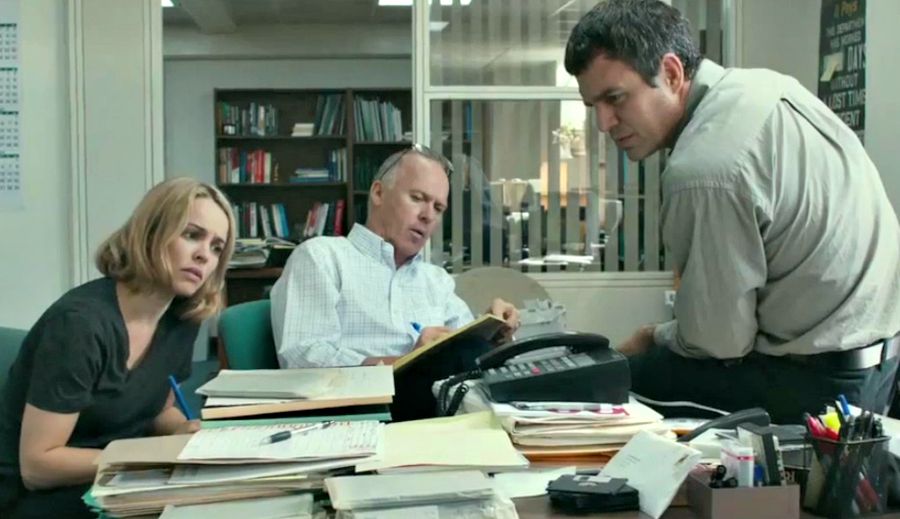
Rachel McAdams, Michael Keaton and Mark Ruffalo in a scene from "Spotlight." Image courtesy Open Road Films.
The remarkable and thrilling “Spotlight” could have taken the easy way out in its retelling of a deep, complicated investigation into a series of child abuse cases perpetrated by Catholic priests and hidden by church officials. Instead of taking the easy route and keeping the blame on the church, the film instead shines a metaphorical light at a society that quietly condones the behavior; as the film explains it, the lawyers, cops, community and even the newspaper investigating the allegations are to blame. From the film’s perspective, it takes a village to fail a child.
The newspaper in question is the venerable Boston Globe, the most well-known newspaper in New England. After a quick trip to a police station in 1976 – a scene used to set up the ensuing reporting – “Spotlight's” action picks up in the Boston Globe office circa 2001 amid a time of great tumult for the paper. New editor Marty Baron (Liev Schrieber) is already talking budget cuts to reduce the expenses of a paper losing its readership steadily, and those cuts could include the titular Spotlight team, an secret investigatory unit overseen by Ben Bradlee Jr. (John Slattery) and consisting of editor Robby Robinson (Michael Keaton) and reporters Mike Rezendes (Mark Ruffalo), Sacha Pfeiffer (Rachel McAdams) and Matt Carroll (Brian D'Arcy James).
The Spotlight unit usually selects its own stories to dig into – those stories are then kept secret even within the Globe's newsroom – but Schrieber pushes an article about alleged sexual abuse of children by Catholic priests. The proposition is met with some resistance from the staff, many of whom grew up Catholic and are cognizant of the church's influence in the area; as one character points out, a majority of the Globe's subscribers are Catholic. Still, the Spotlight team inquires about the allegations, talking with victims, a psychologist, and lawyers involved with settlements involving the church (Jamey Sheridan and Billy Crudup). They also work with an eccentric attorney (Stanley Tucci's Mitchell Garabedian) who represents a number of clients abused by priests and claims he has proof the scandal reaches to the head of the city's diocese, Cardinal Bernard Law (Len Cariou). The reporting starts off with a handful of priests, but the journalists find themselves going down the proverbial rabbit whole as the research deepens and the number of priests involved increases exponentially.
The story is horrifying in its nature, and “Spotlight” never pulls its punches when discussing what exactly happened to these victims. The details as described in the film are heart wrenching, as is the outline of how the priests preyed upon the children. As one character says while listing the step-by-step details of how his priest groomed him, “How do you say no to God?” The statement alone is terrifying, as is the empty promises made by church officials in that very first scene at the police station in 1976 after a parent is dissuaded from pressing charges against a priest: “This will never, ever happen again.”
And yet it does, again and again and again and again for decades and to hundreds of children throughout the greater Boston area. “Spotlight” offers all of its sympathy to the victims of those actions; everyone else, however, has blood on their hands. The church is castigated repeatedly for allowing the abuse to happen and shifting priests from one parish to another to hide the allegations; the state is guilty of looking the other way whenever allegations arose; attorneys representing the church and the victims share guilt for making money from the settlements; and the community deserve scorn for pretending the problem wasn't there. Even the Globe is called out in “Spotlight” for ignoring evidence sent to it years before the investigation actually started.  
Director Tom McCarthy and co-writer Josh Singer do marvelous work setting up the atmosphere in which deference to the church is mandatory so they can show how much effort is required to report on this story. They focus on the process of breaking through the wall that covers basic research and people skills to political haggling, bartering and outright bullying when needed. The process makes for fascinating cinema because of how difficult it can be to get people to do the right thing.
Not that the reporters are men and women filled with an overabundance of courage and bravery; “Spotlight” portrays them as clever, resourceful professionals committed to doing their job and nothing more. They are human, prone to fears of their family’s safety and outright anger as the revelations become more and more horrifying. This is an issue that is worthy of righteous anger, but “Spotlight,” to its credit, never succumbs to that temptation; its mission, like the one the reporters take, is to tell the story and let the facts speak for themselves.

Review: Four and a half out of Five Stars

Click here to see the trailer.

Rating: R
Run time: 128 minutes
Genre: Drama

Ask Away

Target audience: Newspaper nerds and anyone down for a well-executed investigatory flick.

Take the whole family?: Although the film isn't graphic about the content, the information it does provide will bother younger kids. Early teens and older should be fine though.

Theater or Netflix?: Good enough to justify a theater trip.

Academy Award odds?: It's among the favorites for the top prize – although a ton can and probably will change after the nominations come out – and director Tom McCarthy could get a nomination for directing and for Best Original Screenplay alongside co-writer Josh Singer. There's a good shot Mark Ruffalo and Michael Keaton become finalists for Best Supporting Actor, and Rachel McAdams might sneak in for Best Supporting Actress. All are uniformly well deserved nominations.

Watch this as well?: “All the President's Men” is the most obvious companion piece. However, definitely add in “Zodiac” – among the best movies to come out this millennium – and the smaller-scoped “The Paper” (also featuring Keaton) to your journalistic viewing list as well.