Showing posts with label Benedict Cumberbatch. Show all posts

Friday, November 9, 2018

Grinch is more boring than vile

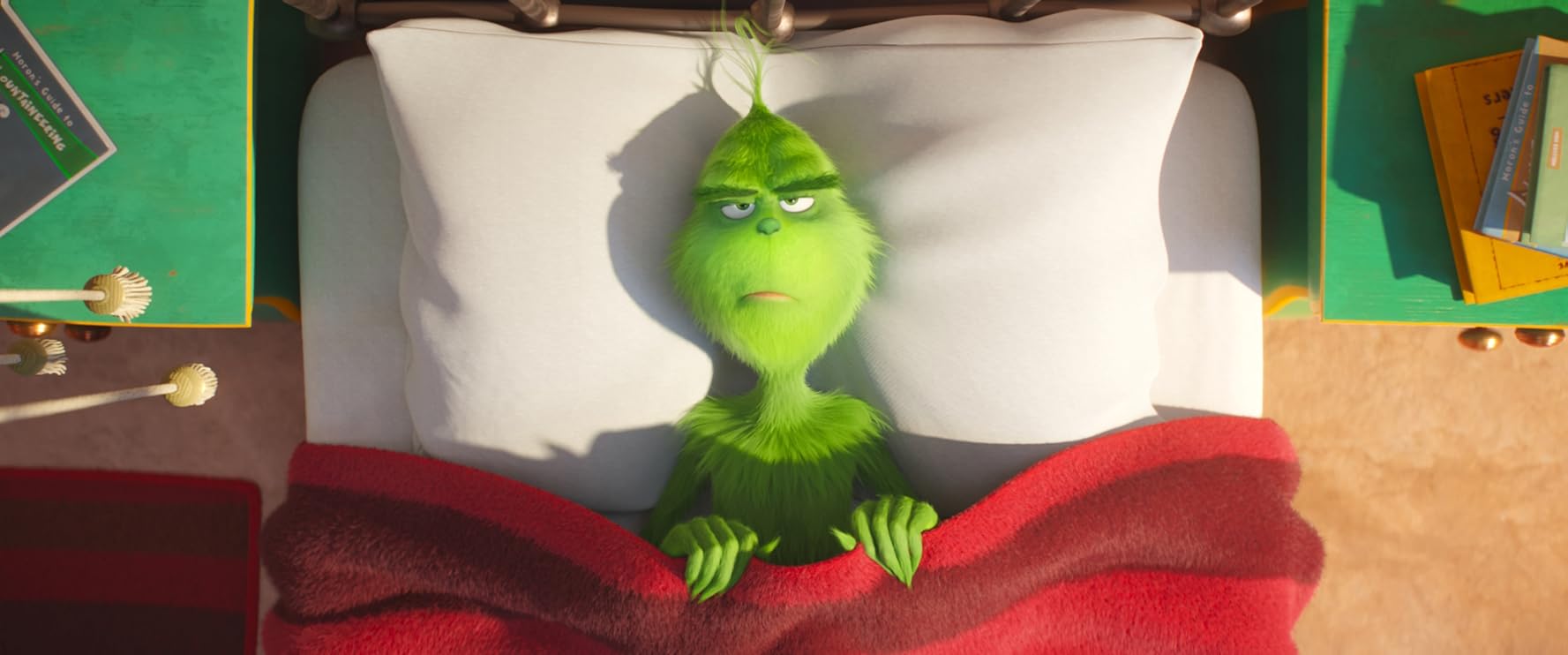
Benedict Cumberbatch voices the Grinch in The Grinch. Image courtesy Universal Pictures.
I'm not quite sure what Illumination was going for with its adaptation of How the Grinch Stole Christmas!, The Grinch. If there's a point for this film's existence, it never comes out over the course of 90 minutes packed with bland animation and an incredibly boring main character. The film has nothing interesting to say about it's star character that needed to be said. There's little art to be found in this interpretation of a seasonal classic, no real moments of innovation or profundity in sight. Like the rest of Illumination's catalog, the movie's main selling points are shininess and a brilliant ability to be completely inoffensive
 
Narrated occasionally by Pharrell, The Grinch throws Benedict Cumberbatch's voice into the mouth of the eponymous green creature who despises the Christmas season. The Grinch is particularly frustrated by the announcement from his neighbor Bricklebaum (Kenan Thompson) that this Christmas will be three times larger than any Christmas before, and vows to ruin Christmas with the help of his very faithful dog Max. Meanwhile, the young Cindy Lou Who (Cameron Seely) hatches a scheme to meet Santa to ask for a little help for her put upon mother, Donna (a very wasted Rashida Jones). Their paths eventually cross and lessons are learned about the meaning of Christmas.

What stands out about The Grinch is the lack of enthusiasm it has for the Grinch as a character. To put it simply, this Grinch is excessively boring, more irked by the world around him than properly evil. On the one hand, this version of the Grinch is far more tolerable than the aggressively obnoxious portrayal offered by Jim Carrey back in 2000, but there's not much to get a hold on beyond a few fun moments of mild chaziness. He's more akin to a mild-mannered Larry David than the imposing figure voiced by Boris Karloff. Cumberbatch's work drives a lot of this problem; he severely underplays his character's enthusiastic entrances into villainy. Like much of the cast, Cumberbatch comes across as unenthusiastic about his participation in this movie. The problem ultimately falls on the writing. The decision to have this Grinch be more put upon than vile just doesn't make a lot of sense on a narrative level. It reduces the sinister nature of his actions – forcing a dog to carry an enormous sleigh and stealing presents on Christmas is just wicked – and negates the grand change of heart at the end. The Grinch even gives him a few moments of outright decency ahead of his redemption that really undercuts the effect of his turn to kindness. 
 
The Grinch works best as a character whose motivations remain somewhat mysterious. There are conjectures and ideas for his vileness presented, but the fact there is disagreement as to what makes him such a monster makes the character far more interesting. Yet the feature-length adaptations have a real bad habit of attempting to explain the why behind the Grinch. The Grinch links this hatred back to a traumatic childhood event, even tossing in an orphanage for good measure. Aside from being tremendously lazy writing, adding a childhood wrinkle adds humanity to a monster before the monster can find his humanity. The ability for a loathsome creature like the Grinch to find love and joy despite his evil ways is inspiring.

The closest the film gets to finding a character of interest is the Grinch's counterpart, Cindy Lou Who. Her kindhearted nature is mixed well by some rambunctious and a hint of mischief, making her a decently fleshed out character. Cindy Lou comes ever so close to a fulfilling story, but the writers can't keep it together in the final act. Instead of fulfilling her wish, the writers ignore the necessity of her actions and never offer Donna any peace of mind. The Grinch doesn't really Cindy Lou for her efforts, but it does shortchange its most interesting story arc.

The troubles with Cindy Lou's story, and that of the Grinch, are connected by both poor writing and uninspired storytelling. The Grinch has nothing of note to say about its characters or about the meaning of Christmas itself. The best parts are cribbed from Dr. Seuss directly, because the original story is so well done it's very difficult to muck it up. But once the movie starts to stray away from the source material it doesn't know what to do with itself. Ingenuity requires some level of courage, and The Grinch's lack of the latter eliminates the former.

Review: Two out of Five Stars

Click here to see the trailer.

Rating: PG
Run time: 90 minutes
Genre: Animated

tl;dr

What Worked: Cindy Lou Who

What Fell Short: The Grinch, narrative arcs, animation, Benedict Cumberbatch

What To Watch Instead: How the Grinch Stole Christmas!, Arthur Christmas

Thursday, April 26, 2018

Infinity War a big, bold Avengers installment

Thanos (Josh Brolin) in a scene from Avengers: Infinity War. Image courtesy Disney.
Avengers: Infinity War makes it clear from the start exactly what the eponymous superhero group faces. The movie kicks off showing the brilliant power its villain Thanos (Josh Brolin) possesses, while hinting at just how zealous he is about it. Stakes matter in a movie as big and bold as Infinity War; viewers need to respect what the nearly two-dozen heroes have to battle against to make the necessary bloat worthwhile. The heroes in this movie aren't simply fighting the concept of amazing destruction, but a being legitimately powerful enough to make that happen. What they face is important, and the movie never lets up on how much they have to accomplish to win.

Infinity War is both the movie one would expect from Marvel's years of buildup and something largely unexpected. It's as big as it should be, littered with heroes ranging from franchise staples to new additions in the last decade or so of movies. Viewers get barbs lobbed between Iron Man (Robert Downey Jr.), Dr. Strange (Benedict Cumberbatch) and Star-Lord (Chris Pratt). Thor (Chris Hemsworth) chills with Rocket Raccoon (Bradley Cooper) and Groot (Vin Diesel). Scarlet Witch (Elizabeth Olsen), Vision (Paul Bettany), Gamora (Zoe Saldana), Black Panther (Chadwick Boseman), Captain America (Chris Evans), Mantis (Pom Klementieff) Falcon (Anthony Mackie), Black Widow (Scarlett Johansson), War Machine (Don Cheadle), Hulk (Mark Ruffalo), Bucky (Sebastian Stan), and Drax (Dave Bautista) take on aliens and other malevolent beings. Spider-man (Tom Holland) is around being all doe-eyed and awkward. Almost everyone of note from a decade of movies is here, and Infinity War spends a lot of time ensuring they all get a few moments to shine. The result is an immense run time, although directors Anthony and Joe Russo keep the drag to a minimum, making for a pretty smooth 150-minute movie. 
 
Pretty much every aesthetic selling point is handled well in this movie. The action sequences are well coordinated and range from small melees to epic battles against alien beings. The Marvel Cinematic Universe’s trademark jokes work more often than not, in large part because the addition of so many otherwise unconnected characters adds a new dynamic to the banter. On the most basic level, Infinity War is the movie people who have followed this franchise would want; the good stuff is there, and it's done rather well. And yet there's still a lot of unexpected bits to Infinity War. With the high stakes established so early, the tone of the movie is not as bright as the banter makes it appear. The jokes aren't as jovial or friendly as they usually are in Marvel films; in this case, the humor is rooted in fear and stress, a reaction to the situation the heroes face. The tone is less hopeful than before, more desperate and worrisome.

A lot of that has to do with how writers Christopher Markus and Stephen McFeely plan their narrative. The film’s focus at first glance is stopping Thanos, the actual protagonist is Thanos himself. It's his quest to collect the Infinity Stones that drives the movie, his journey toward what he believes to be a better universe. The heart of Infinity War lies not amongst the collection of heroes, but with its villain. Brolin's Thanos is not a simple monster bent on destruction for the sake of destruction, or evil just because the film requires him to be the villain for the heroes to fight. The methods to his goal of creating balance in a chaotic universe are horrifying, but there remains an iota of logic to what he wants to accomplish. In his mind, he’s performing a selfless act, and its his fervor as much as the abundance of power he seeks that makes him so dominant. Fanaticism is incredibly dangerous, especially for an infinitely powerful being capable of sacrificing everything for what he deems to be a necessary cause.
 
Making a superhero movie based on the villain is an interesting, albeit counterintuitive choice. What it does though is give Infinity War a sense of urgency it didn’t have before, selling Thanos’ power and conviction to his cause. It makes for a fairly dark superhero movie, adding enough shade to a sunny franchise to keep the audience guessing at what comes next. There’s still reasons for optimism in the Marvel Universe, but they are far more difficult to find than ever been before.

Review: Four and a half out of Five Stars

Click here to see the trailer.

Rating: PG-13
Run time: 150 minutes
Genre: Action

Ask Away
Target audience: People who have watched MCU movies for the last 10 years, as well as anyone else into comic book movies.

Take the whole family?: The tone gets pretty heavy, and families who prefer to limit their children's exposure to violence should keep the kids home. Generally though this isn't too problematic.

Theater or Netflix?: Totally worth a trip to the cinema.

What happens next?: That is an enormous question. Looking at the upcoming slate of films – Ant-Man gets his sequel in a few months, followed by a Captain Marvel movie – gives a little idea of how things will play out. But given how this movie goes, there's a whole lot of room for interpretation for the next installment. Although that is half the fun of these movies; trying to figure out what happens next.

Watch this as well?: Just pick just about anything from the Marvel Cinematic Universe and you'll be in pretty good shape. D.C. has Wonder Woman, but that’s about it.

Friday, November 4, 2016

Dr. Strange a problematic, effective head trip

Benedict Cumberbatch as Stephen Strange in Dr. Strange. Image courtesy Disney.
It's clear the folks behind the Marvel film series have a some sort of plan as to how they want to build up toward the Infinity War mayhem come 2018. And while it is difficult to argue with the success of their plan given the positive reviews and monetary returns the films have received, the existence of a Dr. Strange film always stuck out as a particularly odd note. Of all the characters for the company to introduce, was Stephen Strange really that far ahead of Black Panther, Captain Marvel, She-Hulk, or the cavalcade of other diverse characters riding deep within the company's pockets? And was it necessary to introduce Stephen Strange through his own film while continuing to neglect Black Widow, a frequent source of untapped potential within the Marvel cinematic universe?
The answer is yes and no, at least in the sense of his necessity not to the continuity to the universe, but to the differentiation of the company's otherwise cookie cutter approach to its superhero franchise. Dr. Strange is Marvel's head trip, the experimental, trippy adventure designed to explore regions the company has yet to reach out to thus far. Marvel needs Dr. Strange as a film, and as a character, to add a new dimension to its repertoire. The film is a go at a shot in the arm for the company to mix things up a little bit and step away from the more staid adventures of Thor, the overused Iron Man and Captain America. Dr. Strange is Marvel doing something a little different than what they've had before, although the film itself isn't really that far away from what the company has done for the last decade.
There's nothing inherently inventive about Dr. Strange's narrative. It's a pretty basic origin story featuring Benedict Cumberbatch – copying Robert Downey Junior's swagger and lifting Hugh Laurie's American accent – as the titular doctor rendered useless due to an ego-inflicted auto accident and forced to cure himself through Eastern mysticism. His quest places him smack dab in the middle of a mystical war between Tilda Swinton's Ancient One and a rogue warlock named Kaecilius (played by Mads Mikkelsen). Dr. Strange has a large amount of Iron Man in its DNA, with Strange and Tony Stark each serving as solipsistic geniuses who must reluctantly learn some degree of modesty to reach their true potential. Additional elements, including the potential romantic partner on the periphery (in this case a very wasted Rachel McAdams), a black best friend (Chiwetel Ejiofor as Mordo) and a loose comedic underpinning that has become something of a hallmark for these films also crop up.
What separates Dr. Strange from Iron Man, Avengers and the rest of the Marvel slate is its visual experimentation. This is a film carried thoroughly by its special effects, from the Inception inspired building folds to some trip Stephen Strange through the mind, dimensions, time and beyond, making it resemble at times a very expensive art film befitting the character. This is the reason why Marvel needed a film like Dr. Strange to move away from the action laden flicks of the past couple of years to something a little more opaque. Marvel needed this idea to work, and the visuals at least come close to justifying a Dr. Strange film.
But Stephen Strange has a few underlying issues as a comic book hero that come creeping up in the film, no matter how hard Marvel and Disney try to scrub it away. The very nature of Strange's character arc involves cultural reappropriation, using the exotic concept of Eastern religion to strengthen a white character that reduces Eastern culture into a stereotypical concept and exists just to make the white male character look better by comparison. At issue too is the casting of Swinton as The Ancient One, in which a lily white woman replaces an older Asian male. While there is indeed an argument to be made for avoiding certain stereotypes related to the aforementioned culture problem, the film still replaces a minority character with a white one, which brings up a whole slew of issues of its own.
All of this makes Dr. Strange a funky step for Marvel to take in its world construction. There is a need for someone like Stephen Strange in the company's current roster, and the aesthetics of the film offer some balance to everything else. Yet the character trappings ultimately diminish what is, by concept, a pretty interesting film. It marks a step forward and a step backward for Marvel, with the hope the backward step is not a prelude of what to expect over the next three years.

Review: Three out of Five Stars

Click here to see the trailer.

Rating: PG-13
Run time: 115 minutes
Genre: Action

Ask Away

Target audience: Anyone who has watched a Marvel film since Iron Man.

Take the whole family?: There's nothing overly objectionable content wise, although the film could bother little kids do to some of its graphics along with a couple of swears.

Theater or Netflix?: You'll probably go see it, so if you do pay for the matinee.

What other Marvel characters deserve their own films?: I've vouched for Black Widow and Quasar before, but Marvel could do a fair amount with She-Hulk as a more intelligent, controlled Hulk and Ms. Marvel. It’d be fascinating to see a Squirrel Girl film too, which, if based on the current iteration of the character, would be focused on goofy adventures and a push away from violence.

Watch this as well?: Guardians of the Galaxy, the first Avengers and Winter Soldier remain the cream of the crop of the Marvel films. You could also hit up Inception and 2001: A Space Odyssey to see Dr. Strange's visual influencers.