Showing posts with label Christmas. Show all posts

Thursday, December 6, 2018

Anna and the Apocalypse is bloody holiday fun

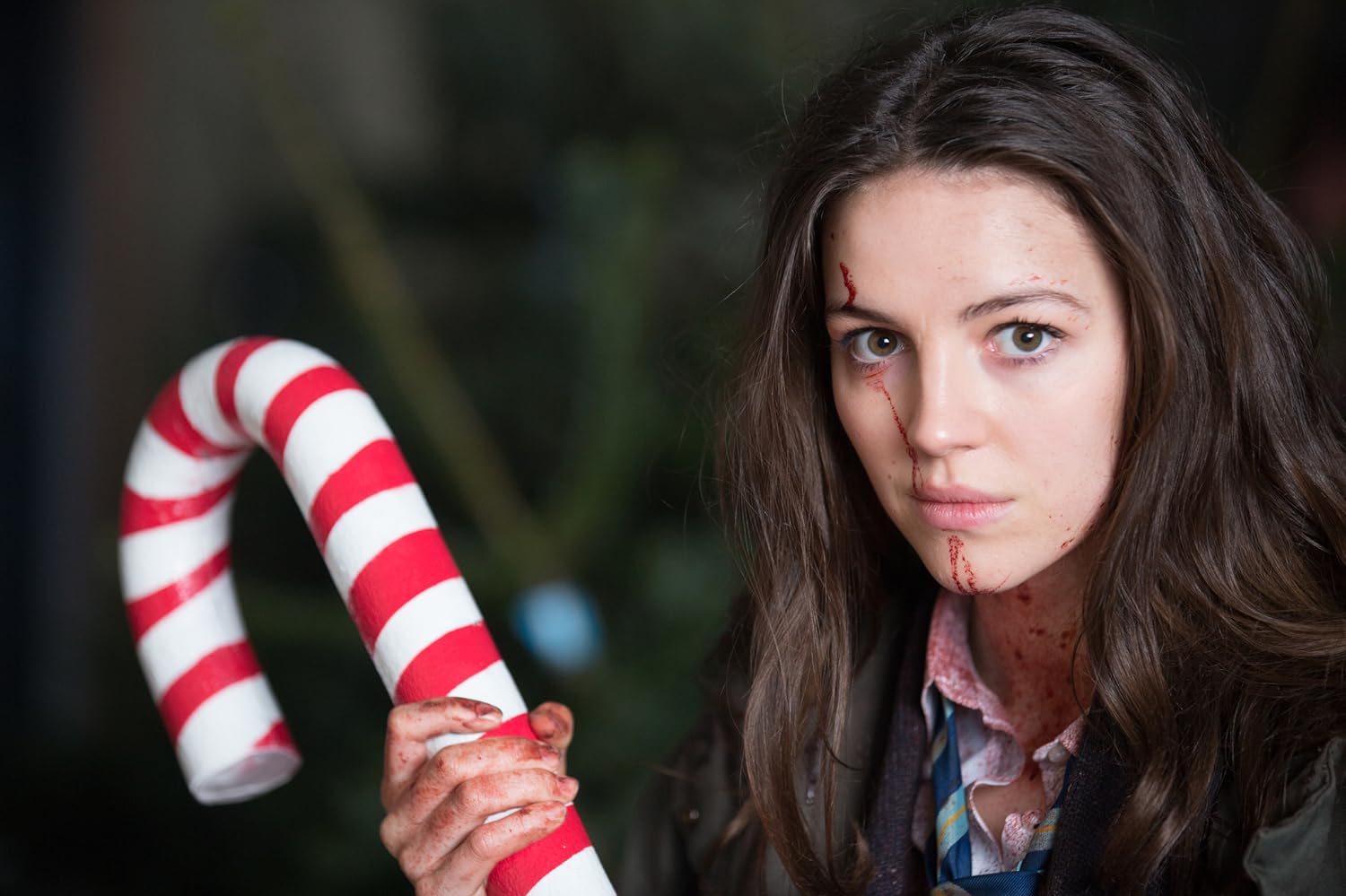
Ella Hunt in Anna and the Apocalypse. Image courtesy Orion Pictures.
On a visceral level, the chaos-laden Anna and the Apocalypse delivers exactly as it promises. It takes place in the days leading up to Christmas, so there is ample holiday decorations and holiday weaponry. The musical numbers are plentiful with a few rather catchy tunes to replay on Spotify. There are a ton of zombies to demolish with creative flair, particularly a rather eventful bowling alley scene that showcases the filmmakers' ingenuity in blood spattering. And it has a sense of humor that ranges from silly teen jokes to some wicked gallows humor. The movie is fun and infectious, a nice little holiday flick that veers off the beaten path. And it could have been a whole lot more than that.

Ella Hunt stars as the eponymous Anna, a high school girl who dreams of exploring the world before college, much to the consternation of her father (Mark Benton). Alongside her best friend/wannabe romantic interest John (Malcolm Cumming), Anna navigates the rigors of high school, intersecting with ambitious student reporter Steph, (Sarah Swire), aspiring chanteuse Lisa (Marli Siu), her boyfriend Chris (Christopher Leveaux), handsome jerk Nick (Ben Wiggins), and intense headmaster Savage (Paul Kaye). Their dreary high school life ends when an infestation of zombies invades their small town, forcing Anna and her friends to fend for survival against an army of the living dead.

The movie certainly has a spark to it, a joy for dismembering zombies and big, bold musical numbers. But Anna and the Apocalypse still feels like a missed opportunity. The combination of horror, comedy, musical, and holiday occasionally conflict to undermine one another, undermining the premise's selling point. Some of the filmmakers' push for comedy lightens the horror elements, resulting in a movie that is more gory than scary. The songs are a little too hit or miss, coming in to either lessen the horror or stall the movie's momentum and character progression. 

The latter is an overarching issue, as Anna and the Apocalypse doesn't give itself enough time to develop either it's world or it's universe. Blending the zombie film with the musical short changes the character development needed to make their fates matter. Musical numbers are often shortcuts to building characters, revealing motivations openly and effectively. Yet the songs don't cover enough of the space, leaving folks like Nick and Lisa to fulfill their arcs through awkward exposition. The filmmakers using a lot of throwaway lines to compensate for missing potential visual indicators or elaboration from characters. Considering how important these little details are – most notably the existence of a military base never mentioned in act one – skipping over those details muddles the story. And it's especially confusing given how religiously Anna and the Apocalypsefollows Chekhov's Gun, with little things like confiscated car keys or a prop falling apart introduced in act one become very important in act three. It's a weird to introduce some elements and bring them back while trying to patch plot holes with exposition, making some of the plot points a little too obvious and blunt at time

Then again, considering Anna and the Apocalypse's horror and musical roots, subtlety is less important than it would be otherwise. And the filmmakers throw in a couple of surprising deaths to avoid having an apocalypse go easily for a collection of mostly untrained teenagers wandering around a land of doom. The deaths would have hit harder had the film invested more time in character development, but the deaths fit the film's melancholy soul.

Like many a great musical, many an excellent horror flick, and several pretty good holiday movies, happiness is hard to find in Anna and the Apocalypse. The characters' circumstances are consistently riddled with disappointment and hopes for a better tomorrow. Anna is very close to making it out, but the end of the world quashes her dreams of exploration. She does not end the movie in a better place than she started it. The reasons she may have stuck around town are gone, but in the cruelest twist of all she has nowhere else she can go. All that's left is to drive headfirst into the miasma, with neither direction nor clarity to guide her.

Review: Four out of Five Stars

Click here to see the trailer.
 
Rating: R
Run time: 97 minutes
Genre: Horror

tl;dr

What Worked: Premise, Ella Hunt, Malcolm Cumming

What Fell Short: Character development

What To Watch As Well: Shaun of the Dead, Dr. Horrible's Sing-Along Blog

Friday, November 9, 2018

Grinch is more boring than vile

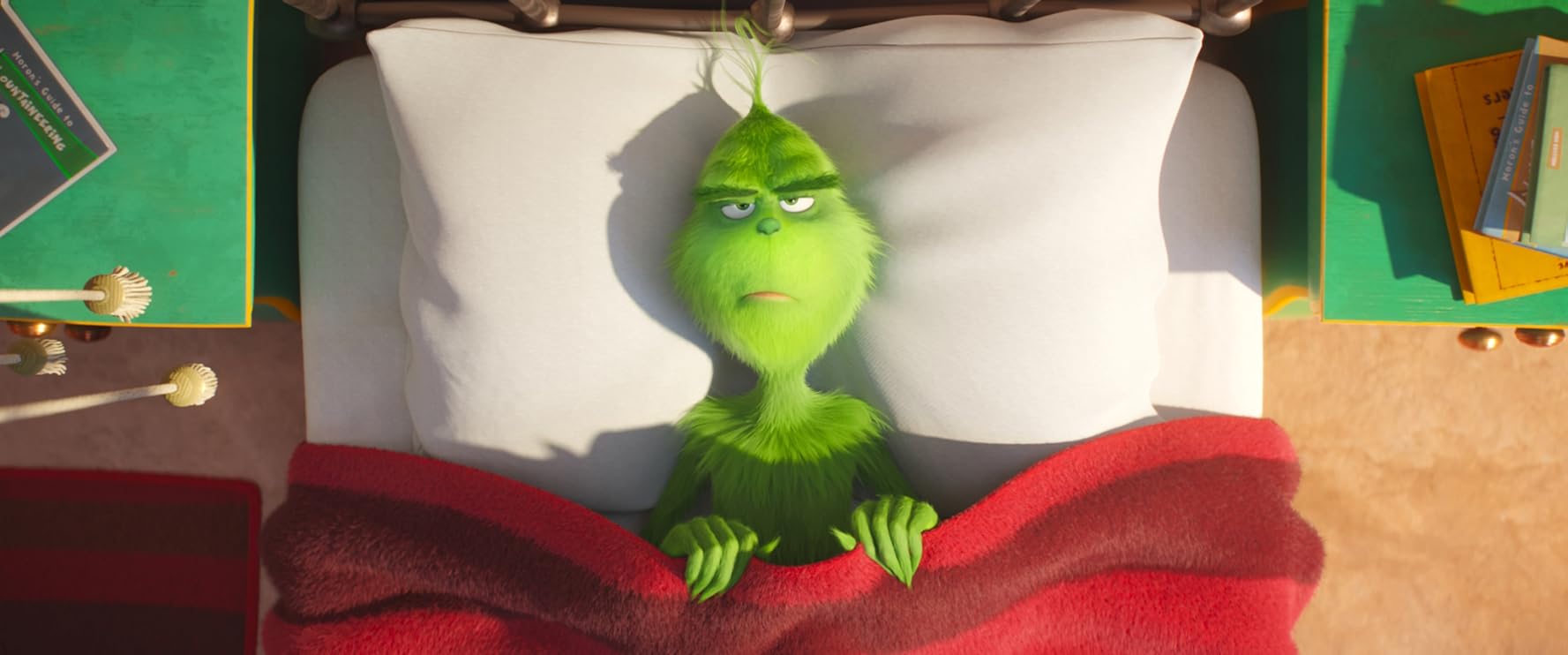
Benedict Cumberbatch voices the Grinch in The Grinch. Image courtesy Universal Pictures.
I'm not quite sure what Illumination was going for with its adaptation of How the Grinch Stole Christmas!, The Grinch. If there's a point for this film's existence, it never comes out over the course of 90 minutes packed with bland animation and an incredibly boring main character. The film has nothing interesting to say about it's star character that needed to be said. There's little art to be found in this interpretation of a seasonal classic, no real moments of innovation or profundity in sight. Like the rest of Illumination's catalog, the movie's main selling points are shininess and a brilliant ability to be completely inoffensive
 
Narrated occasionally by Pharrell, The Grinch throws Benedict Cumberbatch's voice into the mouth of the eponymous green creature who despises the Christmas season. The Grinch is particularly frustrated by the announcement from his neighbor Bricklebaum (Kenan Thompson) that this Christmas will be three times larger than any Christmas before, and vows to ruin Christmas with the help of his very faithful dog Max. Meanwhile, the young Cindy Lou Who (Cameron Seely) hatches a scheme to meet Santa to ask for a little help for her put upon mother, Donna (a very wasted Rashida Jones). Their paths eventually cross and lessons are learned about the meaning of Christmas.

What stands out about The Grinch is the lack of enthusiasm it has for the Grinch as a character. To put it simply, this Grinch is excessively boring, more irked by the world around him than properly evil. On the one hand, this version of the Grinch is far more tolerable than the aggressively obnoxious portrayal offered by Jim Carrey back in 2000, but there's not much to get a hold on beyond a few fun moments of mild chaziness. He's more akin to a mild-mannered Larry David than the imposing figure voiced by Boris Karloff. Cumberbatch's work drives a lot of this problem; he severely underplays his character's enthusiastic entrances into villainy. Like much of the cast, Cumberbatch comes across as unenthusiastic about his participation in this movie. The problem ultimately falls on the writing. The decision to have this Grinch be more put upon than vile just doesn't make a lot of sense on a narrative level. It reduces the sinister nature of his actions – forcing a dog to carry an enormous sleigh and stealing presents on Christmas is just wicked – and negates the grand change of heart at the end. The Grinch even gives him a few moments of outright decency ahead of his redemption that really undercuts the effect of his turn to kindness. 
 
The Grinch works best as a character whose motivations remain somewhat mysterious. There are conjectures and ideas for his vileness presented, but the fact there is disagreement as to what makes him such a monster makes the character far more interesting. Yet the feature-length adaptations have a real bad habit of attempting to explain the why behind the Grinch. The Grinch links this hatred back to a traumatic childhood event, even tossing in an orphanage for good measure. Aside from being tremendously lazy writing, adding a childhood wrinkle adds humanity to a monster before the monster can find his humanity. The ability for a loathsome creature like the Grinch to find love and joy despite his evil ways is inspiring.

The closest the film gets to finding a character of interest is the Grinch's counterpart, Cindy Lou Who. Her kindhearted nature is mixed well by some rambunctious and a hint of mischief, making her a decently fleshed out character. Cindy Lou comes ever so close to a fulfilling story, but the writers can't keep it together in the final act. Instead of fulfilling her wish, the writers ignore the necessity of her actions and never offer Donna any peace of mind. The Grinch doesn't really Cindy Lou for her efforts, but it does shortchange its most interesting story arc.

The troubles with Cindy Lou's story, and that of the Grinch, are connected by both poor writing and uninspired storytelling. The Grinch has nothing of note to say about its characters or about the meaning of Christmas itself. The best parts are cribbed from Dr. Seuss directly, because the original story is so well done it's very difficult to muck it up. But once the movie starts to stray away from the source material it doesn't know what to do with itself. Ingenuity requires some level of courage, and The Grinch's lack of the latter eliminates the former.

Review: Two out of Five Stars

Click here to see the trailer.

Rating: PG
Run time: 90 minutes
Genre: Animated

tl;dr

What Worked: Cindy Lou Who

What Fell Short: The Grinch, narrative arcs, animation, Benedict Cumberbatch

What To Watch Instead: How the Grinch Stole Christmas!, Arthur Christmas

Friday, November 11, 2016

Almost Christmas follows its formula to slightly above average results

A scene from Almost Christmas. Image courtesy Universal Pictures.
My reaction to Almost Christmas is a little scattered and very contradictory. As a piece of filmmaking there isn't a lot going for it; it's a film easy to nitpick for its contrivances and some rather notable script problems. At the same time, well, I kind of enjoyed it. I got a few laughs out of it and a couple of the subplots are interesting enough to maintain interest through the lesser stories. It’s fine enough, a watchable film with just a hint of interesting to keep it a skosh above average.
It would be nice to have a little more vigor for defending this film, but in the end writer/director David E. Talbert dedicated his film to maintaining the standards of the wicked dire holiday film genre. These are the films in which a family or a group of friends come together after or amid a tragedy to a loved one for the season. Think Family Stone, The Best Man Holiday, and similar films in which loads of bickering occur during a season in which family and/or friends come first. The films are guaranteed to be corny as all heck, skimming the surface for pathos without diving deep into character development while relying on clichés to carry the heavy emotional lifting. That flaw is by design, as these films focus on so many characters none of them receive an adequate amount of time to develop, if any time at all to become proper characters. (Poor Nicole Ari Parker is given so little to do it’s easy to forget she's even there.) Almost Christmas never wants to escape these issues. The film has to fit in time for Parker, Danny Glover, Mo'Nique, Gabrielle Union, Omar Epps, Romany Malco, J. B. Smoove, Kimberly Elise and Jessie Usher to develop their characters and find ways for those characters to grow from their experience. A good cliché is the easy answer, so every problem – from mild drug addictions and sisterly feuds to infidelity and political moral uncertainty – is solvable through just a few days of family time and bonding. Almost Christmas is not an intellectual exam; you're brain will be more focused on the tropes and figuring out why the middle of an election campaign occurs five days before Christmas.
Yet there are a few things “Almost Christmas” does right, or at least well enough to make the less interesting tidbits go down a little smoother. Talbert shows a knack for filming a good sequence, opening the film with a time lapse akin to the infamous tearjerker from Up and tossing in scenes of dancing and a touch football game that feel moderately organic. It's as if these moments, while still attached to the clichés around them, offer a modicum of grounding for the cinematic problems that crop up. The dancing scene in particular is organically silly, the kind of moment that feels common enough for a viewer to connect with the characters, at least for this one moment. It helps Talbert filled his film with a collection of ringers who can sell the malarkey in front of them. Union and Epps in particular exhibit a terrific rapport with each other, selling their tired plotline through force of personality alone. Union also clicks well with Elise as a pair of warring sisters who have the most interesting story in Almost Christmas. That Mo'Nique and Smoove are around to give each other grief makes things a little more fun, as does Glover doing the old man routine he's utilized since Lethal Weapon. Almost Christmas' cast is good and game, and that goes a long way to making this film moderately worthwhile.
I think that is really the selling point for Almost Christmas. It's an earnest film that Talbert clearly wants to be endearing and wants to connect with its audience, despite the narrative confines it opts to trap itself in. Talbert isn't the most talented writer or director, but he cares enough for his viewers to want to relate to them somehow without condescending. Almost Christmas is not a film I would want to watch again, nor is it one that will retain much memory beyond this holiday season. This is pretty solid for what it is though, and in this case that’s enough.

Rating: Three out of Five Stars

Click here to see the trailer.

Rating: PG-13
Run time: 112 minutes
Genre: Comedy
Ask Away

Target audience: People wanting to get a jump on their holiday movie splurging.

Take the whole family?: Wouldn't recommend it for kiddos – the content is a little too adult at times and not appealing to that demographic – but a year or two within the rating is safe.

Theater or Netflix?: It's a little too early to see a holiday film, so wait to stream it.

Any truly bothersome issues?: It's Romany Malco's election subplot that keeps bugging me. What doesn't make sense is the timing for the whole thing, given a Congressional election would take place well before or well after the holiday season. The film never mentions a special election, so it really feels out of place for him to focus on a campaign for nothing. Plus it further pushes Nicole Ari Parker to the backburner.

Watch this as well?: The best holiday coming together film of this millennium is the French film A Christmas Tale, which adds a lot more bite to the proceedings than similar American films. Christmas Vacation is always good for a few laughs, and you can flag down the ridiculous but watchable The Best Man Holiday for some laugh. And speaking of Omar Epps, catch the sublime romantic comedy Love & Basketball.