Showing posts with label Rachel McAdams. Show all posts

Friday, November 4, 2016

Dr. Strange a problematic, effective head trip

Benedict Cumberbatch as Stephen Strange in Dr. Strange. Image courtesy Disney.
It's clear the folks behind the Marvel film series have a some sort of plan as to how they want to build up toward the Infinity War mayhem come 2018. And while it is difficult to argue with the success of their plan given the positive reviews and monetary returns the films have received, the existence of a Dr. Strange film always stuck out as a particularly odd note. Of all the characters for the company to introduce, was Stephen Strange really that far ahead of Black Panther, Captain Marvel, She-Hulk, or the cavalcade of other diverse characters riding deep within the company's pockets? And was it necessary to introduce Stephen Strange through his own film while continuing to neglect Black Widow, a frequent source of untapped potential within the Marvel cinematic universe?
The answer is yes and no, at least in the sense of his necessity not to the continuity to the universe, but to the differentiation of the company's otherwise cookie cutter approach to its superhero franchise. Dr. Strange is Marvel's head trip, the experimental, trippy adventure designed to explore regions the company has yet to reach out to thus far. Marvel needs Dr. Strange as a film, and as a character, to add a new dimension to its repertoire. The film is a go at a shot in the arm for the company to mix things up a little bit and step away from the more staid adventures of Thor, the overused Iron Man and Captain America. Dr. Strange is Marvel doing something a little different than what they've had before, although the film itself isn't really that far away from what the company has done for the last decade.
There's nothing inherently inventive about Dr. Strange's narrative. It's a pretty basic origin story featuring Benedict Cumberbatch – copying Robert Downey Junior's swagger and lifting Hugh Laurie's American accent – as the titular doctor rendered useless due to an ego-inflicted auto accident and forced to cure himself through Eastern mysticism. His quest places him smack dab in the middle of a mystical war between Tilda Swinton's Ancient One and a rogue warlock named Kaecilius (played by Mads Mikkelsen). Dr. Strange has a large amount of Iron Man in its DNA, with Strange and Tony Stark each serving as solipsistic geniuses who must reluctantly learn some degree of modesty to reach their true potential. Additional elements, including the potential romantic partner on the periphery (in this case a very wasted Rachel McAdams), a black best friend (Chiwetel Ejiofor as Mordo) and a loose comedic underpinning that has become something of a hallmark for these films also crop up.
What separates Dr. Strange from Iron Man, Avengers and the rest of the Marvel slate is its visual experimentation. This is a film carried thoroughly by its special effects, from the Inception inspired building folds to some trip Stephen Strange through the mind, dimensions, time and beyond, making it resemble at times a very expensive art film befitting the character. This is the reason why Marvel needed a film like Dr. Strange to move away from the action laden flicks of the past couple of years to something a little more opaque. Marvel needed this idea to work, and the visuals at least come close to justifying a Dr. Strange film.
But Stephen Strange has a few underlying issues as a comic book hero that come creeping up in the film, no matter how hard Marvel and Disney try to scrub it away. The very nature of Strange's character arc involves cultural reappropriation, using the exotic concept of Eastern religion to strengthen a white character that reduces Eastern culture into a stereotypical concept and exists just to make the white male character look better by comparison. At issue too is the casting of Swinton as The Ancient One, in which a lily white woman replaces an older Asian male. While there is indeed an argument to be made for avoiding certain stereotypes related to the aforementioned culture problem, the film still replaces a minority character with a white one, which brings up a whole slew of issues of its own.
All of this makes Dr. Strange a funky step for Marvel to take in its world construction. There is a need for someone like Stephen Strange in the company's current roster, and the aesthetics of the film offer some balance to everything else. Yet the character trappings ultimately diminish what is, by concept, a pretty interesting film. It marks a step forward and a step backward for Marvel, with the hope the backward step is not a prelude of what to expect over the next three years.

Review: Three out of Five Stars

Click here to see the trailer.

Rating: PG-13
Run time: 115 minutes
Genre: Action

Ask Away

Target audience: Anyone who has watched a Marvel film since Iron Man.

Take the whole family?: There's nothing overly objectionable content wise, although the film could bother little kids do to some of its graphics along with a couple of swears.

Theater or Netflix?: You'll probably go see it, so if you do pay for the matinee.

What other Marvel characters deserve their own films?: I've vouched for Black Widow and Quasar before, but Marvel could do a fair amount with She-Hulk as a more intelligent, controlled Hulk and Ms. Marvel. It’d be fascinating to see a Squirrel Girl film too, which, if based on the current iteration of the character, would be focused on goofy adventures and a push away from violence.

Watch this as well?: Guardians of the Galaxy, the first Avengers and Winter Soldier remain the cream of the crop of the Marvel films. You could also hit up Inception and 2001: A Space Odyssey to see Dr. Strange's visual influencers.

Friday, November 6, 2015

Shining a light into moral darkness

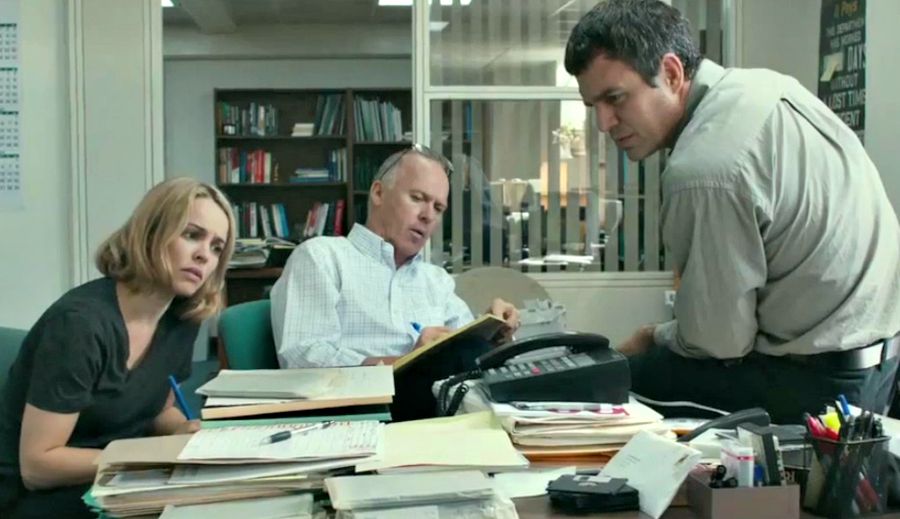
Rachel McAdams, Michael Keaton and Mark Ruffalo in a scene from "Spotlight." Image courtesy Open Road Films.
The remarkable and thrilling “Spotlight” could have taken the easy way out in its retelling of a deep, complicated investigation into a series of child abuse cases perpetrated by Catholic priests and hidden by church officials. Instead of taking the easy route and keeping the blame on the church, the film instead shines a metaphorical light at a society that quietly condones the behavior; as the film explains it, the lawyers, cops, community and even the newspaper investigating the allegations are to blame. From the film’s perspective, it takes a village to fail a child.
The newspaper in question is the venerable Boston Globe, the most well-known newspaper in New England. After a quick trip to a police station in 1976 – a scene used to set up the ensuing reporting – “Spotlight's” action picks up in the Boston Globe office circa 2001 amid a time of great tumult for the paper. New editor Marty Baron (Liev Schrieber) is already talking budget cuts to reduce the expenses of a paper losing its readership steadily, and those cuts could include the titular Spotlight team, an secret investigatory unit overseen by Ben Bradlee Jr. (John Slattery) and consisting of editor Robby Robinson (Michael Keaton) and reporters Mike Rezendes (Mark Ruffalo), Sacha Pfeiffer (Rachel McAdams) and Matt Carroll (Brian D'Arcy James).
The Spotlight unit usually selects its own stories to dig into – those stories are then kept secret even within the Globe's newsroom – but Schrieber pushes an article about alleged sexual abuse of children by Catholic priests. The proposition is met with some resistance from the staff, many of whom grew up Catholic and are cognizant of the church's influence in the area; as one character points out, a majority of the Globe's subscribers are Catholic. Still, the Spotlight team inquires about the allegations, talking with victims, a psychologist, and lawyers involved with settlements involving the church (Jamey Sheridan and Billy Crudup). They also work with an eccentric attorney (Stanley Tucci's Mitchell Garabedian) who represents a number of clients abused by priests and claims he has proof the scandal reaches to the head of the city's diocese, Cardinal Bernard Law (Len Cariou). The reporting starts off with a handful of priests, but the journalists find themselves going down the proverbial rabbit whole as the research deepens and the number of priests involved increases exponentially.
The story is horrifying in its nature, and “Spotlight” never pulls its punches when discussing what exactly happened to these victims. The details as described in the film are heart wrenching, as is the outline of how the priests preyed upon the children. As one character says while listing the step-by-step details of how his priest groomed him, “How do you say no to God?” The statement alone is terrifying, as is the empty promises made by church officials in that very first scene at the police station in 1976 after a parent is dissuaded from pressing charges against a priest: “This will never, ever happen again.”
And yet it does, again and again and again and again for decades and to hundreds of children throughout the greater Boston area. “Spotlight” offers all of its sympathy to the victims of those actions; everyone else, however, has blood on their hands. The church is castigated repeatedly for allowing the abuse to happen and shifting priests from one parish to another to hide the allegations; the state is guilty of looking the other way whenever allegations arose; attorneys representing the church and the victims share guilt for making money from the settlements; and the community deserve scorn for pretending the problem wasn't there. Even the Globe is called out in “Spotlight” for ignoring evidence sent to it years before the investigation actually started.  
Director Tom McCarthy and co-writer Josh Singer do marvelous work setting up the atmosphere in which deference to the church is mandatory so they can show how much effort is required to report on this story. They focus on the process of breaking through the wall that covers basic research and people skills to political haggling, bartering and outright bullying when needed. The process makes for fascinating cinema because of how difficult it can be to get people to do the right thing.
Not that the reporters are men and women filled with an overabundance of courage and bravery; “Spotlight” portrays them as clever, resourceful professionals committed to doing their job and nothing more. They are human, prone to fears of their family’s safety and outright anger as the revelations become more and more horrifying. This is an issue that is worthy of righteous anger, but “Spotlight,” to its credit, never succumbs to that temptation; its mission, like the one the reporters take, is to tell the story and let the facts speak for themselves.

Review: Four and a half out of Five Stars

Click here to see the trailer.

Rating: R
Run time: 128 minutes
Genre: Drama

Ask Away

Target audience: Newspaper nerds and anyone down for a well-executed investigatory flick.

Take the whole family?: Although the film isn't graphic about the content, the information it does provide will bother younger kids. Early teens and older should be fine though.

Theater or Netflix?: Good enough to justify a theater trip.

Academy Award odds?: It's among the favorites for the top prize – although a ton can and probably will change after the nominations come out – and director Tom McCarthy could get a nomination for directing and for Best Original Screenplay alongside co-writer Josh Singer. There's a good shot Mark Ruffalo and Michael Keaton become finalists for Best Supporting Actor, and Rachel McAdams might sneak in for Best Supporting Actress. All are uniformly well deserved nominations.

Watch this as well?: “All the President's Men” is the most obvious companion piece. However, definitely add in “Zodiac” – among the best movies to come out this millennium – and the smaller-scoped “The Paper” (also featuring Keaton) to your journalistic viewing list as well.