Thursday, March 24, 2016

'Batman v Superman' gets almost everything wrong

Ben Affleck and Henry Cavill in "Batman v Superman: Dawn of Justice." Image courtesy Warner Bros. Pictures.
To lift a line from Commissioner Gordon, “Batman v Superman: Dawn of Justice” is not the Batman and Superman film we need, nor is it really the one we deserve either. It represents what happens when a studio takes the Marvel formula (and this film is a vital cog in a Marvel rip off) and doesn’t understand how those pieces fit together to form a cohesive movie. “Dawn of Justice” strips away the qualities that have made the eponymous heroes so memorable, instead opting to turn these characters into hyper violent caricatures of themselves. “Dawn of Justice” fails its audience on almost every level, delivering a soulless flick directed by a man with nary a clue as to what to do with the characters he’s created.
That man is Zack Snyder, who has somehow found himself in charge of DC Comics’ three pivotal characters despite a legacy of mediocrity and hypocrisy as a director. “Dawn of Justice” is not his finest hour, a film with no rhythm and far too many little subplots chucked in despite a central plot that nowhere near justifies two and a half hours in theater. It’s clear Snyder and film writers David S. Goyer and Chris Terrio are setting up the impending “Justice League” franchise throughout “Dawn of Justice,” which is strange considering having Batman, Superman and Wonder Woman in the same movie already accomplishes that feat.
The failures of “Dawn of Justice” as a film begin with those three, from the aforementioned pacing problems to some wonky dialogue to unimpressive special effects to burdensome dream sequences thrown in to make the film feel deep. The fact these dream sequences add little to the film besides precious minutes of our lives is not a factor Snyder, Goyer and Terrio appeared to consider. “Dawn of Justice” is also littered with plot holes and silly contrivances obvious enough to notice and mock while watching the film. Admittedly, those holes did offer the highest level of entertainment this film has to offer.
And then there’s the casting of the charmless Henry Cavill and the Ben Affleckian Ben Affleck as Superman and Batman, respectively. Cavill, who first donned the blue suit for “Dawn of Justice’s” precursor “Man of Steel,” lacks the inherent decency brought to the role by Christopher Reeve that provides some humility to what is otherwise a god. Without humility, you’re left with a cipher, a bland being whose most noteworthy features are a garish costume, laser beams, and the glasses he wears as a disguise. Affleck doesn’t offer much in the way of a performance as either Bruce Wayne or Batman, which is to be expected for the Affleck sibling better served behind the camera than in front.
Cavill and Affleck are so solemn in their performances it makes Jesse Eisenberg’s Lex Luthor even more flamboyant than expected. The Facebook founder appears to belong in a very different movie, taking Gene Hackman’s performance from the first two “Superman” flicks and adding even more scenery chewing to go along with very obvious hints at some level of autism. Everyone else is OK, with Holly Hunter underused as Senator Finch; Amy Adams stuck playing damsel in distress as Lois Lane; Jeremy Irons butles as Bruce Wayne’s loyal butler Alfred; Diane Lane worries as Martha Kent; and Gal Gadot doesn’t do a lot as Diana Prince/Wonder Woman, but just having Wonder Woman around is the best part of “Dawn of Justice.”
The cinematic issues for “Dawn of Justice” though are trumped by the decisions Snyder and his wrecking crew make to the characters themselves. It starts with the opening sequence that shows robber Joe Chill holding up Bruce, Thomas and Martha Wayne. Most versions have Thomas Wayne attempting to shield his family and negotiate with Chill, who shoots him in cold blood before murdering Martha as she screams. Snyder has Thomas Wayne attempt to attack Chill, who shoots Bruce's father out of self defense, then shoots Martha Wayne somewhat accidentally after she attacks him. The difference is minor on the surface, but it effectively inspires the more grotesque acts Affleck's Batman commits in this version and diminishes The Dark Knight's skills as a negotiator, as a hero who tries to avoid a violent confrontation when he can.
This version spreads throughout “Dawn of Justice,” with Batman wantonly murdering, shooting and even branding people out of cruelty. Batman as a character has very clear guiding principles developed not just through the death of his parents, but the strong influence of Alfred as a father figure and a nuanced understanding of justice rooted in his intellectualism. Snyder's version is a dolt who leaves the non-punching work to Alfred and gets duped into taking on a god. Then again, Superman isn't exactly all that brilliant either, and it's implied heavily that he is willing to murder if he deems it necessary. Like Batman, that contrasts greatly from a character who avoids acts of gratuitous violence when he can because he can at least empathize with humanity at some level and understands the horror he's capable of inflicting.
The psychopathic versions of the eponymous heroes comes to a head in an anticlimactic final act highlighted solely by the presence of Gadot's Wonder Woman. The big twist in the film is based on a very famous comic from the 90s featuring an iconic moment that Snyder, of course, fails to grasp. He misses the point of the exercise, the true danger of the villain the heroes battle against and the exhaustion the combatants face at that final draw. It's the biggest misstep in a film that spends 151 minutes going in the wrong direction.

Review: One and a half out of Five Stars

Click here to see the trailer.

Rating: PG-13
Run time: 151 minutes
Genre: Action

Ask Away

Target audience: All of those people who've flocked to see “Avengers” movies in recent years, as well as Batman and Superman fans. In other words, everyone.

Take the whole family?: A lot of people die in this film, so I really wouldn't recommend this thing for kids. You'll take them anyway though, because this is a film with Batman and Superman.

Theater or Netflix?: Matinee if you really, really must.

Where does Ben Affleck rank as a Batman?: It really depends on how forgiving you are about George Clooney – he's tolerable given the circumstances in my view – but I would put Affleck at the bottom of the Batman hierarchy. My list goes Kevin Conroy (he voiced Batman in multiple TV series and video games), Christian Bale, Michael Keaton, Adam West, Val Kilmer, Clooney, Affleck.

Watch this instead?: The first two “Superman” films are still quite good, as are “Batman Begins,” “The Dark Knight,” and Tim Burton's first “Batman” flick. For anyone who wants to dive a little deeper, find episodes of “Batman: The Animated Series” from the 1990s and the “Justice League” franchise that ran on Cartoon Network last decade.

Friday, March 18, 2016

'Allegiant' makes no sense

Theo James and Shailene Woodley are set to kiss at an inopportune moment in "Allegiant." Image courtesy Lionsgate.
It’s clear the filmmakers behind “Allegiant,” the newest entry in the “Divergent” series, had a very specific audience in mind when they opted to make this film. The actors are very pretty, the dialogue is very simplistic, the plot is very straightforward, and the plot holes are big enough for a tank to drive through. So, perhaps but hopefully perhaps not, this film might work for the target audience, but anyone outside of that core demographic is in for a very bumpy ride.
“Allegiant” picks up right after the end of its predecessor “Insurgent,” which came out in 2015. The gate that separated Chicago from the rest of the world has opened, but new leader Evelyn (Naomi Watts, one of many people far too good for this film) prevents anyone from leaving. Instead, she hosts a series of trials to execute the enforcers who served under the previous regime. Not happy with how things are going, series protagonist/The Special Tris (Shailene Woodley) recruits her boyfriend Four (Theo James, aka diet Paul Walker) and a few friends from the other two films in the series (Miles Teller, Ansel Elgort and ZoĆ« Kravitz) to see exactly what life is like on the other side of the fence and to see if the grass is indeed greener.
What they discover is a futuristic society (or one even more so than the future they exist in) headed by David (Jeff Daniels), a researcher who uses Chicago as a sort of experiment to see if humanity can rid itself of the defective character traits that define life in the Windy City. Woodley, as the chosen one, is the key to his research, and he recruits her to meet up with a special council to save the denizens of her home town. Things aren't exactly going swimmingly there though; Octavia Spencer's Johanna is waging a war against Watts for control of the city to restore the factions Woodley and friends fought to destroy, and things are getting out of hand fast. Daniels' David could be the last hope to prevent a civil war, or are his motives could be far more nefarious than Woodley suspects (yes, they are). Regardless, shenanigans encompassing ships, angst, memory erasing, kidnapping, more angst, flying hockey pucks, and a hint more angst for the young stars ensue. –
“Allegiant’s” flaws are legion. It’s generally poorly acted – the high profile names are not invested in this endeavor – and impressively hideous aesthetically with some god awful CGI, and even features dialogue that’s often redundant and definitely overly simplistic even for a film aimed at tweens. The hallmark though are the plot holes, the gaps in logic that keep cropping up because the team of writers enlisted to write this travesty don’t know what to do with their characters. To use an old Roger Ebert concept, the entirety of “Allegiant's” plot machinations is dependent on people acting dumb and, in several cases, against their own or anyone else's interest. Daniels' David, who (spoiler) becomes the film's big bad, can undermine the entire counter operation run by Woodley's Tris and her friends without leaving his office. Or, at least, he should be able to enact his master plan with the flip of a switch from his couch in his boxers while watching “RuPaul's Drag Race.” But he doesn't, and he never designs his grand experiment to be able to do enact his plan, because “Allegiant” makes little to no sense as a concept or as a film.
Yet, somehow, this is actually worse than “Insurgent.” At least that one had a solid grip on the relationship between Woodley's Tris and the appropriately handsome James, who work effectively as partners (admittedly a strength of the series). This time, for some reason, the writers have James' Four pull an Aidan and devolve into a misogynistic chazz to make Woodley’s Tris feel bad. There's also no good reason why the writers opt to make Watts' Evelyn as erratic as she is; it's as if they can't decide if they should make her Eleanor Iselin, Margaret Thatcher, Mussolini, or some strange hybrid of the three.
Little about “Allegiant” makes any sense. Even the full title listed at IMDB “The Divergent Series: Allegiant – Part 1” is undercut by the name of the next film in the franchise, “Ascendant,” meaning “Allegiant” doesn't technically have a part two. Sadly, there is still at least one more film left to go in this franchise, and if it follows the pattern set by the last two “Divergent” films, it's not going to end well for anyone.

Review: One and a half out of Five Stars

Click here to see the trailer.

Rating: PG-13
Run time: 121 minutes
Genre: Action

Ask Away

Target audience: Fans of the book series and people interested in less well-developed “Hunger Games” knockoffs.

Take the whole family?: For a series targeted at tweens, there is a whole lot of shooting and murdering going on. In other words, not so much for the little ones.

Theater or Netflix?: Stay away if you can.

Is there anything to recommend about this movie?: Miles Teller is the series MVP, often serving as an audience surrogate to point out how stupid these films are. Something that always tickles me about these films is the use of banal first names to identify the villains. The series tries very hard to make their villains frightening, but names like David, Evelyn and Jeanine just aren’t intimidating.

Watch this instead?: “Gattaca” addressed all of the moral implications raised in “Allegiant” with a deft touch and a hint of creepiness that makes it worth seeking out.

Friday, March 11, 2016

Three people alone in a bunker waiting for the world to end

John Goodman and Mary Elizabeth Winstead in "10 Cloverfield Lane." Image courtesy Paramount Pictures.
J. J. Abrams has a penchant for shrouding his work with mystery, selling the intrigue of an idea instead of the actual film. It’s a fun gimmick too, with the ad campaigns providing just enough information to tantalize but not enough to describe what the film is actually about. The question, though, is whether or not these projects (and they feel more like projects than films) are good enough to justify the secrecy. In the case of “10 Cloverfield Lane” – a film which bears Abrams’ name as a producer – the answer is a resounding no.
Even if the big twist (or twists?) are asinine at best, I’ll still be a good sport and limit the plot outline to the bare essentials. “10 Cloverfield Lane” is the film equivalent of a television bottle episode, placing three people within the confines of an underground bunker in the boonies of Louisiana. One participant, Michelle, (Mary Elizabeth Winstead) wakes up there after a car accident, carried in by the owner, Howard (John Goodman), a farmer and professional doomsday prepper. The third player is Emmett (John Gallagher Jr.), a self-identified disappointment who built the bunker for on Goodman's behalf. What brings the three of them into the bunker remains a mystery. Goodman and Gallagher claim some sort of an attack – the cause of which is speculated at frequently and ranges from aliens to Russians – has contaminated the air and killed millions of people. Winstead, who was in the process of leaving her fiance prior to the accident, doesn't quite believe the outlandish story, and the rest of “10 Cloverfield Lane” is spent delving into the mysteries of the circumstances and discussing abusive parents and broken families.
There are in effect three mysteries in this film split between the inside of the bunker and the outside world, and those mysteries are tied to the trustworthiness of the bunker’s inhabitants – the movie poster raises that question – and the circumstances above ground. “10 Cloverfield Lane” does a rather poor job integrating all three together into one coherent film, deciding instead to tackle the queries it raises one at a time with just a few less than stellar hints as to the nature of each mystery. The effect is like three acts told in a linear fashion, a bit of a disappointment for a film that sells itself as esoteric, with the pieces mashed together with the deftness of drunken thief. The effect is a film that drags out once the first two mysteries are resolved but still feels short because the three sections don't receive enough time to breathe..
Perhaps things might have been different if the film played up the claustrophobic nature of the environment – a feature that should be the main selling point for a film that mostly takes place in an underground bunker. While the place is indeed small, it's never depicted as uncomfortably tight for its three occupants. There's more than enough space for characters to chat and plan behind another character's back, or to construct things without the third party knowing exactly what is going on around his or her back. This is “10 Cloverfield Lane’s” grandest weakness; the movie still could have been something if it at least maintained some level of intensity within it’s theoretical small confines.
Failure in that aspect makes the film’s other flaws even more glaring, one of which is really a shame to have to say because it involves Goodman. The Howard role calls for someone capable of evoking menace, which just isn’t a level Goodman is capable of reaching. He can do strange, avuncular, fatherly, and definitely crazy, but his presence in this movie never ascends to discomfiting or creepy: He's usually far more comically odd than he is terrifying, drawing a surprisingly large number of laughs for someone who is characterized as being unhinged.
That last point infects “10 Cloverfield Lane” far more than it should. Even the opening scene, an homage of sorts to “Psycho,” tries so hard to be intense it comes across as light and humorous. “10 Cloverfield Lane” has a habit of accidentally deescalating the intensity instead of ramping it up, resulting in a surprisingly campy experience for a film that, again, positions itself as mysterious and esoteric. Then again, to paraphrase Public Enemy, you shouldn’t necessarily believe the hype when it comes to films tied to J. J. Abrams.

Review: Two out of Five Stars


Click here to see the trailer.

Rating: PG-13
Run time: 103 minutes
Genre: Mystery

Ask Away

Target audience: People wondering what all the rumpus is about.

Take the whole family?: The violence in it is graphic enough to ensure a tough viewing experience for kids younger than 10.

Theater or Netflix?: Wait for it to come to you.

Does J. J. Abrams have any substance?: If he does, he hides it pretty well behind all of the lens flares and glossiness of movies like “Star Trek” and the pretty good “Star Wars” sequel he just directed. Abrams does have a sizable amount of talent, especially when it comes to juggling the wants of fervent fan bases like the two mentioned earlier, but he takes these projects far, far too seriously when it comes to the marketing. I think there’s more to him than easy gimmicks, but he needs to do one film without that sales pitch to prove it.


Watch this instead?: “Unbreakable Kimmy Schmidt” is way more fun than this thing is. Plus, try getting the theme song out of your head. I'm also a fan of “Super 8,” another Abrams film that marketed curiosity but is often engaging and at least shows Abrams can make light of himself.

Friday, March 4, 2016

'Zootopia' is deceptively cute

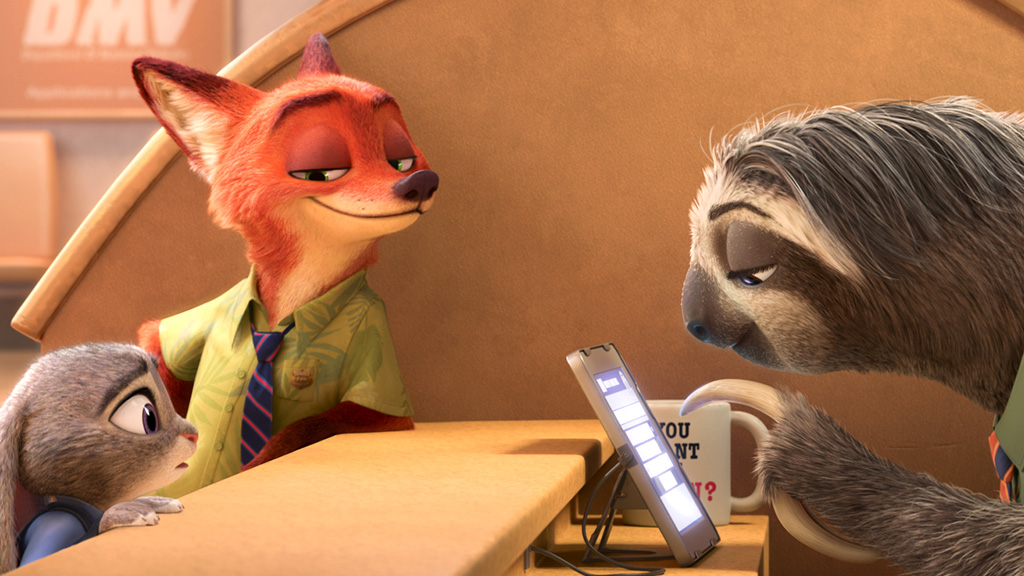
Judy Hopps (Ginnifer Goodwin), Nick Wilde (Jason Bateman) and Flash (Raymond Persi) reenact the typical DMV experience in "Zootopia." Image courtesy Disney.
Zootopia” is one of those films that starts off on a very good note and just continues to build from there. In this case, it’s an opening sequence that provides useful exposition in a unique and credible manner and establishes the personality of its main character, a bunny named Judy Hopps.  Hopps, depicted in the opening as a child but voiced later by Ginnifer Goodwin, is shown as an inventive, optimistic, smart, melodramatic and resourceful rabbit willing to stand up for what she thinks is right no matter what the consequences may be. Viewers learn all of that within five minutes, and the important attributes of the little bunny (and female role model) that eventually can are built upon from there.
That little tidbit is isn’t the most important reason to enjoy this fun and clever little flick, but it does showcase the very good filmmaking behind “Zootopia” and puts faith in the audience that the filmmakers can handle the topic they are about to address. This film is about racism, a topic that is difficult to discuss or even write about because of its complexities, yet one the filmmakers handle with grace and a gentle hand. “Zootopia” tackles this issue head on and hammers the message home with the help of some good character buildings and oodles of humor that – to cop a phrase from another Disney film – helps the medicine go down.
Back to Goodwin's little Judy Hopps, who starts off as a rabbit living in a small town with her farming family (her parents are voiced by Bonnie Hunt and Don Lake) but dreams of becoming a police officer. Her goal is an ambitious one – no rabbit has ever served as a police officer because rabbits are small and seen as meek – but she finishes at the top of her class at the police academy and is assigned to work at a station in the heart of the titular city, Zootopia. Hopps imagines Zootopia as a place where animals from all backgrounds come together and thrive; the reality is a messy city where major conflict lies just under the surface. Even her dream job is a letdown, as her boss, Chief Bogo, (Idris Elba) assigns her to be a meter maid and dole out tickets as the rest of the department searches for more than a dozen citizens gone missing. She soon finds herself assigned to the case of a missing otter at the behest of assistant mayor Bellweather (Jenny Slate) and enlists the help of con artist fox Nick Wilde (Jason Bateman) in the search. The investigation takes them all over the city's vast terrain and into a complicated conspiracy that puts the future of Zootopia in jeopardy.
At its heart, “Zootopia” is a film about racism. It’s a movie that outlines the dangers of racial stereotypes, explains how easy it is for people to succumb to and be manipulated by preconceived notions of other people (or animals in this case). That’s the funny thing about the world depicted within the city of Zootopia, a place Hopps initially imagines as a Utopia but a place that keeps it together out of necessity. So while a giraffe and a tiger might mingle on a bus, an elephant can and will deny service to a fox like Nick Wilde because of blatant racism, and a leopard can get demoted because of his perceived nature. Those are big notes to hit, the easy kind that when left in isolation create pablum like Academy Award winning picture “Crash,” yet “Zootopia goes for institutional racism – Hopps’ storyline is rooted in that issue – and even casual racism that pops up in quotidian situations. The fact that “Zootopia” takes a minute to discuss the use of certain words and outlines the problems of, say, touching people’s hair is rather impressive and much more nuanced than other films that tackle race like the one mentioned earlier.  
“Zootopia” presents all of this in a brightly colored and very hilarious package that limits the onslaught of animal-related cultural puns that cheapen the experience and opts instead to craft some subtly spectacular jokes. That sloth sequence shown in the trailer plays just as well in the theater – that slow-building smile is terrific – and “Zootopia” complements that with pratfalls, sight gags, clever word play, pop culture references and a few killer punchlines to form a rather fun time at the cinema. At least until the third act, which sees the film drag a little as its burdened by a complex yet easy to figure out plot. Then again, neither problem is a fatal flaw for a film targeted at children, and “Zootopia” does so much right (how many films successfully tackle race and feminism?) it earns a little forgiveness for those flaws. It’s easy enough to rail against kid-centered films like the loathsome “Norm of the North” that represent everything wrong with children’s entertainment; “Zootopia” on the other hand, is an example of what the genre can be at its best.

Review: Four and a half out of Five Stars

Click here to see the trailer.

Rating: PG
Run time: 108 minutes (One hour and 48 minutes)
Genre: Animation

Ask Away

Target audience: Families and people interested in anthropomorphism.

Take the whole family?: Kids old enough to attend a movie screening without automatically bursting into histrionics will find this film very entertaining.

Theater or Netflix?: Take the kids to the theater for a fun day out; just avoid paying for the unnecessary 3D or IMAX options.

How many pop culture references are there?: Not quite as many as one would find in a “Shrek” film, but “Zootopia” does have its fair share. Some, like a “Godfather” reference or one about Adele, are a little easy, but they're balanced by a rather fun “Breaking Bad” shout out and a subtle reference to the great Christmas special “Emmet Otter's Jug-Band Christmas.” Most importantly, the humor works without needing to know what is being referenced.

Watch this as well?: Anything within Disney's recent run – “Wreck-It Ralph” is my favorite – makes for a solid companion to this one. Add to that another little family film that deals with racism in spectacularly clever way while maintaining a strong sense of humor, “Paddington.”

Friday, February 26, 2016

Blurring the thin blue line

Anthony Mackie and Clifton Collins Jr. in "Triple 9." Image courtesy Open Road Films
Most of my time watching the almost entirely forgettable “Triple 9” was spent thinking about the many other better movies I could be watching at the moment. “Deadpool,” after all, was just a theater away, or I could have gone home and put on “Rififi” or “Dog Day Afternoon.” I sat through “Triple 9” anyway, waiting for something unique or noteworthy to occur and hoping beyond hope this thing could contribute something more to society than contrivances, racism and Aaron Paul doing crack once again.
That moment never came though, largely due to a plot dreamed up by a bored Homer Simpson and written by an overeager freshman film major. “Triple 9” opens with a successful bank robbery – because it's always a bank robbery – perpetrated by Paul, Chiwetel Ejiofor, Clifton Collins Jr., Norman Reedus and Anthony Mackie. The big twist? Everybody except Paul and Ejiofor are cops for the Atlanta Police Department pulling the job for Russian mob boss Irina Vlaslov (Kate Winslet pulling out an atrocious Russian accent from a secondary orifice) who happens to be the sister of Ejiofor's ex (Gal Gadot). One job isn't enough though, and the crew is recruited for another heist that will free Winslet's husband from the Gulag or something like that. (It was tough to tell because the dialogue was in Russian and the subtitles were cutoff on the bottom of the screen.) This new job is difficult, as robbing from a Homeland Security building will draw lots of unwanted attention.
Unless, that is, someone kills a cop – a titular code 999 – which will distract every officer in the area. And who better to murder than Mackie's new annoying partner Chris Allen (Casey Affleck), nephew of daffy but well-regarded investigator Jeffrey Allen (Woody Harrelson), who happens to be investigating that first heist. Mackie and company come up with a plan to slaughter Affleck for their own means, but the best laid plans in such films never work out so well, and things start to fall apart from there amid shenanigans involving Latino gangs, booze and women filled with malice.
In other words, pretty much the general plot of most heist films stuffed into less than two hours of run time, even though director John Hillcoat and writer Matt Cook clearly need more time to establish characters and coordinate plot machinations. “Triple 9” is far too short for it's ambitions – it feels like someone slashed off 15 minutes or so indiscriminately – although it still somehow lasts too long after the second heist when all the loose ends have to be wrapped up. One of the worst places a film can be is in that zone of being too long and too short, and “Triple 9” finds itself right smack dab in the middle of the dull zone. Then again, a longer film would mean having to watch even more of “Triple 9,” which isn't a very exciting proposition. It's not a visually stunning movie nor a particularly well executed one when it comes to its action sequences, most of which are filmed in a workmanlike fashion with little to no ownership. Even the moments theoretically meant to invoke suspense come off as funny and light instead of serious; the audience literally laughed at what was clearly the point of greatest tension of the entire movie.
None of this would be overly bothersome; forgettable films come and go like the tides or the next great presidential candidate. What makes “Triple 9” stand out though is a discomfiting vein of racism directed toward its Hispanic characters. Hillcoat and Cook go out of their way to establish a backstory for just about every character to offer some justification for their actions; it’s the main reasons why the plot is so overstuffed. Ejiofor has a kid he's trying to see again, Mackie is torn between loyalty to his partner and his comrades, and Paul is mourning for much of the film. Clifton, the lone Hispanic member of this group, is a remorseless killer though, a very bad man whose motivations are rooted solely in dollars and self preservation. He's an extension of the way the filmmakers portray the Hispanic community, a group that in this film is violent, uneducated, crude, cruel, slightly atavistic, and borderline subhuman. “Triple 9” is a film built to justify white people's fear of Hispanic communities, which is such a weird angle for a film otherwise devoted to themes of loyalty and moral quagmires.
It's that aspect that shoves “Triple 9” into the problematic realm, a film unwilling to shake clichĆ©s both damaging and useless because they might look cool. It tries ever so hard to be smart, to be a head spinner on par with a Tony Gilroy flick. But as “Triple 9” proves, trying too hard to be smart really makes you look pretty dumb.

Review: One and a half out of Five Stars

Click here to see the trailer.

Rating: R
Run time: 115 minutes (One hour and 55 minutes)
Genre: Drama

Ask Away

Target audience: People who want an unnecessarily convoluted cop flick.

Take the whole family?: A ton of dudes get shot in the head in this one, so stick with the rating suggestion and send your kids to “Zootopia” next week.

Theater or Netflix?: Stream it.

Who do you want to win the Academy Awards?: Brie Larson for “Room” and Rooney Mara for “Carol” would be terrific choices for Best Actress and Supporting Actress, respectively. On the male side, Leonardo DiCaprio is the best choice from the options granted, while I'd really like Mark Ruffalo to win for “Spotlight.” If I had my druthers, George Miller would win for directing and “Mad Max: Fury Road” for Best Picture, although neither will probably occur.

Watch this instead?: Considering “Triple 9” tries to be a cop film and a heist film, recommending from both genres makes sense. Both “Bad Lieutenant” and “Bad Lieutenant: Port of Call New Orleans” are fascinating films for the former category, while “Inside Job” (also starring Chiwetel Ejiofor) and “Asphalt Jungle” are terrific heist films.

Friday, February 19, 2016

That crazy witchcraft

Anya Taylor-Joy in a scene from "The Witch." Image courtesy A24.
Two days after watching “The Witch” and I can’t decide whether or not I actually like it. It's interesting to say the least, sometimes a little sillier than it intends to be and often overbearing in how it approaches the main objective of scaring the bejesus out of the audience. Whether it accomplished that objective depends on what scares you: the occasional creature popping out of nowhere (usually a mirror) or watching a family self destruct in a discomfiting fashion. If it's the latter, then “The Witch” is heartlessly effective; if it’s the former than prepare to be teased.
“The Witch” sets its premise quickly, with the father of the Calvinist family, William (Ralph Ineson), effectively getting his family banished from a well protected camp in the new world sometime in the 1630s. Joined by his wife Katherine (Kate Dickie), eldest daughter Thomasin (Anya Taylor-Joy), eldest son Caleb (Harvey Scrimshaw), twins Mercy and Jonas (Ellie Grainger and Lucas Dawson) and infant Sam, William finds a plot of land near the woods and builds a small farm to start their new life. Everything starts off pretty well until Sam is abducted by a clandestine witch in the middle of a game of peek-a-boo with Taylor-Joy. Thinking a wolf took her, the family's life begins to fall asunder when the crops start failing and the livestock acts strange as weird things begin to happen around the family.
Not much more than that happens in “The Witch.” The plot is intentionally thin, more of a necessity to deliver chills than the crux of the film. Writer/director Robert Eggers’ main interest with this film is to frighten his viewers, and he digs pretty deep into his bag of tricks to pull that off, from intimidating animals and the woodland setting to an over-the-top score and a few first act/third act set ups. All of this buildup though doesn't really go anywhere. “The Witch” sports one or two traditional scares and really ends up being more weird than scary.
The real horror comes from how easy it is for a family to turn against itself when strange calamity occurs. Sam's kidnapping is the first in a series of calamities to reveal how little the family members truly care about one another; rather, their reason to be is to atone for their earthly sins in the slim chance of entry to heaven. Religion is an easy scapegoat, especially given the faith of choice is the dreary New England trademark based on predeterminism and constant sinning, but there's a deeper issue to that as well. Religion, for “The Witch,” is more of an excuse to act on the human feelings of fear and paranoia and hate when life goes astray and deleterious emotions take over for love or rational thought. Whatever faith or philosophy is practiced, people often act out of fear and self interest when things go to pot, and Eggers exploits that idea to deliver a strong rebuttal against the concept of family being a strong enough bond to stave that off.
And yet, Eggers undermines his own point in his presentation. “The Witch” literally features a witch, a being with supernatural power that has it out for the people who have intruded into her domain. The audience knows this titular spell caster exists and is introduced to her in the first act, ending any suspense as to the possible causes of all these terrible things happening to this family. Without the possibility of a family member – posited as either Taylor-Joy or the twins – actually being in league with the devil, the audience doesn't feel the same amount of paranoia as the family does. Eggers keeps viewers a step removed from the drama, and that distance hinders their involvement and even interest in the proceedings.
That’s the downside to presenting this as a folktale, which sets the tone for how the story will unravel and the inherent need to accept the supernatural elements. Still, “The Witch” earns credit for offering a fair number of chills and a discomfiting experience, and Eggers explores the central concept with aplomb. It's not a milestone film or the next great horror film, but it's interesting, and interesting is always worth at least a cursory glance.

Review: Three and a half out of Five Stars

Click here to see the trailer.

Rating: R
Run time: 92 minutes
Genre: Horror/Thriller 
 
Ask Away

Target audience: Scary movie nerds who are really really interested in New England folklore.

Take the whole family?: Kids will get freaked out by the violence and the rather notable score.

Theater or Netflix?: This film would work best in a midnight screening. It at least has to be nighttime to have the full effect.

Is this a horror film?: Writer/director Robert Eggers addressed this topic after the screening and essentially said it is, but he doesn't give a fuck what people call it. I’m a little on the fence about it; it doesn’t have the same type of rhythm or intensity as something like “The Babadook,” but it is close enough in vibe to “Rosemary’s Baby” that it still fits into the genre, just barely.

Watch this as well?: Trade witches for aliens and “The Witch” is pretty similar to “The Thing,” which is always worth seeing. Also watch on of my favorite recent animated flicks,“ParaNorman,” for a family friendly retelling of the perils of supernatural abilities.

Friday, February 12, 2016

No electricity left in this boogaloo

Owen Wilson, Ben Stiller and Penelope Cruz do stuff in "Zoolander 2." Image courtesy Paramount Pictures.
I can see why Ben Stiller would want to revisit his Zoolander character, even after a 15-year break. Derek Zoolander fits right within his acting wheelhouse (Stiller can play three things: stupid, nebbishy, and macho) and the universe the character exists in is bound by the thinnest threads of reality. Strangely though, he doesn’t seem to have much more to say in “Zoolander 2,” aside from some trite themes about fatherhood and getting Sting some work. Otherwise the jokes are remarkably similar to the original, although they lack the whimsy and the charm of the first version.
Since the last film left off, former fashion model Zoolander (Stiller) has gone from the top of the fashion world to a self-proclaimed “hermit crab.” His wife Matilda (Christine Taylor) died when the school Stiller fought to build collapses (it's seemingly his fault for the incident too), and he also lost his son thanks to his utter incompetence as a parent. Best friend Hansel (Owen Wilson) has had his fair share of hard times too: the building accident left him scarred, and he now resides in a desert along with his beloved orgy. That situation falls apart too after the members (including Kiefer Sutherland) inform Wilson they are pregnant. Wilson, as many a man does in movies, runs away from his impending fatherhood, citing his own lack of a father figure growing up.
Fate (or Billy Zane) has other plans for the retired models though. Top designer Alexanya Atoz (Kristen Wiig looking like Donna Versace) recruits them to rejoin the fashion world at a show in Rome, where they encounter Valentina (Penelope Cruz), an Interpol agent working a rather odd case involving dead musicians (Justin Bieber included) and Stiller's modeling past. Also residing in a Rome orphanage is Stiller's son Derek Jr. (Cyrus Arnold), a whip-smart boy with a pretty strong hatred of his father. Everything just seems too convenient for Cruz's liking, and the easy circumstances could be linked to evil designer Mugatu (Will Ferrell), who has spent about a decade looked away in a fashion prison. Shenanigans involving fashion, celebrities, tiny cellphones, fat jokes and lava ensue.
“Zoolander 2” aims to amplify the first film, simply adding more to the quirky little flick that preceded it. More violence, more celebrity cameos, more exotic locations, more ennui, more everything except Ferrell (the movie offers less of him). More isn't necessarily better though, especially when it interferes with the plot machinations and, in the case of the bloody Bieber murder emphasized in trailers, doesn't offer that much in the way of laughs. Momentum frequently comes to a full stop to insert a celebrity into the proceedings, a problem the original avoided by having those moments heighten the film’s surreality, like during David Bowie’s (RIP) walk off appearance. “Zoolander 2” often throws them in for the sake of showcasing Stiller's Rolodex.
“Zoolander 2” is just off, relying too much on Cruz to provide humor (she tries, but just doesn’t fit in the “Zoolander” universe) but keeping pros like Wiig and Ferrell closer to the sidelines. The success of the film, then, depends on the performances of Stiller and Wilson, neither of whom plays a character who is really all that likable; like Harry and Lloyd in “Dumb and Dumber,” their models come across as aggressively stupid. The same problem arose in the first film, although Stiller used Ferrell and Taylor (and the cameos) as buffers to make Zoolander and Hansel look more approachable. Left mostly alone and their artificiality and banality come to the surface, and the film just shambles forward through the first two acts.
What saves the third act is the arrival of Ferrell's Mugatu, who injects a bit of the original's endearing oddness to things. He's such a weird character, so evil and childish and disdainful of his profession because he's the only one who realizes how insipid fashion really is, which makes him fit perfectly into the slightly off world Stiller built for his Zoolander. Most of the best lines of the film come from Ferrell's lack of respect for those around him (he also gets the one good joke about Bieber's death); that “Zoolander 2” falls apart once he leaves the screen is less than surprising and reinforces the idea that one really fun film was more than enough. “Zoolander” certainly didn't need a derivative slog as a followup.

Review: Two out of Five Stars

Click here to see the trailer.

Rating: PG-13
Run time: 102 minutes (One hour and 42 minutes)
Genre: Comedy

Ask Away

Target audience: People who remember the first one with some fondness.

Take the whole family?: The humor is puerile enough to appeal to viewers a hint younger than 13, although the graphic language will turn off parents.

Theater or Netflix?: Definitely Netflix if one must.

Is there an issue with Benedict Cumberbatch's model?: I didn't mention him in the review because he appears in the film for all of a minute, but Cumberbatch's character All is problematic. The actor does what he can; it’s the nature of the character as shown by Ben Stiller and his fellow writers is meant for mockery. They treat All like a freak show, a thing that is meant to make people say “ewww,” especially the two lead characters.

Watch this instead?: Rent the first “Zoolander” if you haven't seen it already. A bit of a bust at the time (it came out a little more than two weeks after 9/11), it has very much earned the cult following its endeared due in large part to Will Ferrell's performance as Mugatu and, of course, David Bowie.