Showing posts with label Bruce Willis. Show all posts

Sunday, January 20, 2019

Glass an awkward step back for Shyamalan

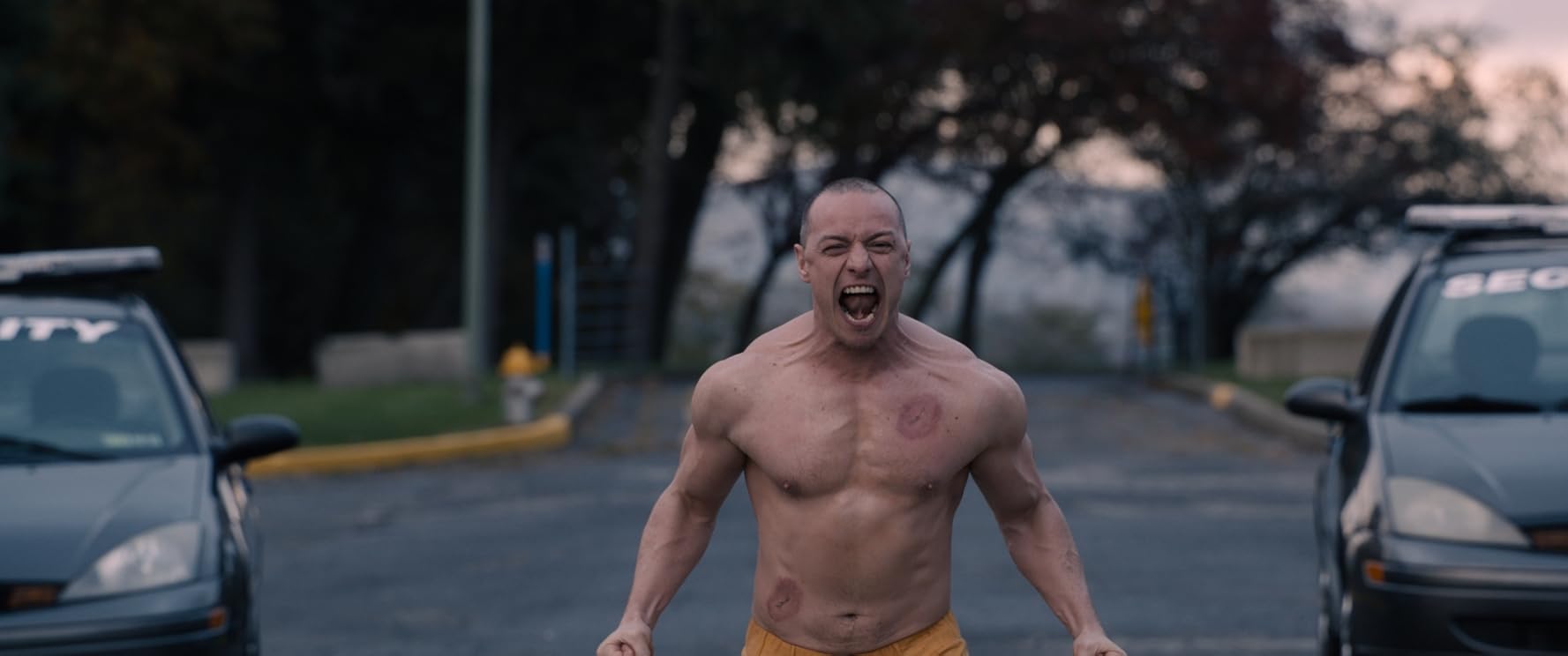
James McAvoy in Glass. Image courtesy Universal Pictures.
Perhaps 10 years ago or so Glass would be more innovative and interesting than it is. A movie dedicated in large part to deconstructing superhero mythology was novel when writer/director M. Night Shyamalan first started playing with the idea with Unbreakable, but the influx of comic book movies and the need to analyze the genre has produced better versions of Shyamalan's newest movie, Glass. This, instead, feels like an amalgamation of ideas Shyamalan himself has already delved into in this very franchise, undercutting any sense of profundity he aimed for.

Officially the third film in the Unbreakable franchise, Glass connects the characters from the first film – Bruce Willis' heroic David Dunn and Samuel L. Jackson's Elijah Price/Mr. Glass – with the villain from Split, the multi-personality plagued Kevin (James McAvoy, still great in this role). The three of them are gathered together in an asylum under the watch of Dr. Ellie Staple (Sarah Paulson), who believes their powers are actually delusions they've conjured to compensate for traumatic pasts. Dr. Staple has three days to work through their issues and ensure them their lives are normal. As the three men debate their existence, David's son Joseph (Spencer Treat Clark), Mr. Glass' mom (Charlayne Woodard), and Casey Cooke (Anya Taylor-Joy), who survived the first attack from the Beast, ask their own questions about the lives of their families and friends.

What remains somewhat unclear with Glass is the need to go backward with the origin stories. Both Unbreakable and Split dedicated significant parts of their films to answering questions about their characters' abilities. David has to overcome his own self-doubt about his abilities again, despite spending 19 years as an underground superhero. Kevin/Patricia/Hedwig et al already witnessed the arrival of the Beast and have spent two years kidnapping and killing girls in the greater Philadelphia area. They are established heroes and villains, capable of performing outlandish and beyond-human feats of strength, endurance, and invulnerability. By adding doubt only to eventually overcome that doubt, it shows Shyamalan didn't quite know how to go forward with the universe he developed.
 
It is additionally frustrating how poorly Shyamalan soul searches through his franchise. The premise of having three days to treat two serial killers and a violent vigilante is laughable in and of itself, and Glass does little to elevate it into something interesting. Even the one moment of highest intensity, the group therapy session with Dr. Staple, David, Kevin, and Elijah, lacks inspiration and tension. Dr. Staple's psychological skills are unconvincing, especially given how much David, Kevin, and Elijah have come through to discover their powers. The film can't really sell it's own disbelief, which reinforces the lack of point or direction for this entire endeavor.

Then there's the twist, because every Shyamalan movie has a twist. The twist in Glass is designed to add perspective and depth to this cinematic universe, but is on par with the events of films two, four, five, and six of the Halloween franchise. The swerve is handled awkwardly with insufficient foreshadowing, which is followed by yet another twist that is even weaker than the first twist. Shyamalan somehow adds too much foreshadowing and does too little of it, providing a rather frustrating ending just when the film was gaining a little momentum.
 
The ending underlines what how frustrating Shyamalan is as a filmmaker. He still is a pretty solid director; Glass generally looks good, with a creepy aesthetic that works really well for what the film has going for it. Shyamalan also has a knack for discomfiting viewers with subtle visual cues in lieu of jump scares, giving viewers enough of a heads up to remain freaked out about the ensuing moment. But whatever talents he has as a director, Shyamalan still cannot get out of his own way as a writer. The dialog, as always, is a mess. The twist on top of the twist is spurred by an out-of-character moment and some awful exposition. How that final twist is executed makes zero sense given the nature of the first twist. The questions Glass leaves are less philosophical than impractical, which is about the expectation for an M. Night Shyamalan film.

Review: Two out of Five Stars

Click here to see the trailer.

Rating: PG-13
Run time: 129 minutes
Genre: Drama

tl;dr

What Worked: James McAvoy, directing.

What Fell Short: Ending, dialog, writing.

What To Instead: Unbreakable

Friday, March 2, 2018

Death Wish misses the point

Bruce Willis and Ronnie Gene Blevins in Death Wish. Image courtesy MGM.
On the most basic, surface level view, Eli Roth’s remake Death Wish is fine. It’s sometimes a little campy, shot in a style that is neither appealing nor unappealing. The thrills are there, the blood is copious, and the deaths are grotesque in the Roth style. For what it is, Death Wish isn’t particularly interesting or groundbreaking. But it isn’t a catastrophe, and nothing about the surface levels screams incompetence. It exists to earn Bruce Willis some more money and revitalize his persona as an action star, and it does that to a degree. Looking at the movie as a basic piece of cinema obscures the grotesqueness Roth and writer Joe Carnahan created on screen. The message they have is an utter mess, either completely missing or gleefully ignoring the points of the 1974 Charles Bronson flick and the original novel about the inhumanity that comes from a quest for revenge. Their Death Wish isn’t even interesting enough to qualify as morally reprehensible; rather, it’s morally stupid.

Death Wish has little interest in holding Willis’ Paul Kersey to the fire for blasting people around Chicago. Roth and Carnahan justify it as a quest for revenge against the men who hurt his daughter (Camila Morrone) and murdered his wife (Elisabeth Shue). The expectation is to root for Kersey as he straight murders criminals and puts innocent people at risk as he gallivants around Chicago hunting people for sport. And this is a sport for Kersey, an after-work or weekend activity to engage in between saving people’s lives as a surgeon because it’s somehow the “right” thing to do. That he disobeys the most basic sense of law and order is not a factor for the filmmakers; they want viewers to cheer wildly for their “hero” as a savior for the people of Chicago (or at least the white people). Kersey should not be depicted as a hero; at best he could be viewed as complex, although neither Willis’ performance nor the script make Kersey appear overly complicated.

Death Wish should be a gritty movie. It needs to make people squirm from the violence on screen and the implications of revenge, showing how a man who seeks revenge becomes the monster he seeks to slay. It needs to make people second guess their thoughts about heroism and just be incredibly brutal. The original nails that aesthetic, due in large part to the 1970s-era New York City setting and Bronson’s cold demeanor. Bronson veers so close to crossing the line between good and evil he is often comparable to a slasher horror villain like Michael Myers or Jason Voorhees, an unrelenting machine designed to kill for the sake of killing. That Death Wish is often uncomfortable to watch because of how little regard Kersey has for life.

Roth and Carnahan go the other way with their interpretation. It’s too shiny and polished for a movie about moral decrepitude, too willing to wrap things up in a nice tidy bow and make the decisions for the audience. Their decision to make Kersey’s pursuit about justice for his family instead of vengeance against societal evils washes the characters hands of the mayhem he has brought to the city of Chicago. Even the way Roth frames the murders Kersey commits removes the discomfort from the whole scenario. Roth is outlandish in his deaths, showing as much blood and mush and guts as possible, transforming an act of brutality into a cartoonish farce. It can work in the right setting, for movies in which the fun comes from silly violence, but it doesn’t work when the point is to be ugly and cruel and to question the lead character’s motivations. 
 
None of that would be a real issue if Roth and Carnahan hadn’t sought that out in the first place. They litter the movie with faux debates over the righteousness of Kersey’s actions, only to vindicate him with a bloody finale designed to, again, make him heroic and justified. Simply put, Roth and Carnahan aren’t smart enough as filmmakers to even begin to have this debate, nowhere near evolved enough to understand what they’re even discussing in the first place. Death Wish would have been a fine popcorn flick had Roth and Carnahan with nothing under its veneer. But they are far away from their element here, and it results in an abysmal, heartless movie.

Review: One out of Five Stars

Click here to see the trailer.

Rating: R
Run time: 107 minutes
Genre: Action

Ask Away

Target audience: Folks with fond memories of the original or people interested in the works of Eli Roth.

Take the whole family?: Nope.

Theater or Netflix?: Just wait for it to stream.

What is up with Eli Roth?: Roth is just not very good at nuance or complexity. There are some major issues with his depiction of race in Death Wish, and he had a similar issue with homophobia in Hostel. He’s solid when he sticks to being weird but simple with Cabin Fever and his great trailer in Grindhouse.

Watch this instead?: The 1974 Death Wish isn't great, but it has the grittiness and an epic stoic performance from Charles Bronson to make it at least somewhat interesting. The later sequels are fascinating if only because of how utterly bonkers they become.