Showing posts with label James McAvoy. Show all posts

Friday, September 6, 2019

Horror missing from campy It Chapter Two

Jessica Chastain, Isaiah Mustafa, and Jay Ryan in It Chapter Two. Image courtesy Warner Bros.
It Chapter Two is a bad piece of horror. It fails at some fundamental elements of horror to the degree the supposed frights are laughable, because the filmmakers never find an adequate ambiance for their film. And somehow this is one of the least offensive aspects to It Chapter Two, which wanders into some troubled waters through either ineptitude or cruelty.

It Chapter Two picks up 27 years after the first film, with the return of the evil clown Pennywise (Bill SkarsgÄrd) to the small, (apparently) redneck town of Derry, Maine. Losers Club member Mike (Isaiah Mustafa) recruits Bill (James McAvoy), Beverly (Jessica Chastain), Ben (Jay Ryan), Richie (an excellent Bill Hader), and Eddie (James Ransone) for one final battle against an ancient evil. Together, the Losers need to overcome bad memories, their worst fears, and the return of the crazed Henry Bowers (Teach Grant) to save the denizens of a small Maine town from a voracious clown.

The underlying issue with It Chapter Two is a lack of tonal consistency. The film veers all over the place throughout its nearly three hours, jumping from comedy to horror to oddity to melodrama and back and forth and forth and back. All of these tones form a campy goulash, a very silly little thing with barely a whiff of horror. The reliance of poor CGI adds to this overarching silliness, as it's difficult to take a monster seriously when it clearly doesn't exist in the same plane as the characters screaming at it. Ultimately it's unclear what director Andy Muschietti and writer Gary Dauberman want It Chapter Two to be. If they wanted horror they needed to set a stronger atmosphere and tone, or pump more out of the individual horrors the characters have to work through to survive. If they wanted to do parody a la Cabin in the Woods they need to have more to say about the genre they mock. What's left is bizarre, but in a way that indicates the creators are trying far too hard to be strange.

Viewers get a lot of this because It Chapter Two is long. It is very, very long, nearly three hours of plot to get through for an unsatisfying conclusion. Even with the extra time the film remains a mess with its character development, with the arcs for Ben, Beverly, Richie, and Mike incomplete or unsatisfying. It Chapter Two focuses mostly on Bill as he overcomes his guilt over his brother's death in film one. It's a nice story, but the film pads a couple of side adventures for Bill that hammer in a point already told effectively. By going all in on Bill the other stories lack comprehensive resolutions. It Chapter Two has some rather strange narrative choices it navigates through. A couple of kids are sacrificed to Pennywise because the main characters need to feel even more guilt for abandoning their responsibilities. Henry Bowers returns and engages in some stabbing shenanigans that ultimately don't add anything of note to the story. Other decisions are far more troublesome, like the use of magical Native Americans as a solution for killing Pennywise. This is both incredibly lazy storytelling and a regressive view of Native American culture.

Most of these can be chalked up to mediocre to bad filmmaking. What's really bothersome about It Chapter Two is Richie's arc. Richie is gay. The film insinuates this point throughout the course of its run time, alluding to deep secrets and a lost, unrequited love. Yet It Chapter Two never uses the word gay or queer or any non-pejorative to describe Richie. Richie never says the word aloud either, despite his narrative centering on self acceptance. This is very much bullshit. It takes a lot of courage to come out, courage which Richie shows through multiple battles with Pennywise. Coming out would be a near perfect conclusion to his story, but instead the filmmakers quietly allude to it again because they can't have a main character say “I am gay.” The only openly gay characters are beaten to near death before Pennywise shows up to take a chunk out of one of them. It Chapter Two literally opens with a hate crime, sprinkles in additional slurs throughout, but lacks the cajones to allow its one gay protagonist to come out. This is both lazy writing and cowardly, which fits a film without a clear vision of what it wants to be.

Review: One and a Half out of Five Stars

Click here to see the trailer.

Rating: R
Run time: 209 minutes
Genre: Horror

tl;dr

What Worked: Cast (especially Billy Hader), Humor

What Fell Short: Horror, Plot, Length, Tropes

What To Watch As Well: Scary Stories to Tell in the Dark, Midsommar

Sunday, January 20, 2019

Glass an awkward step back for Shyamalan

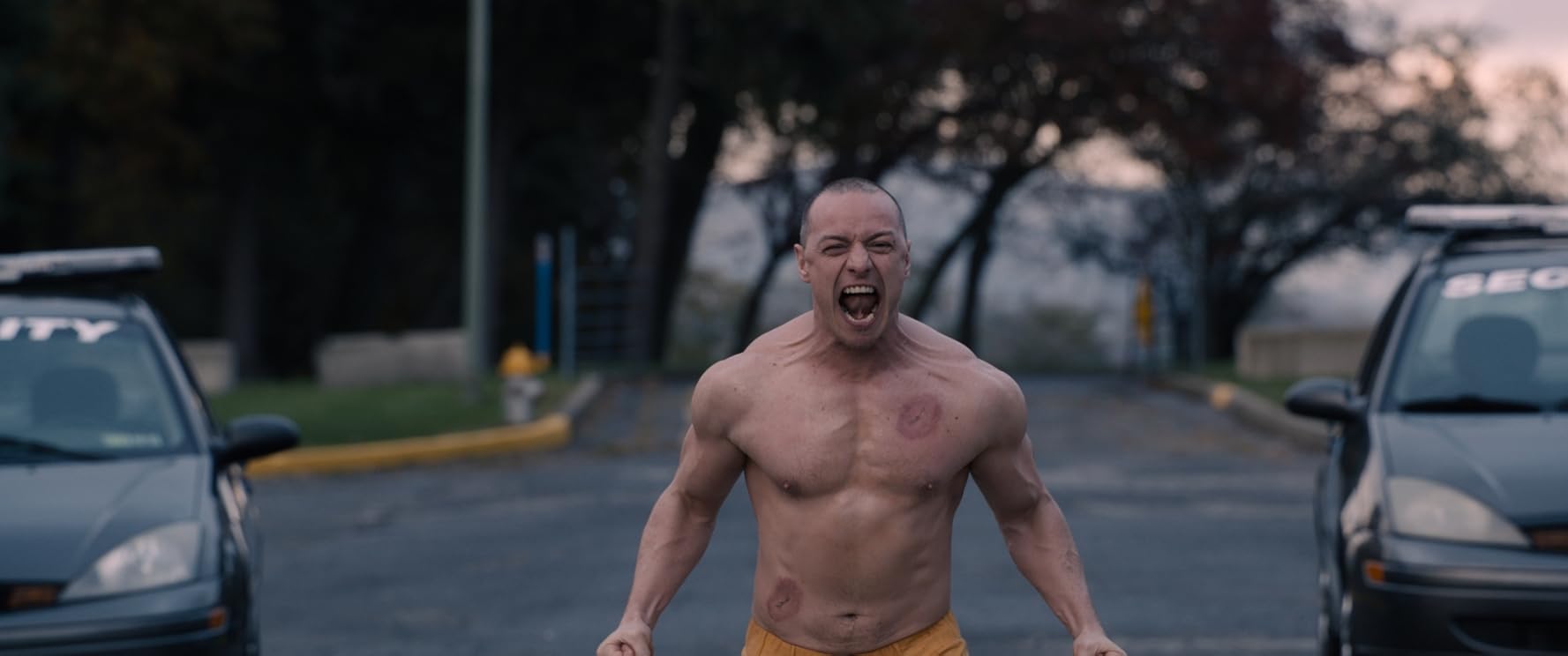
James McAvoy in Glass. Image courtesy Universal Pictures.
Perhaps 10 years ago or so Glass would be more innovative and interesting than it is. A movie dedicated in large part to deconstructing superhero mythology was novel when writer/director M. Night Shyamalan first started playing with the idea with Unbreakable, but the influx of comic book movies and the need to analyze the genre has produced better versions of Shyamalan's newest movie, Glass. This, instead, feels like an amalgamation of ideas Shyamalan himself has already delved into in this very franchise, undercutting any sense of profundity he aimed for.

Officially the third film in the Unbreakable franchise, Glass connects the characters from the first film – Bruce Willis' heroic David Dunn and Samuel L. Jackson's Elijah Price/Mr. Glass – with the villain from Split, the multi-personality plagued Kevin (James McAvoy, still great in this role). The three of them are gathered together in an asylum under the watch of Dr. Ellie Staple (Sarah Paulson), who believes their powers are actually delusions they've conjured to compensate for traumatic pasts. Dr. Staple has three days to work through their issues and ensure them their lives are normal. As the three men debate their existence, David's son Joseph (Spencer Treat Clark), Mr. Glass' mom (Charlayne Woodard), and Casey Cooke (Anya Taylor-Joy), who survived the first attack from the Beast, ask their own questions about the lives of their families and friends.

What remains somewhat unclear with Glass is the need to go backward with the origin stories. Both Unbreakable and Split dedicated significant parts of their films to answering questions about their characters' abilities. David has to overcome his own self-doubt about his abilities again, despite spending 19 years as an underground superhero. Kevin/Patricia/Hedwig et al already witnessed the arrival of the Beast and have spent two years kidnapping and killing girls in the greater Philadelphia area. They are established heroes and villains, capable of performing outlandish and beyond-human feats of strength, endurance, and invulnerability. By adding doubt only to eventually overcome that doubt, it shows Shyamalan didn't quite know how to go forward with the universe he developed.
 
It is additionally frustrating how poorly Shyamalan soul searches through his franchise. The premise of having three days to treat two serial killers and a violent vigilante is laughable in and of itself, and Glass does little to elevate it into something interesting. Even the one moment of highest intensity, the group therapy session with Dr. Staple, David, Kevin, and Elijah, lacks inspiration and tension. Dr. Staple's psychological skills are unconvincing, especially given how much David, Kevin, and Elijah have come through to discover their powers. The film can't really sell it's own disbelief, which reinforces the lack of point or direction for this entire endeavor.

Then there's the twist, because every Shyamalan movie has a twist. The twist in Glass is designed to add perspective and depth to this cinematic universe, but is on par with the events of films two, four, five, and six of the Halloween franchise. The swerve is handled awkwardly with insufficient foreshadowing, which is followed by yet another twist that is even weaker than the first twist. Shyamalan somehow adds too much foreshadowing and does too little of it, providing a rather frustrating ending just when the film was gaining a little momentum.
 
The ending underlines what how frustrating Shyamalan is as a filmmaker. He still is a pretty solid director; Glass generally looks good, with a creepy aesthetic that works really well for what the film has going for it. Shyamalan also has a knack for discomfiting viewers with subtle visual cues in lieu of jump scares, giving viewers enough of a heads up to remain freaked out about the ensuing moment. But whatever talents he has as a director, Shyamalan still cannot get out of his own way as a writer. The dialog, as always, is a mess. The twist on top of the twist is spurred by an out-of-character moment and some awful exposition. How that final twist is executed makes zero sense given the nature of the first twist. The questions Glass leaves are less philosophical than impractical, which is about the expectation for an M. Night Shyamalan film.

Review: Two out of Five Stars

Click here to see the trailer.

Rating: PG-13
Run time: 129 minutes
Genre: Drama

tl;dr

What Worked: James McAvoy, directing.

What Fell Short: Ending, dialog, writing.

What To Instead: Unbreakable

Friday, July 28, 2017

Charlize Theron brawls her way through glossy, inconsistent Atomic Blonde

Charlize Theron fights her way through some cops in Atomic Blonde. Image courtesy Universal Pictures.
Atomic Blonde is just fun enough to enjoy despite its many, many flaws. This movie is a sizable mess, littered with inconsistencies and banal ideas like the McGuffin lifted from the first Mission: Impossible movie, and it is difficult to reconcile Atomic Blonde's flaws due to their basis in disinterest rather than experimentation. Fortunately, the visceral response is stronger than the logical disruption caused by this movie. Turning the brain off for a while is a prerequisite for allowing the empty mind to absorb all the fights and rad '80s music that streams through the cinema speakers.
There really aren’t many particularly notable aspects to Atomic Blonde, starting with a pretty basic plot involving Charlize Theron engaging in a series of spy games in Berlin circa 1989. The elements of the basic spy thriller are there, including dealings with fellow British spy Percival (a rather bonkers James McAvoy), French agent Delphine (Sofia Boutella), the well-informed East Berliner Spyglass (Eddie Marsan) and a series of Soviet flunkies to fight off. She's also stuck in an extended debrief to a pair of MI6 leads (Toby Jones and James Faulkner), and a CIA suit (John Goodman), which is standard spy stuff as well. It’s all very functional without a lot of excitement or passion for anything too far beyond Theron using garden hose to whip some poor German cop. There’s an underlying emptiness of the whole endeavor. Sure, this is a movie that lives for its aesthetic and retro '80s style, but that doesn't have to result in the level of emptiness Atomic Blonde seems to aspire to, content in its inability to offer viewers a more complex viewing experience.
Any attempts at depth are grasped at the characterization of Theron's agent, Lorraine Broughton, and the plot itself. Starting with the second before returning to the first, Atomic Blonde uses its plot to deceive the audience in a less than satisfying fashion. Twists are thrown in out of some expectation of necessity and, to steal a line from The Room, to just makes things interesting. Or, rather, appear interesting for a moment or two. Atomic Blonde throws in two major twists in the last five minutes; the first is telegraphed heavily through dream fragments and some heavy dialog, the second is effective. Neither is vital for the viewer and only seem to contribute to a movie in which 90 minutes would have more than sufficed to complete the story.
Both twists do speak to Atomic Blonde's attempts at painting Lorraine as a figure for decency despite spending 95 minutes or so outlining her as a more morally ambiguous figure, someone willing to save lives when needed but whose end goal remains something of a mystery. Rather than leave her as a woman of great intrigue and allow for some ambiguity in the narrative, the filmmakers use one of the two aforementioned twists to push her toward the side of angels and effectively vindicate some of her actions from before. It’s a pretty solid letdown for a movie that, at least for a while, actively fights against such easy portrayals. There's a streak of punk running through this film's veins, so it becomes a little sad when the filmmakers normalize things for narrative laziness.
At least the aesthetics are enough to keep viewers somewhat engaged in the movie's many twisted machinations. The action sequences are rather effective at diverting viewers' attention away from the weak plot and to root for Theron’s spy, who is tough as hell but still small compared with many of her adversaries. Director David Leitch – who has spent much of his career working on stunts as a director, coordinator or active participate – reveals a knack for showcasing gritty sequences that float between brutal and darkly humorous. Atomic Blonde shines as bright as the neon in its logo when it allows Theron to punch, stab, kick, lasso and shoot her way through a series of enemies.
Much of the entertainment belonging to Atomic Blonde comes courtesy of Theron's force of will and icy charisma. Her performance transforms someone designed to be a prototypical action hero – stoic and centered on fights and vengeance – into a fleshed out character worth rooting for despite the mayhem she causes and very much in spite of the writing around her character. For a movie that focuses more on the late '80s patina than depth, it's vital to have someone who can pull the audience into the movie with her. Without her, Atomic Blonde would be lose a good amount of the style it values so much, along with almost all of the intrigue.

Review: Three and a half out of Five Stars

Click here to see the trailer.

Rating: R
Run time: 115 minutes
Genre: Action

Ask Away

Target audience: Viewers interested in some largely mindless violence and anything involve Charlize Theron.

Take the whole family?: Definitely not.

Theater or Netflix?: Wait for a home viewing with a few friends.

How great is James McAvoy?: He is pretty fun in this movie, carrying the charismatic insanity he had in Split over to this performance as well. The movie rightly belongs to Theron, but McAvoy does his best to keep his character worth watching in the scenes where she isn’t around. A movie dedicated to his character Percival’s adventures in Berlin could make for a heck of a time.

Watch this as well?: Drive does the stylized bit a lot more effectively than this movie does. For folks who want to see Theron fight her way through swarms of enemies should check out Mad Max: Fury Road and the underappreciated Kubo and the Two Strings.

Friday, January 20, 2017

McAvoy shines in flawed but thrilling Split

James McAvoy in Split. Image courtesy Universal Pictures.
With Split, M. Night Shyamalan has created a terrific thriller rooted in elements of B-movie grit and grime that add a little verve otherwise missing from the man's repertoire. Shyamalan’s also created a film with a number of narrative flaws and a major problem with his female characters, neither of which is overly surprising given his previous efforts. It results in a mixed bag carried largely by the center performance by James McAvoy, who takes full advantage of the showcase role and captivates throughout. This movie at the very least proves how vital casting can be, and how a great performance can save a troubling film.
In a weird way, Shyamalan either nearly saves himself from himself or he nearly drowns himself. It depends on how you look at the man who directed and wrote this film and see if his talents as a director saved his poor writing skills or if his subpar writing skills undermined his directorial talents. Because the man is a pretty darn fine thriller director who takes Split's goofy premise – a man (McAvoy) with 23 distinct personalities kidnaps three students (Anya Taylor-Joy, Haley Lu Richardson and Jessica Sula) as part of a sacrifice to a seemingly legendary 24th entity – and somehow creates an intense, discomfiting atmosphere in which even the daylight intimidates. The film is loaded with tight spaces, small corridors, confines falling apart and darkness barely interspersed with light that offer up an impeccable ambiance for oddity. He plays around with a few camera angles to offer a little insight into his characters' point of view at a given moment. His best little trick though is changing how he frames the various figures played by McAvoy when interacting with the abducted students and with his doctor (played by Betty Buckley). It adds a bit of nuance to the relationship McAvoy's personas have with the other people in his life.
That latter point is a sign of a good filmmaker, but it also compensates for his inability to accomplish the same goal as a writer. The writing in Split is remarkably sub-standard, beginning with the aforementioned premise that is too improbable to believe and never quite sticks despite the best efforts of Shyamalan's better half and the cast to sell it. There's also the dialog that lessens the further characters get into conversations, their chats riddled with those little bits of faux mysticism he likes to vomit into just about everything he does. A movie can't just be about a man with multiple personalities; it has to be about a mythic beast, or a character searching for some sort of potion through documentary filmmaking like in The Visit. Shyamalan tries too hard as a writer to force his films to sound important without conveying the natural oddity of the magical realism he's searching for. It doesn't help that he's a lazy writer to boot. One of the major character arcs of the film – the conversion by McAvoy's characters to the aforementioned 24th personality called The Beast – is rather similar to the one used by The Tooth Fairy in Manhunter and Red Dragon. His female characters are inconsistent, with one note portrayals – neither Richardson nor Sula get much to do beyond scream and moan – and astounding incompetence shown Buckley's doctor. Taylor-Joy's character, the prototypical final girl, gets the worst of it, with Shyamalan using past molestation and the resulting self harm as key driving points of her character and her chances at survival. This point can be viewed as the laziest bit of writing in this film and as an incredibly sexist characterization in a movie littered with such points.
Split’s saving grace is the bonkers and incredible performance put on by McAvoy. McAvoy loses himself to the characters within the characters he plays, from the scheming and evil Dennis to the goofy child Hedwig to the very in control Patricia. He makes them distinct beings – complete with inflection changes and individual tics – even as they begin to blur into one another toward the end, bouncing from one persona to the next in an internal battle for control. It's riveting to watch play out and immensely impressive to see the wild swings McAvoy undergoes in about a minute before his bad parts gain control and the momentary reprieve from the danger ends.


Review: Three out of Five Stars

Click here to see the trailer.

Rating: PG-13
Run time: 117 minutes
Genre: Thriller
Ask Away

Target audience: Thriller fans who wanted something decent from M. Night Shyamalan.

Take the whole family?: I'm really impressed this thing somehow only garnered a PG-13 rating. Don't stray too far from that recommendation.

Theater or Netflix?: You can wait for it at home.

What happened to M. Night Shyamalan?: Aside from this film, which is the best thing he's done in years, what he's fallen into is the need to pull out tricks and stunts with many dashes of pretentiousness along with it. With Split he mostly grounds himself with tight corridors and grubbiness and gets a little dirty in the process. He's sort of like a less talented Terry Gilliam; both need constraints to hold back their worst impulses.

Watch this as well?: Psycho is the best bet for films featuring characters with dissociative identity disorder. Considering how much this film lifts from Manhunter, watch that and the still solid remake, Red Dragon. Unbreakable remains the best thing Shyamalan has directed, and is also one of the best superhero films of the past 20 years.