 |
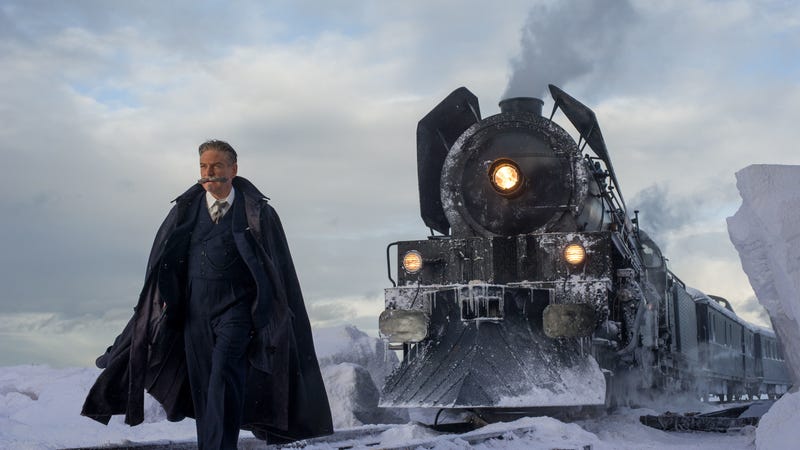
| Kenneth Branagh as Hercule Poirot in Murder on the Orient Express. Image courtesy 20th Century Fox. |
Murder on the Orient Express is a pretty adequate movie. It boasts a lovely (albeit underutilized) supporting cast, good imagery, and an ending that, more than 80 years after Agatha Christie wrote it in the book of the same name, remains brilliant. But on the whole, the movie is just adequate, which is a low bar to achieve for a film based on such a nuanced, immersive story. Director Kenneth Branagh and writer Michael Green definitely aim for greater than adequate, but their interpretation of the source material misses on several important aspects that the best this film can achieve is adequacy, heavily disappointing adequacy.
Branagh and Green bank a lot on the cachet of Murder on the Orient Express protagonist and world's greatest detective Hercule Poirot, betting the famous fictional Belgian with the established mustache could carry what is, at heart, an ensemble piece. Ego drives the decision quite a bit – Branagh himself dons the detective’s legendary (and ridiculous) mustache and a wavering accent – but from a distance the logic is there to support that decision. The mind of a genius is interesting to observe, to learn more about what drives such brilliance and how a mind as brilliant as Poirot's processes a complicated case and finds the truth amid a collection of lies. Branagh and Green instead effectively portray him as Sherlock Holmes combined with Tony Shalhoub's Monk (who is, again, based on Sherlock Holmes), and Poirot becomes a fussy, egotistical fellow with a nasty self-righteous streak. It's been done, and it's been done far better than what Branagh and Green have to offer. They scrub much of the character's sense of whimsy and create a sourpuss with an unclear devotion to a mysterious woman from his past. Which, again, has been done.
Fittingly enough, that lost love is mentioned fleetingly in a movie about Hercule Poirot. So too is Poirot's investigative process, which is clipped by the film's script. Key clues are conjured from thin air in Murder on the Orient Express, with the ones that could be caught by the audience sometimes ignored in exchange for some bit of background Poirot figures out away from the viewers. This is a cheap trick that murder mysteries have gotten away with for years, but the issue is less egregious in other formats because the stories focus on the mystery, not the detective. Switching the focus back over to the detective, as Branagh and Green do, both makes those cheats more pronounced and frustrating, and reduces a lot of vital character development. If the movie is about Poirot, the steps Poirot takes to solve the eponymous crime need to be outlined, not worked around.
Swept aside by all the love for Poirot is a pretty deep supporting cast and the characters they portray. Keeping the movie under two hours (although it feels much longer than that) restricts the screen time for talented performers like Penelope Cruz, Michelle Pfeiffer, Daisy Ridley, Leslie Odom Jr., Derek Jacobi. Judi Dench, Johnny Depp, and Willem Dafoe, all of whom could do wonders with their roles as the murder suspects and the victim. Aside from Pfeiffer getting her (possible) Oscar moment toward the end and Odom Jr. and Ridley stepping up for a few moments, the supporting case otherwise blends in together, stuck waiting for Poirot to got talk to them. Poirot is better served as an audience surrogate to learn about the passengers on the train, not as the center of attention.
Murder on the Orient Express replaces much of its character development with an overarching sense of despair. This Hercule Poirot is kind of emo, haunted by a mysterious past and tired of his own greatness at solving crimes. The pursuit of knowledge, the intellectual curiosity of discovering the motives and method of an impossible murder, mean little to this version of Poirot. He's out for a very black and white version of justice that doesn't necessarily fit a character who otherwise lives in the grey area of life. Even the actions around the murder are portrayed with a great level of heft and severity, the stakes raised to add some drama to what, ideally, is a fun little murder mystery. Instead, Green and Branagh went for gritty in a genre that works best as either noir or as a sort of popcorn movie where the audience tries to figure out who did the deed. Ideally a movie like Murder on the Orient Express would be more joyful than stern, the darkness of the murder lightened by the cast and the quirks of Poirot's investigative method. What’s offered instead is the token gritty reboot, which are a dime a dozen these days.
Review: Two and a half out of Five Stars
Click here to see the trailer.
Rating: PG-13
Run time: 114 minutes
Genre: Mystery
Ask Away
Target audience: People who've either read Murder on the Orient Express and any of Agatha Christie's other novels with Hercule Poirot, have watched one of the previous adaptations, or like Kenneth Branagh movies.
Target audience: People who've either read Murder on the Orient Express and any of Agatha Christie's other novels with Hercule Poirot, have watched one of the previous adaptations, or like Kenneth Branagh movies.
Take the whole family?: Keep it around the PG-13 rating, especially given how uninteresting the content would be for younger viewers.
Theater or Netflix?: Netflix is better.
Does this movie have issues with racism?: It does cross a few lines that it can't talk its way out of. The language is a problem despite the era the film is set in, but what doesn’t pass the thin “it was a different time” excuse is an action taken by Leslie Odom Jr.'s character late in the movie that falls back on a trope about African-Americans and violence. The moment is unnecessary for both the character – other versions have shown that character's temper in less overt ways – and the movie itself.
Watch this instead?: The 1974 Murder on the Orient Express is a classic with a much lighter touch than this version. Also worth a look is Murder by Death, a delirious parody of murder mysteries featuring Peter Falk, Peter Sellers, David Niven, Eileen Brennan, Maggie Smith, and, randomly enough, Truman Capote

