Showing posts with label Willem Dafoe. Show all posts

Thursday, October 17, 2019

Confusion reigns in beguiling Lighthouse

Willem Dafoe and Robert Pattinson in The Lighthouse. Image courtesy A24.
Reality is at best a concept in The Lighthouse. The film sees it as a thing that possibly exists, perhaps a baseline for comparing behavior, then tosses gasoline onto that otherwise intangible possibility and lights it ablaze. Because, ultimately, whether or not its protagonist can differentiate between what is real and what is in his imagination is irrelevant. Just searching for that dividing line between them is a horrifying, dangerous endeavor that consumes even the sturdiest of souls. 

The Lighthouse stars Robert Pattinson as Ephraim Winslow, a young lighthouse keeper apprenticing under the boisterous Tom Wake (Willem Dafoe). The two must spend a month tending a lighthouse on an island somewhere in New England, with Winslow stuck doing the grunt work for Wake as Wake tends to the light. They survive the month alone, but a massive storm delays their transport off the island. Time becomes impossible to track for Winslow, who begins seeing strange things around the lighthouse, including some rather odd behavior from the mysterious Wake.

Perhaps Wake is not acting so strangely, which he brings up to call out Winslow's loss of sanity. Or Winslow is perceiving the situation correctly; there are odd things afoot on this island and the secret lies in the light. What is clear is Winslow's perspective is unreliable, which puts the audience in a similarly foggy place. Director Robert Eggers (who wrote the film with his brother Max) prefers to keep the audience in the dark, showing Winslow as a hard and dedicated worker, only to tell that he is a drunken, lazy oaf unworthy of trust. What The Lighthouse shows and what it tells are fascinating contrasts that cause the mind to do breakdown a little as it tries to process this conundrum. And it doesn't really matter, because Eggers' focus is on the chaos wrought by isolation and paranoia. Lying underneath every moment is a layer of tension waiting to burst, with Winslow and Wake perpetually a wrong comment or valve release away from snapping. Eggers uses the sound of the lighthouse and the island as a means of increasing that tension, bumping the volume of the diegetic noises to perhaps tease at a slip in control of reality for Winslow. The island is too small to escape from the noises, creating a sense of dread and terror. 
 
The only thing Winslow can rely on is his stormy relationship with Wake. Once the film enters act two and the liquor begins to flow The Lighthouse shifts into a relationship drama between Winslow and Wake. They spend much of the second act oscillating between friendship and fighting, affection and outright hatred, both attracted and reviled by the existence of the other. The most intense moments from The Lighthouse come following the moments of sweetness. Winslow and Wake open themselves up emotionally – Winslow by revealing a dark secret, Wake by showing vulnerability when Winslow derides his culinary skills – and inevitably the other finds a way to utterly decimate the other's feelings. Each feels betrayed by the only one they care about, the cruelty of their words heightening the film's intensity and providing justification for the vitriol they spew at one another. Invectives thrown by a stranger cause minimal harm, but harsh words from a loved one cut to the core of one's being. This is by far the funniest part of the film as well. Pattinson and Defoe have a fascinating patter and ramp up the tenderness and vitriol, with Eggers' script adding nice touches of era-appropriate verbiage. 

The relationship between Winslow and Wake ultimately falls apart as most relationships do when neither person can trust the other wholesale. All Winslow can do is search for the truth about the island and what Wake does at the lighthouse alone at night. Winslow seeks the light desperately, hoping its secrets can reveal some truth about the island. The Lighthouse takes elements of a few myths of the sea along with some Greek stories that serve as an omen for the lost Winslow. Ultimately Winslow's quest for knowledge becomes his downfall, suffering a fate akin to that of the bringer of light onto earth, destroyed by his curiosity and hubris.

Review: Four and a half out of Five Stars

Click here to see the trailer.

Rating: R
Run time: 109 minutes
Genre: Horror

tl;dr

What Worked: Robert Pattinson, Willem Dafoe, tension, humor

What Fell Short: A little too long in the third act

What To Watch As Well: Jacob's Ladder, The Shining

Friday, November 10, 2017

Murder on the Orient Express a lackluster character study

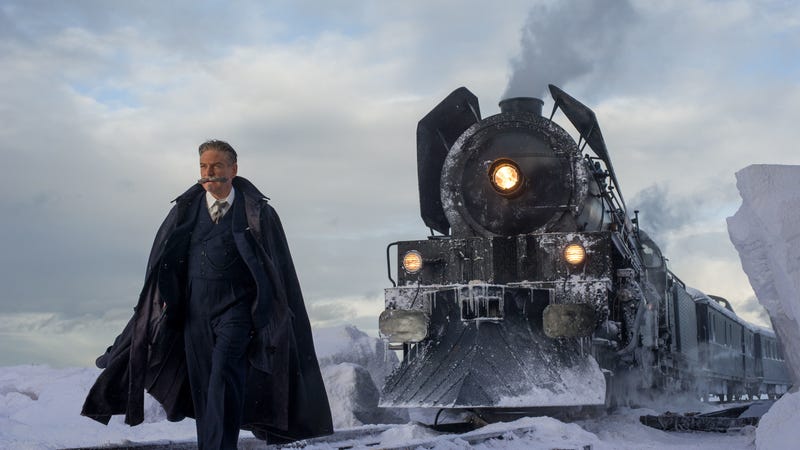
Kenneth Branagh as Hercule Poirot in Murder on the Orient Express. Image courtesy 20th Century Fox.
Murder on the Orient Express is a pretty adequate movie. It boasts a lovely (albeit underutilized) supporting cast, good imagery, and an ending that, more than 80 years after Agatha Christie wrote it in the book of the same name, remains brilliant. But on the whole, the movie is just adequate, which is a low bar to achieve for a film based on such a nuanced, immersive story. Director Kenneth Branagh and writer Michael Green definitely aim for greater than adequate, but their interpretation of the source material misses on several important aspects that the best this film can achieve is adequacy, heavily disappointing adequacy.
Branagh and Green bank a lot on the cachet of Murder on the Orient Express protagonist and world's greatest detective Hercule Poirot, betting the famous fictional Belgian with the established mustache could carry what is, at heart, an ensemble piece. Ego drives the decision quite a bit – Branagh himself dons the detective’s legendary (and ridiculous) mustache and a wavering accent – but from a distance the logic is there to support that decision. The mind of a genius is interesting to observe, to learn more about what drives such brilliance and how a mind as brilliant as Poirot's processes a complicated case and finds the truth amid a collection of lies. Branagh and Green instead effectively portray him as Sherlock Holmes combined with Tony Shalhoub's Monk (who is, again, based on Sherlock Holmes), and Poirot becomes a fussy, egotistical fellow with a nasty self-righteous streak. It's been done, and it's been done far better than what Branagh and Green have to offer. They scrub much of the character's sense of whimsy and create a sourpuss with an unclear devotion to a mysterious woman from his past. Which, again, has been done.
Fittingly enough, that lost love is mentioned fleetingly in a movie about Hercule Poirot. So too is Poirot's investigative process, which is clipped by the film's script. Key clues are conjured from thin air in Murder on the Orient Express, with the ones that could be caught by the audience sometimes ignored in exchange for some bit of background Poirot figures out away from the viewers. This is a cheap trick that murder mysteries have gotten away with for years, but the issue is less egregious in other formats because the stories focus on the mystery, not the detective. Switching the focus back over to the detective, as Branagh and Green do, both makes those cheats more pronounced and frustrating, and reduces a lot of vital character development. If the movie is about Poirot, the steps Poirot takes to solve the eponymous crime need to be outlined, not worked around.
Swept aside by all the love for Poirot is a pretty deep supporting cast and the characters they portray. Keeping the movie under two hours (although it feels much longer than that) restricts the screen time for talented performers like Penelope Cruz, Michelle Pfeiffer, Daisy Ridley, Leslie Odom Jr., Derek Jacobi. Judi Dench, Johnny Depp, and Willem Dafoe, all of whom could do wonders with their roles as the murder suspects and the victim. Aside from Pfeiffer getting her (possible) Oscar moment toward the end and Odom Jr. and Ridley stepping up for a few moments, the supporting case otherwise blends in together, stuck waiting for Poirot to got talk to them. Poirot is better served as an audience surrogate to learn about the passengers on the train, not as the center of attention.
Murder on the Orient Express replaces much of its character development with an overarching sense of despair. This Hercule Poirot is kind of emo, haunted by a mysterious past and tired of his own greatness at solving crimes. The pursuit of knowledge, the intellectual curiosity of discovering the motives and method of an impossible murder, mean little to this version of Poirot. He's out for a very black and white version of justice that doesn't necessarily fit a character who otherwise lives in the grey area of life. Even the actions around the murder are portrayed with a great level of heft and severity, the stakes raised to add some drama to what, ideally, is a fun little murder mystery. Instead, Green and Branagh went for gritty in a genre that works best as either noir or as a sort of popcorn movie where the audience tries to figure out who did the deed. Ideally a movie like Murder on the Orient Express would be more joyful than stern, the darkness of the murder lightened by the cast and the quirks of Poirot's investigative method. What’s offered instead is the token gritty reboot, which are a dime a dozen these days.

Review: Two and a half out of Five Stars

Click here to see the trailer.

Rating: PG-13
Run time: 114 minutes
Genre: Mystery

Ask Away

Target audience: People who've either read Murder on the Orient Express and any of Agatha Christie's other novels with Hercule Poirot, have watched one of the previous adaptations, or like Kenneth Branagh movies.

Take the whole family?: Keep it around the PG-13 rating, especially given how uninteresting the content would be for younger viewers.

Theater or Netflix?: Netflix is better.

Does this movie have issues with racism?: It does cross a few lines that it can't talk its way out of. The language is a problem despite the era the film is set in, but what doesn’t pass the thin “it was a different time” excuse is an action taken by Leslie Odom Jr.'s character late in the movie that falls back on a trope about African-Americans and violence. The moment is unnecessary for both the character – other versions have shown that character's temper in less overt ways – and the movie itself.

Watch this instead?: The 1974 Murder on the Orient Express is a classic with a much lighter touch than this version. Also worth a look is Murder by Death, a delirious parody of murder mysteries featuring Peter Falk, Peter Sellers, David Niven, Eileen Brennan, Maggie Smith, and, randomly enough, Truman Capote

Friday, October 13, 2017

Florida Project is sad, sweet, and fun

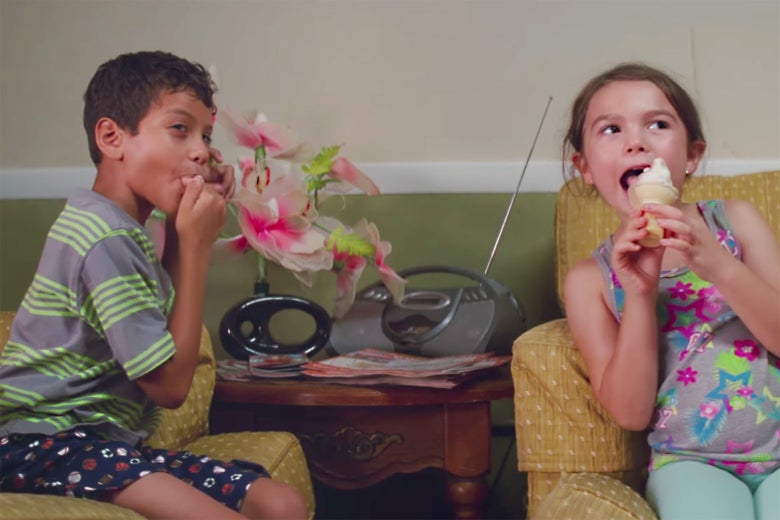
Christopher Rivera and Brooklynn Prince in The Florida Project. Image courtesy A24
Fantasy in The Florida Project is serves as a vital component for existence and a dangerous facade. For 6-year-old Moonee (Brooklynn Prince) and her friends Jancey (Valeria Cotto) and Scooty (Christopher Rivera) the illusion granted by childhood masks the reality of the hopelessness of their circumstances. They survive and thrive because they can't comprehend the scale of their lives, but the realities of what their world is really like resides just above their heads, controlled by adults who can't quite seem to understand the gravity of their responsibilities. Few characters in this movie have their heads above the sand.
The marvelous The Florida Project skirts the fine line between fantasy and reality throughout, juxtaposing the children's antics and shenanigans – some playful, others far more reckless – against the hardship of their existence. It’s the little moments of innocence that make this movie, in effect a series of escapades capturing a fateful summer for Moonee and friends. as fun and joyful as it is. It’s great to watch them banter as they try to con people out of money to buy ice cream cones or share jelly sandwiches while sitting on a fallen tree. One of the more memorable scenes is a simple birthday celebration for Jancey where Moonee and Moonee's mother Halley (Bria Vinaite) tell Jancey that the fireworks are going off to celebrate her birthday. It's a lovely, perfect little moment of escapism for Jancey, a small moment of joyful solipsism for a child who doesn’t get those enough.
Setting the film as a series of short adventures allows for an easier contrast between those bits of joy and the starkness of their reality. They are incredibly poor, barely able to pay the rent to live in rundown hotels tainted by a variety of criminal activities. Their innocence is really the only thing that shields Moonee, Jancey and Scooty from the realization of their plight and the possible dangers associated with living in a hotel with little adult supervision save hotel manager Bobby (a terrific Willem Dafoe). For most of The Florida Project the kids are on their own hiding about in the parking lot, underneath staircases, or out in the middle of possibly alligator-infested lands. That no physical harm comes to any of them is a testament to luck and Bobby keeping a really, really good eye on them.
They are effectively latchkey children, although The Florida Project is director Sean Baker and his co-writer Chris Bergoch avoid placing blame on the parents for the lack of oversight. Scooter's mother Ashley (Mela Murder) spends most of her time working as a waitress in a nearby diner, trying to earn enough to afford the hotel's weekly rent. Jancey is cared for by her grandmother (Josie Olivo) who does about as well as she can to offer a stable home. Halley is the wildcard, a young woman with little regard for authority and a free-spirited nature inherited by her daughter. Her parenting skills include little discipline and a less than healthy diet for her and her daughter, but she is not depicted as a bad mother. Rather, she's simply out of her element, clearly unsure of how to raise a child aside from offering love and any amount of support she can give. Halley is living in her own dreamworld, although when reality eventually does hit it strikes very, very hard.
It’s not like this movie gives Moonee and company a lot of options either. They live a stone’s throw away from Disney World and the manufactured wonderment it has to offer. The only thing worse than ersatz fantasy is being surrounded by bootleg versions of that false fantasy, the outlet shops and Orlando shops that promise “real” Disney items. They even live in a hotel called The Magic Castle, a place that is about as far away from the Magic Kingdom as it sounds. They’re stuck living in a place that pales in comparison to a better version that promises a false fantastical experience, a simulacrum of a profitable simulacrum. So it makes sense then for The Florida Project to conclude with wish fulfillment. In this movie, hiding in dreams remains the best tactic even as reality comes crashing down around you.

Review: Four and a half out of Five Stars

Click here to see the trailer.

Rating: R
Run time: 115 minutes
Genre: Drama

Ask Away

Target audience: Indie movie lovers and people interested in movies about people who are down and out.

Take the whole family?: Most of the more adult aspects to this movie are hinted at, so the rating is a little harsh. Teenage and up are fine with this.

Theater or Netflix?: This is a great little film, so it’s totally worth a theater trip if it is screening near you.

How great is Willem Dafoe?: Pretty wonderful. Dafoe gives adds charm and decency to a character that could have across as gruff and stern without the actor’s touch. Dafoe makes it clear his character has accepted his lot and life and does the best he can to accept what he has.

Watch this as well?: The 400 Blows and The Spirit of the Beehive have darker overtones than this movie, but they share the same concept of childhood as an escape from misery. For a more recent option, check out Beasts of the Southern Wild