Showing posts with label Rebecca Ferguson. Show all posts

Friday, October 20, 2017

Snowman never comes to life

Michael Fassbender in The Snowman. Image courtesy Universal Pictures.
The Snowman is an awful film on just about every level, but it masks its incompetence by being largely boring and dull. It’s just a way of wasting two hours of one's existence, watching poor Michael Fassbender mope around a very snowy Oslo searching for one of the least interesting serial killers in cinema history. It's a movie that just happens, it exists and it ends with no measurable effect on the viewer's outlook on life.
A lot of strange decisions were conjured to create The Snowman. Making the movie heavily centered around the titular beings of ice, snow, coal, carrots, and leftover winter clothing is among the more notable ones. The snowmen in this movie are little tokens left by the serial killer after he's abducted or murdered someone, designed to be ominous and foreboding. Except, well, snowmen don't really work as images of horror. They're beings of snow that just stand around waiting to melt, their horror derived more out of an existential terror than a more primal fright. Perhaps a field of snowmen could be frightening, a phalanx of creatures built of ice and snow with mean dark eyes and coal frowns… although just typing that sentence still makes them sound silly. If an army of snowmen can't produce any sense of fear, a single snowman won't succeed in that task.
So why does the killer design these snowmen in the first place? It's revealed in an opening sequence as a result of a traumatic childhood moment. It's not a competently executed sequence, with a poorly executed twist with no real motivation provided to the viewer. And that's not the only moment in which The Snowmen opts to keep what should be important information away from the viewers. Suspects are tossed out and in not because of any real detective work from Fassbender (playing a detective named Harry Hole) and his partner (played by Rebecca Ferguson). Rather, there's some unseen internal logic that at one moment makes J.K. Simmons a suspect before moving on to some other bloke until the real killer is revealed. There's also an undercooked subplot about Fassbender's ex (Charlotte Gainsbourg), along with unnecessary backstory involving Val Kilmer that would tie in cleaner with Ferguson's story if the movie had a stronger narrative connection. The Snowman is really more of a series of plot holes cobbled together into a thin story, which isn’t surprising considering around 15-percent of the script wasn’t actually shot, per director Tomas Alfredson.
Hypothetically the additional amount of footage would have given The Snowman more time to provide those clues so the audience can parse out the killer’s identity. Not that it's all that difficult to figure it out, but that isn't because of any clues or hints provided by the filmmakers. Rather, the resolution comes from knowledge of the genre that makes the whole reveal obvious; the movie itself just says it’s this guy without any legitimate clues, let alone any logic behind it. A clever movie can take advantage of audience knowledge and use it against viewers, but this movie is nowhere near clever enough to pull off such a feat. The killer is the killer, and the killer is disposed of with a lame Deus ex machina because the filmmakers opted not to make it properly climactic or thrilling. It just sort of ends, because everything has to end at some point and the movie couldn't figure out a better way of getting away from itself.

Review: One out of Five Stars

Click here to see the trailer.

Rating: R
Run time: 119 minutes
Genre: Crime

Ask Away

Target audience: Criminal procedural fans and people who like snowmen.

Take the whole family?: It gets graphic enough to bother kids, so make it a date night if you decide to go out...

Theater or Netflix?: Or just don't go out at all to see it.

Does this movie do anything right?: By name the cast is OK. Michael Fassbender, Charlotte Gainsbourg, and J.K. Simmons all have strong acting chops, and Val Kilmer has a couple of great performances under his belt from like 25 years ago. Figures that this movie couldn't do anything with the cast it had.

Watch this instead?: Insomnia does a lot of what The Snowman tries to do, but way, way better. There's also the animated Snowman movie from the 1980s that is just splendid.

Friday, October 7, 2016

Girl on the Train wastes talent, time

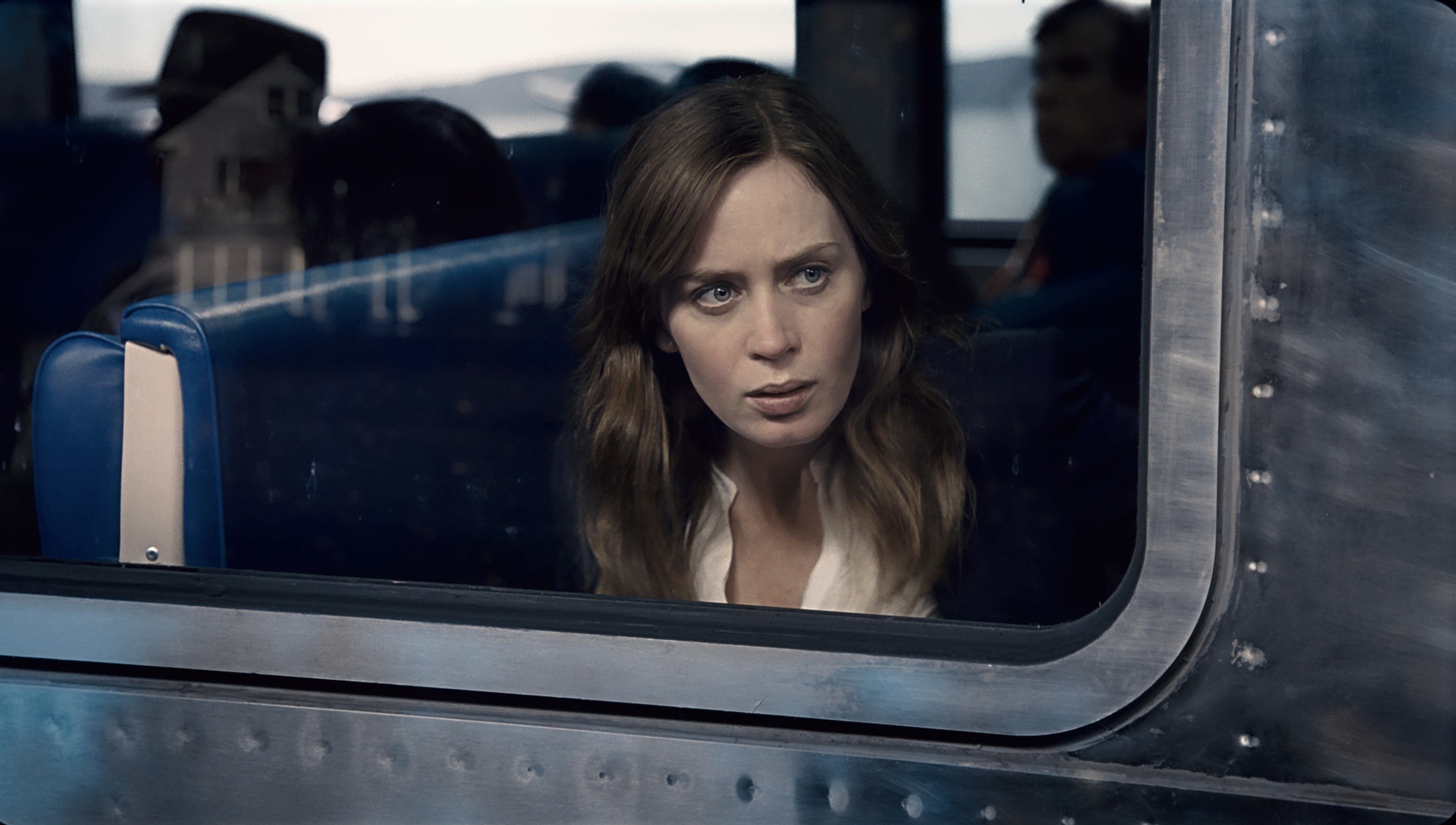
Emily Blunt stars in The Girl on the Train. Image courtesy Universal Pictures.
The Girl on the Train opens with the eponymous commuter Rachel (Emily Blunt) declaring in a voiceover that she has an overactive imagination. The point of the line and the others that spill out from Rachel’s mind during the opening is to put the viewer inside the unfiltered mind of the film's featured character while revealing her unreliability as a narrator. That she immediately stops telling the story is a problematic approach to the set up, as the film shifts away from her eyes to incorporate the stories of token housewife Anna (Rebecca Ferguson) and the soon-to-be missing Megan (Haley Bennett) to connect the three women to one singular narrative. It essentially took less than five minutes for this film to defeat the purpose of its introduction, along with much of the intrigue of its existence.
Alas, this isn't an unexpected flaw in a film full of them. The Girl on the Train is a silly little blunder that tries ever so hard to be lurid and dangerous but comes off instead as an above average Lifetime film with a hint more steaminess. Its central mystery is easy to resolve once the main players – the three women along with characters played by Luke Evans, Justin Theroux and Edgar Ramirez – are introduced and settled in. It features mediocre to subpar performances – even the oft great Blunt can't make the material work in her favor – and misused moments from the usually sublime Lisa Kudrow and Allison Janney, along with some perfectly preposterous dialog. The scenes are shot cold and distant as a film like this could be, but the movie lacks quality cinematography and the aesthetics are those not belonging to a film with this wide of release. Everything is so serious, and the tone is so poorly established, the movie sets itself up to be glorious camp, especially whenever Theroux enters to snack on scenery. The Girl on the Train would be a much more entertaining film had the filmmakers followed Theroux’s example and inserted a smirk in every scene.
What's truly weird about the whole experience is the heavy emphasis on motherhood among the three female characters and how the concept of being a mother effectively defines their femininity. All three women are influenced by a child in some capacity, be it having one, losing one, or being unable to conceive at all, and their personalities are tailored to what level of ability they have for it. The only one of the three granted any perception of happiness is the one willing to trade her independence and hope to be with a monster to raise her child; the other women are depicted as incomplete and empty.  The concept is inherently regressive and dehumanizing (although it does result in the best bad line of the film) and the extremes the filmmakers take it is disturbing. The Girl on the Train effectively punishes characters for their failures as mothers through characterization (Blunt's Rachel as a morose alcoholic) and through physical pain as the film progresses. That the film could serve as a criticism for society's blame in these categorizations is moot considering how often the film luxuriates in Rachel's sadness and the pain wrought to the other women.
Blunt's Rachel is the source of many of The Girl on the Train's ailments. As the key to the mystery of the missing woman, the film uses her alcoholism as a way to obfuscate the mystery while faulting Rachel for not doing more to stop the crime she eventually solves. It would work in a Memento fashion if the film constructed the narrative around her and the memories she can't recapture as it teases a possible violent streak aroused during her states of inebriation. But the incorporation of the other women and their stories negates the impact of her lost memory and the possibility of her being the person responsible for the disappearance. The audience isn't required to trust Rachel to understand the story; rather, viewers watch her stumble about and wait for the memories of the night in question to reappear again and indicate the most logical candidate for the crime. (On a side note, the film does a rather poor job employing red herrings.) Watching an alcoholic stumble through an investigation is less interesting than interpreting his or her lost memories, and the film never seems to capture this, or any concept, it aims to depict.

Rating: Two out of Five Stars

Click here to see the trailer.

Rating: R
Run time: 112 minutes
Genre: Thriller

Ask Away

Target audience: Those who read and love the book.

Take the whole family?: The “R” rating is fair enough, so stick with that and keep the kiddos at home.

Theater or Netflix?: Stream to pair it with a low-priced pinot grigio.

Does this pass the Bechdel test?: I had this discussion with a woman who came with me to see it, and we couldn't really come up with a solid answer for it. Despite the film centering on three women, their discussions are either about a man or an issue related to a man. The closest the film gets to not having that discussion involves conversations Lisa Kudrow has with other women about bad restaurants, and those are more background noise than anything. That the film apparently elicited a description as a “sausage party” overheard by my fellow moviegoer underlines the aforementioned issue.

Watch this instead?: Every time I see Justin Theroux, I want to watch Mulholland Drive or Inland Empire. And because I always recommend Mulholland Drive, you should also sit down and watch Memento to see how a film can effectively work with a memory lapsing protagonist.